

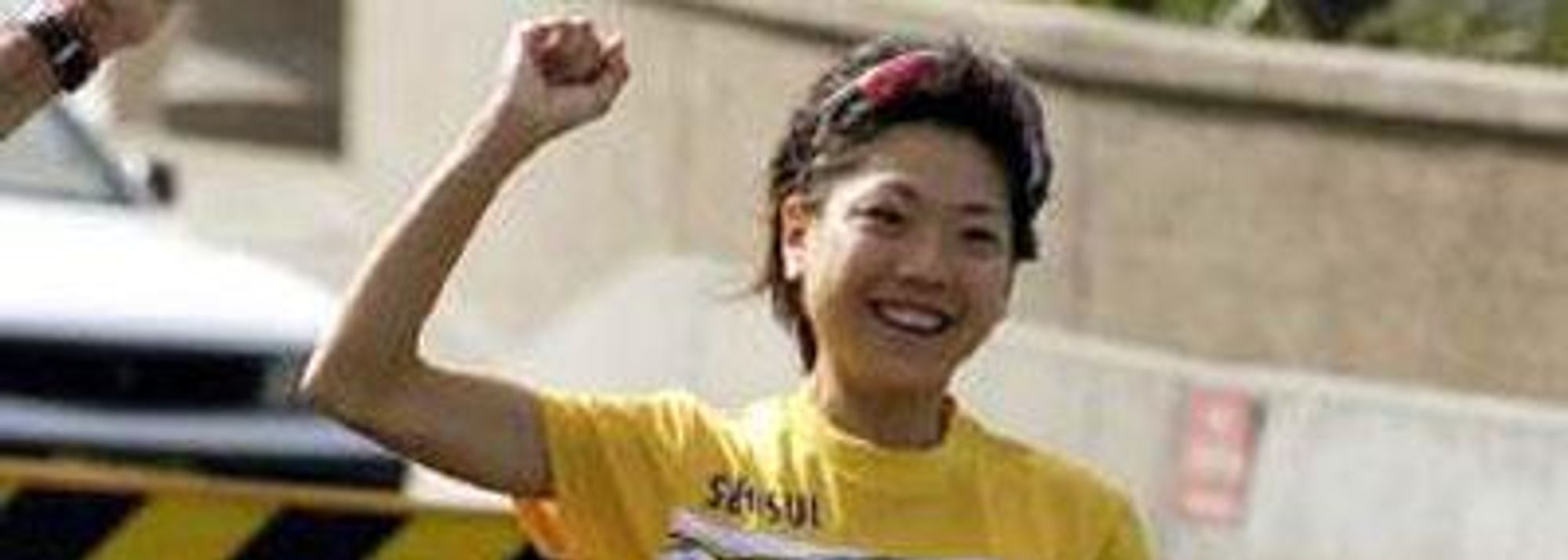


Naoko Takahashi in the Flora Sydney run (© Getty Images)
Olympic Marathon champion Naoko Takahashi, will attempt to qualify for the Japanese marathon team for Athens when the Tokyo International Women’s Marathon, takes place this Sunday 16 November.
Despite the notoriously unpredictable hazards which can unfold for anyone running the classic distance, Takahashi’s victory in Tokyo is seen by many marathon pundits as automatic, with the only real question being how fast will she run.
“I know everyone is interested to know how fast I can run, but actually I am the one most interested in that question,” said the reigning Olympic marathon Champion.
On 6 November upon her return to Japan from a four-month high altitude training trip in Boulder, USA, a press conference was held at Tokyo International airport. The main subject was that of ‘records’ because in the recent Beijing marathon China’s Sun Yingjie had broken the Asian marathon record, previously held by Takahashi. So could Takahashi reclaim the record in Tokyo?
Asian Record?
The course is not an easy one but the present course best is still a quite impressive 2:22:12 (Eri Yamaguchi in 1999). Although the course loses 30m of elevation from 3Km to 6Km, it gain 30m of elevation from 36Km to 39Km, just when the going gets tough for the runners, thus the second half of the course is at least a minute slower. In 1999, on her way to the record run, Yamaguchi went through the half marathon in 1:09:31. It is reported that Takahashi is planning to go through the half in 1:08.
“I have been very careful with everything for the last few months, so I am injury free” said Takahashi, who had to pull out of the last year’s race due to an injury she picked up in Boulder, which also caused her to miss the World Championships in Paris.
“Training in Boulder went exactly as planned,” said Yoshio Koide, who coaches Takahashi. “There was no interruption due to an injury. In order to peak on the race day, the start of speed work phase has been delayed. Barring accidents, like falling off the stairs or catching cold, Takahashi’s run should please everyone,” concluded Koide.
Alemu, the principal challenger
Because the Japanese love Olympic Champions, Ethiopia’s Fatuma Roba, 1996, gold medallist is very popular in Japan, and thus invited to the race once again. Roba was invited to run the Tokyo Women’s Marathon in 1996 (8th), 1997 (4th), 1998 (8th) and 1999 (2nd), however, she is yet to win in Tokyo.
Several other invited runners are also familiar with the Tokyo’s course, having run in the previous editions. While Roba’s teammate Elfnesh Alemu was fourth in 2002, Bruna Genovese was third in 2001 and Irina Timofeyeva was third in 2002 and second in 2001.
Mihaela Botezan is the fastest track runner in the field, having ran 31:13.96 for the 10000m and 15:08.78 for the 5000m. She was fourth at 10000m and sixth at 5000m in the 2002 European Championships. Botezan finished 9th with 2:25:32 in her marathon debut at the 2003 London marathon.
With most of the best Japanese runners opting for Osaka Ladies Marathon, the only Japanese entrants who could possibly challenge or have a chance to end Takahashi’s six marathon winning streak (1998 Nagoya, 1998 Asian Games, 2000 Nagoya, 2000 Olympics, 2001 Berlin, 2002 Berlin) are second time marathon runner Mari Ozaki (5th 2003 Osaka in 2:23:30) and a debutante Mikie Takanaka (2002 Miyazaki Half Marathon, 1:08:32).
Mass race debut
For 24 years, the Tokyo Women’s Marathon was an elite only race. To enter the race, one had to qualify, for example by running 3:15 for the marathon or 1:30 for the half marathon. This year, however, for the first time it will also be a mass race which will start just outside of the national stadium (the start of the main race) and will join the main race 1.5Km into the race. All runners will finish in the stadium.
With two more Olympic qualifying races – Osaka in January and Nagoya in March – coming up, Takahashi must run very fast to put the pressure on the other contenders who are planning to run in Osaka or Nagoya.
Ken Nakamura for the IAAF
With assistance from Tatsuo Terada.
Invited Runners
Japanese
Naoko Takahashi 2:19:46, 2001 Berlin
Mari Ozaki 2:23:30, 2003 Osaka
Kiyoko Shimahara 2:28:17, 2003 Hitachinaka
Hisae Yoshimatsu 2:28:49, 2002 Sapporo
Yuka Hashimoto 2:30:51, 2002 Tokyo
Mai Tagami 2:32:00, 2002 Boston
Mikie Takanaka Debut (Half Marathon best: 1:08:32)
International
Fatuma Roba (ETH) 2:23:21, 1998 Boston
Elfnesh Alemu (ETH) 2:24:29, 2001 London
Irina Timofeyeva (RUS) 2:25:29, 2001 Tokyo
Mihaela Botezan (ROM) 2:25:32, 2003 London
Bruna Genovese (ITA) 2:25:35, 2001 Tokyo
Grazyba Syrek (POL) 2:26:22, 2003 Chicago
Irina Bogacheva (KGZ) 2:26:27, 2000 Boston
Ulrike Maisch (GER) 2:31:21, 2003 Worlds (Paris)

