

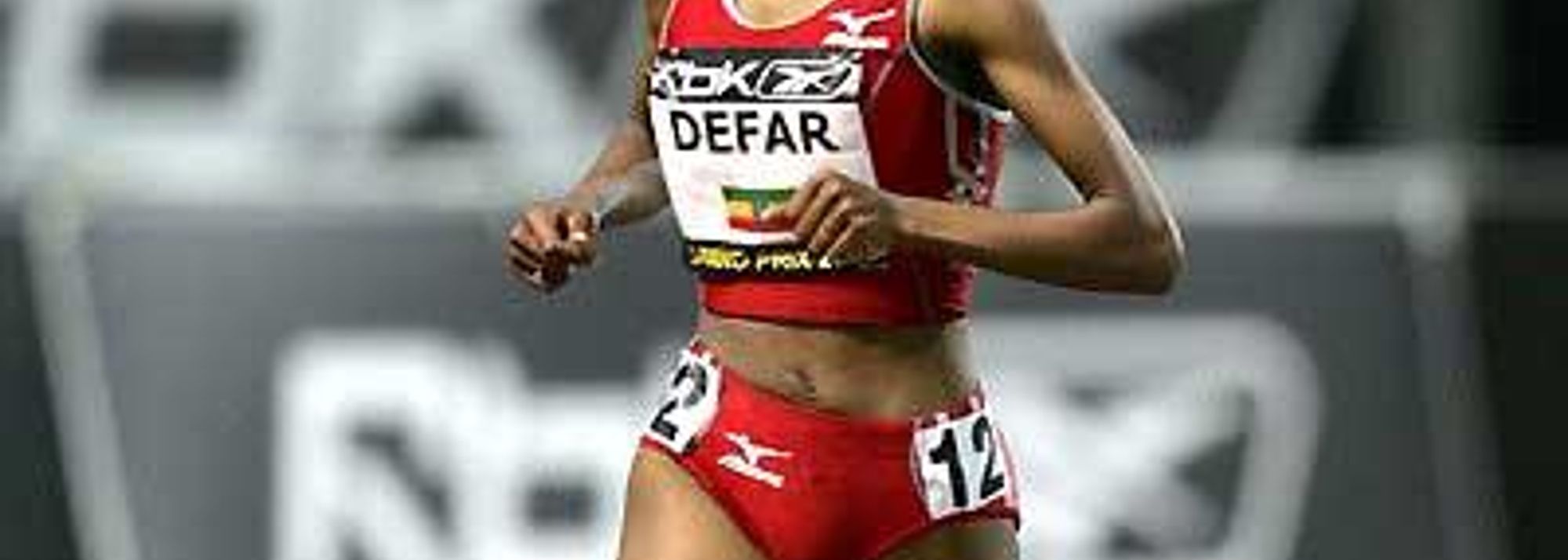


Meseret Defar World record bound in New York (© Victah Sailer)
Since winning two World Junior titles barely four years ago, Ethiopia’s Meseret Defar has amassed almost every honour a track and field athlete can dream of. But as Sabrina Yohannes reports the 22-year-old had long been expecting to break a World record, a feat finally achieved in New York City
Meseret Defar has collected two World Junior titles, two World Indoor titles, an Olympic gold medal and an unofficial road world best, among other distinctions, but next to her 2004 Athens Olympic title, the accomplishment she cherishes the most is the world 5000m record she set in New York City last month.
“It’s something I dreamt about for so long,” said the Ethiopian, after running 14:24.53 at the Reebok Grand Prix meet on Randall’s Island on 3 June to break Elvan Abeylegesse’s 2004 14:24.68 mark. For Defar, the feat, like her Olympic and 2006 World Indoor golds, was preceded by near-misses that fueled her determination and made attaining her goal all the sweeter.
The first World record Defar seriously attempted was the 8:29.15 indoor 3000m mark that her compatriot Berhane Adere set in 2002.
“I tried twice to break the record in Boston,” said Defar. At the Reebok Boston Indoor Games on 29 January 2005, her compatriot Tirunesh Dibaba set a new World 5000m record, but when Defar took to the track later in the evening, she was blocked by lapped runners in the final lap and ran 8:30.05, missing the mark by under one second. Despite her clocking what was then the second fastest time ever, her frustration after the race was clearly visible.
She attacked the record again later that season in Birmingham, and a year later in Boston. When her manager, Mark Wetmore, signaled to her mid-race that she was two seconds off the pace, she misread the signal to mean she was two seconds inside the pace, and eventually ran 8:30.94. In her final attempt in Stuttgart in February, she ran 8:30.72. Then, at the Russian national championships that month, Liliya Shobukhova slashed the mark down to 8:27.96. Defar turned her disappointment at failing to get the record into fuel for a successful defense of her 2004 World Indoor title in the event, but her desire for a record remained unfulfilled.
Defar had won a cross country meet in Fukuoka, Japan in 2005, and considered contesting the 2006 IAAF World Cross Country Championships there despite not having participated in the Ethiopian trials for the championships. Selections to the Ethiopian team had in recent years included one or two top athletes who hadn’t contested the trials. “I wasn’t given the opportunity,” said Defar.
She instead trained hard for an attack, at the Carlsbad 5000 in California, on the 5km road unofficial world best of 14:51 held jointly by Paula Radcliffe and Dibaba. Defar’s preparation paid off when she ran 14:46. “When I bettered it by five seconds, I knew I could run well on the track as well,” she said.
She set her sights on attacking the 5000m track record in Hengelo on 28 May. “In Hengelo, both the pacing and the weather weren’t good,” said Wetmore, adding, “The hardest job for me is finding a good pacemaker.” Defar ran a world leading 14:35.30.
“I was running alone against the wind,” she said, but she received encouragement for her next attempt in New York from her compatriot and the former holder of the men’s mark for the distance, Haile Gebrselassie, as well as her fiance Teodros Hailu, both of whom were in Hengelo.
“Knowing that I could have run a World record in Hengelo but that it didn’t work out was frustrating,” said Defar. After training there for a few more days, she felt confident New York would go well. “I knew if nothing else, the world leading time of the year would be mine,” she said. The night before the meet at New York’s Randall’s Island, Dibaba won the first IAAF Golden League 5000m of 2006 in Oslo, setting a new World leading time of 14:30.40 in the process.
Rain had soaked the track at Randall’s Island and began to fall again as the 5000m race began, but Defar felt strong. “The pace for the first kilometre was good, but I had to push the second pacemaker and she dropped out after 2000m,” said Defar, who was led to 2000m in 5:47.7 by Christin Wurth-Thomas, and the Ethiopian ran alone after her compatriot Workitu Ayanu followed her for another lap before falling back. “I just focused and pushed myself,” added Defar, who felt a surge of confidence when she passed 3000m in 8:42.83, and put in a 69.2 penultimate lap.
“At the bell, I knew for sure I could do it,” she said, but when she came so close to the Ethiopian-born Turk Abeylegesse’s record, and then stopped the clock at 14:24.53, Defar was overwhelmed. “If it had been bettered by one second, or two seconds, that would have been one thing,” she exclaimed. “But it was by microseconds! God helped me to make it.” Defar’s exuberance was unmistakable as she fell to the track, then ran to acknowledge the fans, and later leapt into Wetmore’s arms.
Her joy was matched by the cheers that accompanied her entrance later that night at New York’s Queen of Sheba Ethiopian restaurant. People lining the bar and seated at the tables rose and applauded Defar, who had changed into a smart white jacket and fashionably faded jeans, and was accompanied by fellow Ethiopian athletes like Gebregziabher Gebremariam and Abebe Dinkessa. Sitting on a cushioned wooden stool at a traditional basket table called a mesob, under an Ethiopian flag placed for the occasion below a tapestry on the wall, Defar indicated the magnitude of the day’s feat when she ranked the achievements of her career.
“First is the Olympics, and then this,” she said, without hesitation. “Next is Carlsbad, and then winning two golds at the World Juniors. And after that it’s this year’s World Indoors.”
Defar’s stellar career has been studded with honours in the four years since she signaled her arrival on the global stage by following up a 1999 IAAF World Youth Championships 3000m silver with a sweep of the 3000m and 5000m at the IAAF World Junior Championships in Kingston, Jamaica in 2002 (beating Dibaba over the longer distance).
At the time, Defar, a young runner from the outskirts of Addis Ababa, and a member of the Banks athletic club, credited her breakthrough to the innate talent her running had revealed since elementary school, as well as to the moral support and sometime training partnership of a Banks football player, Hailu - to whom she later became engaged - and the well-balanced focus she gave her training and rest and recovery as a result.
In 2003, Defar ran well indoors in the US before taking World Indoor bronze over 3000m behind Adere.
She clocked personal bests at Carlsbad (15:19) and the Rome Golden Gala 5000m (14:40.34), and after falling ill at the Paris IAAF World Championships and failing to make the final, she made the All-Africa and Afro-Asian Games count when she took 5000m gold at both and headed into the Olympic year with confidence.
“But I competed at the Olympics after a lot of difficulties,” Defar, who nearly didn’t make the team, said, explaining one of the reasons winning there in 2004 meant so much to her. The year began with Defar clocking an indoor 8:33.44 personal best for 3000m in Birmingham before outkicking Adere for the World Indoor gold in Budapest. But outdoors, despite successfully defending her 2003 national 3000m title, Defar’s best 5000m times for the season trailed those of several of her compatriots and she was named the fourth - and thus reserve - member of the Athens 5000m squad, behind Dibaba and her sister Ejegayehu, and Sentayehu Ejigu.
Since winning double gold in Jamaica, Defar had dreamt of the Olympics but suddenly her very participation was uncertain. Only her Christian faith in God, and her family’s and Hailu’s faith in her, sustained a crushed Defar as she prepared for Athens. Just before the team set off, the Ethiopian Athletic Federation dropped Adere from the 10,000m team, citing a lack of form, and the event’s reserve Ejegayehu Dibaba moved up to take her place, vacating the slot she had been given on the 5000m squad. Defar was then officially placed on the 5000m team, but still shaken: every time she saw her name appearing as that of a reserve on team lists that had been submitted previously, it was enough to remind her of her initial uncertain status.
In the Athens final, when she outkicked Kenya’s Isabella Ochichi in a blistering last lap to take gold in 14:45.65 (with Dibaba taking bronze), Defar wept under the stands. “What I went through to run there makes that gold more precious to me,” she recalled.
“It was also the first time the Olympic women’s 5000m gold went to Ethiopia. And nothing compares to the Olympics.”
The following year, Defar’s 3000m World Indoor record attempts were unsuccessful, and in the Helsinki IAAF World Championships 5000m she took silver as part of an Ethiopian sweep led by the double World Cross Country - and then double World track - champion Dibaba. Then Defar showed her form in an African record 14:28.98 5000m in Brussels, and a 3000m-5000m double victory at the World Athletic Final in Monaco.
On 17 February 2006, her failure to break the World Indoor 3000m mark that had proved elusive to her on several occasions was underscored when not only Shobukhova, but her runner-up at the Russian championships, Olesya Syreva, ran under the record, with Syreva clocking 8:29.00.
Arriving in Moscow for the 10-12 March IAAF World Indoor Championships to defend her 2004 title, Defar said journalists referred to the accomplishment by the two Russian women and then asked her, “What do you hope to achieve?” The question further steeled her resolve, and Defar said she declared, “I’ve come to take the gold.”
She bade her time in the race and followed the Russian pair, taking the lead with two laps left and kicking at the bell to win in 8:38.80. “The World Indoors was very satisfying because I beat the world record holder,” said Defar, whose clenched teeth and fists as she crossed the line conveyed her sentiments.
“It was also a fiercely competitive race.”
Now, Defar is the repeat World Indoor champion, but also a World record holder in her own right, and given her form, she expects to be able to better that mark, which she may attack in the Brussels Golden League meeting in August. But in the meantime, she will be dueling with Dibaba on the circuit for the Golden League prize.
“My plan is to contest five Golden League meets, and my aim is to win all five,” she said.
Unfulfilled dreams and close calls fueled several of her quests in the recent past, but Defar goes into the rest of the 2006 season content and confident. “It’s a very special feeling,” she said.
Published in IAAF Magazine Issue 2 - 2006