

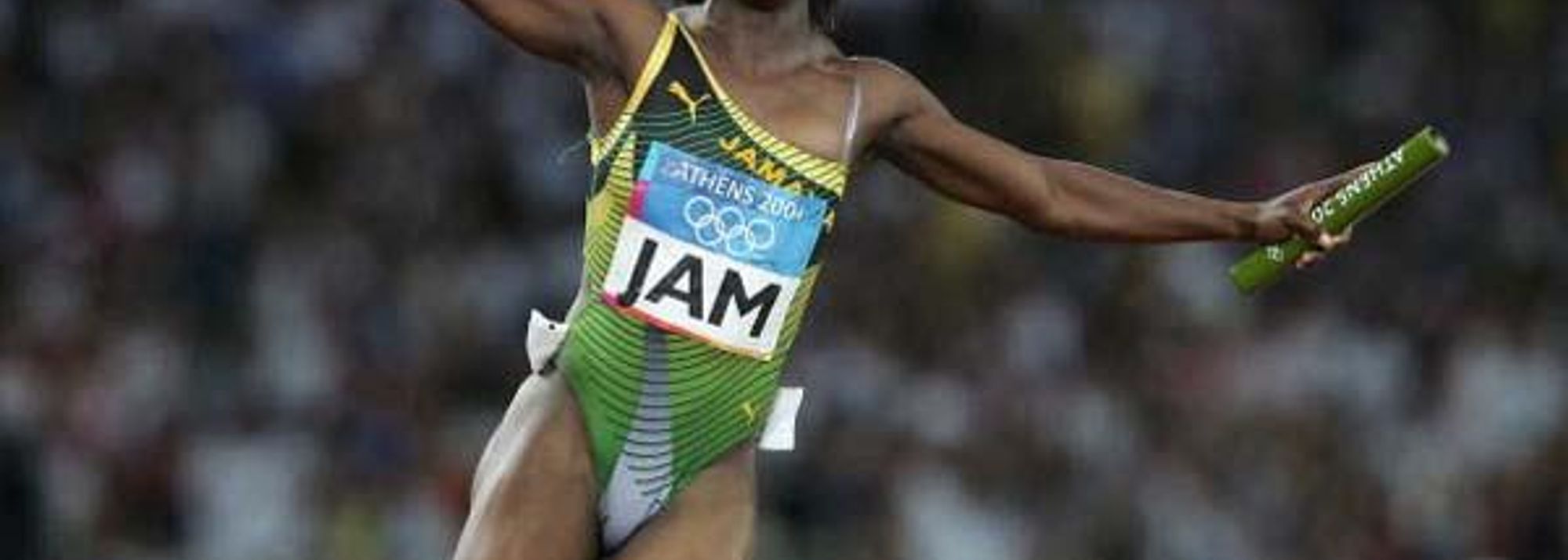


Veronica Campbell anchors Jamaica to gold in the 4x100m relay (© Getty Images)
With two gold and one bronze medals Veronica Campbell returned from the Athens Olympic Games as the new sprinting sensation. Matthew Brown spoke to the young woman who led a whole new generation of Jamaican sprinting talents to Olympic glory.
Call it providence. Or good timing. Maybe it was the power of prophecy. Whatever it was, when Slovenian sprinter Merlene Ottey visited her former team-mates in the Jamaican relay squad at the Athens athletes’ village the day before their Olympic 4x100m final, she had a profound effect.
At 44, Ottey is the grande dame of Jamaican sprinting, a veteran of seven Olympic Games with eight medals and 13 final appearances to her name – more than any other female Olympian in history. Although she now runs for Slovenia, Ottey clearly still holds a special place in the hearts of all Jamaican athletes, especially young women sprinters like Veronica Campbell, Aleen Bailey and Sherone Simpson.
So when Ottey told them they could break the national record, and win the gold medal, there was little they could do but follow her advice. The following day, with Tayna Lawrence on lead-off, Simpson, Bailey and Campbell, brought day eight of the Olympic athletics programme to a close with a rousing victory – Campbell romping home with the baton for her second Olympic gold in three days.
The time of 41.73 was indeed a new national record, eclipsing by 0.21 seconds the mark set by Ottey and Co. when they won the World Championships back in Tokyo 1991 – in a whole different era. After their stunning victory, the 22-year-old Campbell sat between her young team-mates and talked about Ottey's influence on her and the "new generation".
"Merlene is one of my role models and has always been my idol," said Campbell, in her thick, warm Jamaican accent. "She was up at the village yesterday and told us that we could break the national record and win the gold medal. It was a very grand gesture from her, an inspiration, and we all felt we must win it here for her tonight."
For Campbell, the relay victory crowned a triumphant week that will doubtless change her life beyond recognition. Only seven days earlier she had settled into her blocks at the start of the Olympic 100m final as just another bright young sprinter with hopes of glory. She finished third, behind the Belarussian Yuliya Nesterenko and USA’s Lauryn Williams, while Bailey and Simpson were fifth and sixth respectively.
"This is stupendous and fantastic," she said after that race "it's better than anything I could imagine, and this bronze medal is a bonus."
"A bonus"? Campbell seemed to know there were more "stupendous and fantastic" things to come. Four days later, she dominated the 200m final, taking her country's first gold medal since Deon Hemmings won the 400m Hurdles in Atlanta 1996. Her winning time, 22.05, was a personal best, and the fastest by any athlete in 2004.
"I've been dreaming all my life to get an Olympic gold, and today I did it," said the proud sprinter afterwards. Two days later she had a second. Suddenly she was no longer just another member of sprinting's "new generation", but the most successful Jamaican female Olympian of all time – in gold medal terms at least.
Indeed, Campbell now has four medals from two Olympic Games for, at just 18 she had been a member of the 4x100m team that won silver in 2000, running the second leg in a quartet anchored by Ottey. At exactly half her age, Campbell has now achieved twice what has eluded Ottey for an athletics lifetime and seven Games – an Olympic title.
Although Ottey fell out with the Jamaican federation after Sydney, prompting her to take Slovenian citizenship, the blessing she gave to her former compatriots before the relay final obviously meant a great deal to them. That alone, was reason enough to win. But the Jamaicans had two other powerful sources of motivation.
One came from the mouth of Marion Jones, the USA's multi-medal winner from Sydney. A woman once considered virtually unbeatable over 100m, Jones famously tried to win five golds in 2000, but came up short in the Long Jump and the 4x100m, in which she had to be satisfied with bronze. Jones was in the US relay team in Athens that was the clear favourite, after running 41.67 in the semi-finals.
Campbell saw things differently. After the 200m final she said Jamaica would win, "if we get the baton round". At the time it seemed a bold claim, but after the final it seemed like just another sign of the self-confident determination that had defined her performances all week.
Asked whether she had been nervous about running against the US, Campbell's answer was firm. "No, I wasn't nervous, I was very determined," she said "Marion did an interview before, saying that any team that was going to beat the US has to run a World record. Well tonight we have not run a World record… and we have won!"
The third spur to success came from the Jamaican quartet's decision to wear the most eye-catching costumes anyone had dared to put on all week. As Campbell explained, wearing such glamorous, off-the-shoulder outfits was one thing, but wearing them and not winning would only make them look foolish. "They were designed especially for the final," she explained "and as I said to the girls before we went out, 'Wearing a suit like this we have to win.'"
It was the USA, and Jones in particular who looked foolish in the event, while Campbell and her colleagues fulfilled Ottey's predictions – bringing Jamaica its seventh Olympic gold in athletics, and only its second ever in a relay. The first came 52 years ago in the men's 4x400m, won by a squad containing such famous Jamaican quarter-milers as Arthur Wint, Herb McKenley and George Rhoden.
Such was the delight and pride in Jamaica at that triumph that the nation took a national holiday. This time too the women were left in little doubt what their victory meant to the people back home. Before Campbell's 200m triumph the nation had little to celebrate. The island of 2.6 million (struggling with a soaring homicide rate and a sluggish economy), had harboured high hopes of its male sprinters Asafa Powell and Usain Bolt, who both, for one reason or another, failed to bring glory.
By stepping into the breach, these women had won their hearts, according to one Jamaican journalist who stood up at the press conference to applaud his team. "All the nation is lifted by your achievements," he proclaimed "the aspirations of the country were riding on your backs."
Inspiration for Campbell's relay victory may have come from the words of Ottey and Jones, in their different ways, but the forces driving her individual achievements are rooted much further back.
Born in Clarkes Town, Trelawny, Campbell is one of nine siblings. Her father, Cecil Campbell, left when she was one, and Veronica was brought up by her mother, Pamela Bailey, in St Catherine. But she has always remained close to both of them.
"My mother and my father have been my inspiration all my life," she says "they’ve been beside me a lot. Because she needed money to send me to school, my mother had to be up at three o'clock in the morning to get me on the bus, and accompany me to school and back."
Running came naturally and early. "I was talking to my Dad the other day," she says "he was telling me that he used to run back in his days, so I realised I get my running from him. I started at school I suppose. I was playing out a lot, running and playing with balls and all that. I realised I always beat my friends. And then I entered a couple of local championships, and won a few races."
It was then that a teacher she calls 'Mr Collins' took her under his wing, and became her first coach. "He saw the potential in me, and motivated me," she says "he made me believe I could do well."
Another great influence was Neville Myton, a friend of the family and former middle-distance runner who ran 800m and 1500m at the 1964 and 1968 Olympics. Along with his wife Paulette, 'Mr Myton' has been something of a mentor to Veronica and other young Jamaican athletes, as well as a great support to her mother.
"They are really lovely," says Campbell "just awesome. They are like my second parents. They try and lead me down the right path. If he asked me to jump over the moon, I would ask him 'How?' 'When?' because I trust him completely".
By 16 Campbell was running for Jamaica at the 1998 World Junior championships, where she made the quarter-finals. The following year she won World Youth titles at 100m and 4x100m. In 2000, after lapping up her first Olympic experience, she flew on from Sydney to Chile, where she became the first woman to win the 100m and 200m double at the World Juniors.
By now Campbell was more than just a local teenage high school star from Trelawny. Her name was buzzing across the radar screens of world athletics, and being talked about as one to look out for on the senior stage, even mentioned as the next Merlene Ottey.
But 2001 was a difficult year, and a hamstring injury kept Campbell out of the World Championships in Edmonton. In the autumn she left Jamaica, moving from Vere Technical College on a scholarship to Barton County Community College in Kansas, USA, where she met her current coach Lance Brauman.
As a freshman she won four national titles in the 60m, 100m and 200m, indoors and outdoors, and in 2002 was back on the international scene, winning two Commonwealth Games silver medals in the 100m and 4x100m. But 2003 was another troubled year, as injury again kept her out of the World Championships.
Campbell moved to the University of Arkansas and, conscious of the long season a US college athlete has to endure, Brauman changed her training, gearing it specifically towards the Olympic Games. "The secret of my success here has been my training", said Campbell after winning the 200m. "I've done a lot of background work, trying to get strong, so my body would be able to take me right through the season and run so many races at the Games".
Campbell (who completed nine races in Athens) says that not running in the NCAA championships early in the season paid huge dividends, helping her to remain fresh for Athens, and she pays tribute to her coach for getting her into such good shape. "He’s a great person. He’s like a father to me," she says "he’s encouraging. At my training sessions, he’s there, always. He will watch me do my warm up, everything. He takes care of me."
Campbell's careful preparation was one of the key factors behind her success. Before the 200m final she studied the races of her rivals, especially the 19-year-old American Allyson Felix, and concluded that she needed to run a fast bend to win the gold. "It was important to run the way I did," she said, after blasting round the turn and never being caught. "That's why I ran a hard curve. I'd been expecting the gold, and I knew that with the perfect race I would win for sure. When I got to the straight and I didn't feel Allyson anywhere I knew I had the race won."
Campbell's time, 22.05, was not only a personal best, but eclipsed her own world-leading time for the year. When she added the relay gold and national record just two days later, it completed Campbell's triumphant Games. The fact that she has achieved in just two Olympics, and at such a young age, what Ottey had tried and failed to do for so long, is not lost on this confident young woman.
"What does it mean to have a gold medal when I’m just 22?" she wonders "Maybe I’ve got to achieve more. Maybe I’ve got another two or three more Olympic Games to get more medals, I don’t know".
With four, she's already half way to Ottey's total, although we probably shouldn't expect her to be around for quite so long. "I don’t know how long I am going to run for," she says. "I would like to start a family at some point, so I guess I need to make some money."
With medals and star status confirmed, that task should be somewhat easier now. After all, she's no longer the new Merlene Ottey; she's Veronica Campbell, Olympic champion.
Published in IAAF Magazine Issue 3 - 2004

