

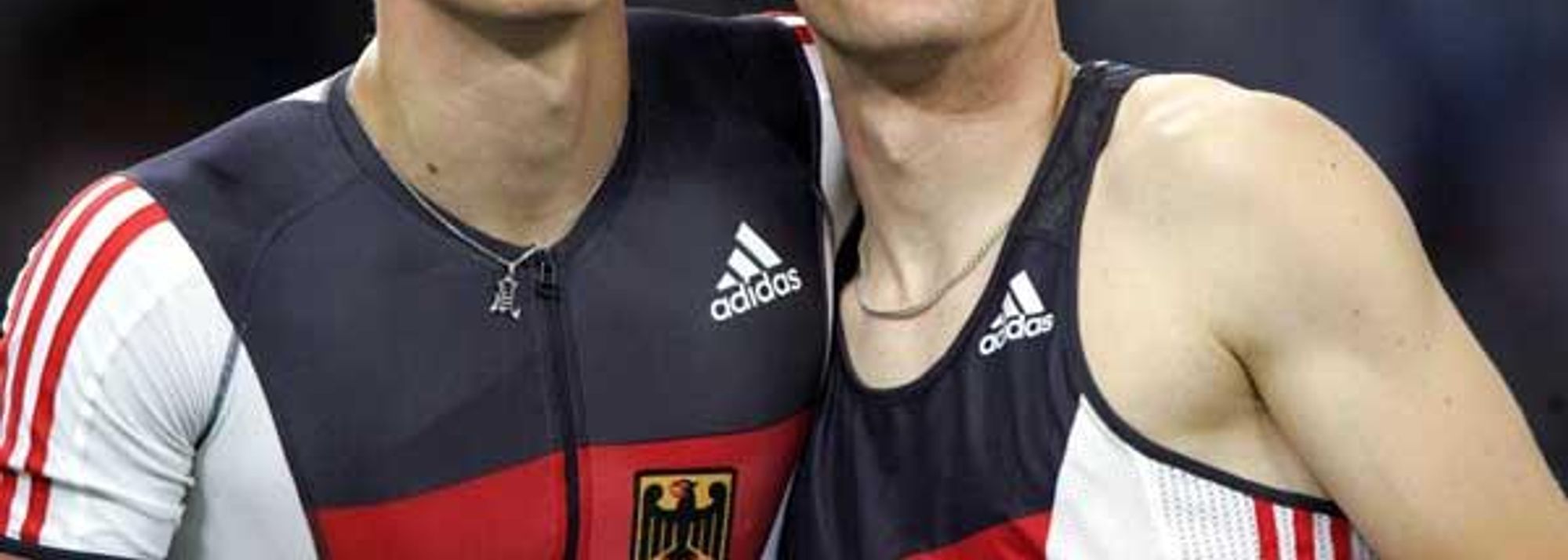


Sebastian Ernst and Tobias Unger (r) in Athens (© AFP/Getty Images)
German men’s sprinting has gone through a bad period for nearly two decades but while much of the rest of the German athletics team provided disappointing performances at the Athens Olympics, the efforts of two sprinters shone through - Tobias Unger, who finished seventh in the 200m final, and Sebastian Ernst, who just missed the final.
While Unger is 25 years-old and improved to 20.30 seconds in Athens, Ernst turned just 20 a couple of weeks after the Games. He improved to 20.36 in Athens. So suddenly last year there was some light at the end of a very dark tunnel for German sprinting – at least in the 200m event.
World Indoor bronze
But it was of course Unger who was more in the centre of national interest than Ernst. Unger had already surprised with a 200m bronze medal at the IAAF World Indoor Championships in Budapest. Then recently it was Unger who was voted athlete of the year in Germany by the readers of athletics magazine Leichtathletik’ and the web page leichtathletik.de’.
In Budapest Unger became the first German male 200m sprinter ever to win a medal at the World Indoors Championships, and in Athens it was Unger who achieved something that no German had managed for 20 years. It was back in Los Angeles in 1984 when a male sprinter from Germany had last qualified for an Olympic final. West German Ralf Lübke had been fifth in 1984 running 20.51, while a year earlier East Germany’s Frank Emmelmann had placed fifth (20.55) in the 200m final of the inaugural World Championships in Helsinki. Emmelmann, was of course not able to compete a year later because of the political boycott.
“Something to offer again”
And there is another historical footnote at which Unger can aim, Frank Emmelmann's ancient national record of 20.23. Clocking 20.30 in the Athens’ quarter final Unger came very close and ran the fastest time by a German 200m sprinter for more than 15 years. His achievements from last year could well be an important milestone in the development of a new and more successful reputation for German male sprinting.
“In the past people complained a lot about the poor results of German sprinters – and they had every reason to do so. But now we have something to offer again. And we will get even stronger”, said Unger.
Looking back to Frank Emmelmann achievements, this year’s IAAF World Championships’ venue could be a good omen for Tobias Unger. If Unger reaches the final in Helsinki he would be the first German male sprinter to do so in the World Championships since Helsinki 1983. Besides Emmelmann, West German Christian Haas reached the 100m final in Helsinki’83, where he finished sixth.
Consistency
While other German sprint hopefuls like Matthias Schlicht, Marc Blume or Tim Göbel never quite made it into international top class at the 100 metres, Unger now is on a good route in the 200m. Asked about the possibility of breaking the German record the 25 year-old says: “If you have run 20.30 then of course the national record is a goal. But first of all it is more important for me to be able to run more consistently between 20.30 and 20.40.”
Inspired by Fredericks
Unger, who lives in south western Germany, remains cautious. He is not a friend of big words. The IAAF World Championships in Stuttgart in 1993 had some impact on his way into athletics. Unger grew up just some ten miles away from the city. And it was in 1993 when he first saw Frank Fredericks, who became World champion at 200 metres. Unger was 14 years old at this time. “It was a great experience to run with him in the Olympic final in Athens”, he says.
Long term coaching partnership
It was soon after Stuttgart when Unger met Michael Corucle. The Romanian, who had been a national youth champion in speed skating and has a hand timed 100m best of 10.2, is still coaching him today. “I soon realised that Tobias was a great talent for sprinting”, confirmed Corucle.
Unger focussed more on the 100 metres at first. He clocked 10.90 seconds at this distance as a 16 year-old. His first electronic 200m time is from 1997 when he was 18 (22.31). Three years later he sprinted 20.96 and another three years later he clocked 20.41. Additionally he improved to 10.32 at the 100m. After these personal bests expectations were high regarding the World Championships in Paris in 2003. But Unger did not even make it through the first round.
Shifting work commitments
There were a number of reasons for that. He had been slightly injured and the pressure appeared to be too big. But the main reason was his job. Until July 2003 he was a trainee in a bank. So it was only possible to train in the evening at that time. The bank clerk then started to study business management but did not attend the summer semester because he wanted to fully concentrate on training for Athens. That decision paid off well. In the meantime he has switched studies and is now doing sports management.
Learning to relax like the Americans!
After the disappointing performance in Paris in 2003 he rearranged his personal surroundings. He continued working with Corucle but additionally a doctor, a nutrition adviser, and a physiotherapist who also helped him psychologically, were included in the team.
“Psychologically I learnt how to build up confidence instead of weakening myself. In former years we looked up to the Americans because they were always relaxed. Now we decided to do it that way ourselves.”
Although Unger mainly trains outdoors in the winter months he will still do an indoor season. The problem is that the nearest indoor facility is too far away from his home. But nonetheless last year he was successful indoors. The European Championships in Madrid in March are his first big goal this season. “I want to reach the final. I try to set high goals but realistic ones.” Looking ahead to Helsinki Tobias Unger says: “I want to get as far as possible.” He will fight for two final places: in the 200m and the sprint relay.
Jörg Wenig for the IAAF

