

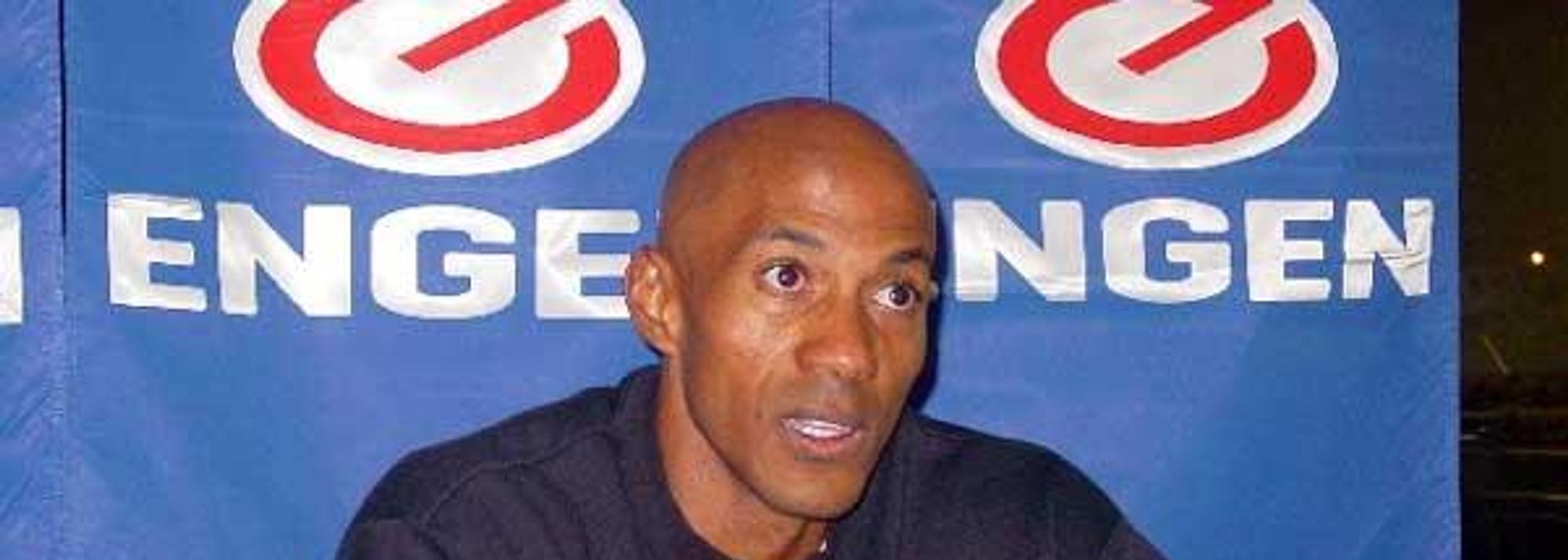


Frank Fredericks at the 2003 Engen Series Press Conference (© Getty Images)
Following on from Frank Fredericks announcement of his international retirement after taking the silver medal at 200m at the All-Africa Games in Abuja on Wednesday, in tribute to the 36 year-old Namibian’s contribution to our sport we are pleased to bring you this feature which details Fredericks' illustrious career up until the end of 2002. This story first appeared in the IAAF Magazine (Vol 17 no.3 2002).
Few expected Frank Fredericks would ever return to his top level after he broke his Achilles two years ago. Not only did the legendary Namibian sprinter made a great comeback but he also snatched three titles in less than a fortnight. Duncan Mackay reports.
The Nightmare ends
It was when the first melodic notes of the haunting Namibian national anthem started to ring around the magnificent City of Manchester Stadium that Frankie Fredericks realised the nightmare was finally over and the tears of joy began to roll down his soft ebony cheeks.
The cloud of the last three years began to lift from above the head of the man no-one has a bad word to say about. He had just won the Commonwealth Games 200m gold medal in 20.06 following a period when his career seemed to be in jeopardy due to an Achilles injury. The sun was shining again for the 34-year-old.
“I’ve had three horrible years,” said Fredericks. “I missed the Olympics and the World Championships. Only my family and manager know what I’ve been through. Even here I was worried as I didn’t know if my Achilles would survive the rounds.”
Fredericks’ return to form was confirmed a week later at the African Championships in Rade when he completed the 100m-200m double.
“I’m living in a new dream,” he said afterwards. “I’m now living a second life. I do not take anything for granted anymore.”
An inspiration
Even his beaten Manchester rivals, England’s Marlon Devonish and Darren Campbell, appeared genuinely pleased to see Fredericks back. “Frankie is an inspiration to us,” said Campbell. “He’s the second fastest ever over 200m but he’s also the nicest man you could hope to meet anywhere.”
Winner of four Olympic silver medals and two world titles, Fredericks will be remembered as much for the gentlemanly way in which he has conducted himself during his career.
Fredericks is soft spoken, with an easygoing manner but has a sharp sense of personal ethics and responsibility that stems from his upbringing.
A child from Windhoek
He was the only child born to Riekie Fredericks and Andries Kangootui, who split up when Frankie was an infant. Riekie raised Frankie in a four-room house in Katutura, a tough black township outside Windhoek, the capital city of Namibia, a nation of 1.6 million on the Southwest coast of Africa that until 1990 was a territory under South African control.
At the age of 13, Fredericks enrolled at D”bra, a segregated Catholic school 20 miles outside Windhoek renowned for its football teams. “You just didn’t lose at D”bra,” says Fredericks. Three years later Fredericks was offered an academic scholarship at Concordia, a newly formed (and also segregated) private school in Windhoek proper.
The education was wonderful, the football terrible. “We would lose 4-0, and my teammates would be laughing,” said Fredericks. He made the switch to track.
The frustration of failure on the football pitch meant Fredericks began increasingly looking towards running, where at least he would be judged by his own efforts. Concordia athletics coach Koos van Staden would drive Fredericks to a synthetic track in Windhoek, the only such surface in all of Namibia. In his final year at Concordia he was the South African schools champion at both 100m and 200m.
Scholarships were tendered by South African universities, but Fredericks accepted an offer - one of only five given to Namibian high school students - to work in a management training program for the Rossing Uranium Mine. He spent the spring of 1987 working in the coastal city of Swakopmund, where he continued to train.
US Scholarship
At the South African junior championships that same year, he met Patrick Shane, an assistant coach at Brigham Young, who put Fredericks in touch with Willard Hirschi (who was then BYU’s sprint coach and is now the university’s head coach). In the autumn of 1987, Fredericks enrolled at BYU, bankrolled in part by a track scholarship and in part by Rossing (on the agreement that he would return to work for the company, which he did, as a marketing associate). He earned a computer science degree in four years and, in 1994, added an MBA. In 1991 he became the first sprinter in 13 years - and the first born outside the US - to win the 100m and 200m at the prestigious American collegiate championships.
During Fredericks’s first three years at BYU, Namibia was part of South Africa, which was banned from international competition. At the end of the college season, when elite athletes customarily compete in Europe, Fredericks would return to Namibia to work for the mine. “If there was a choice between a test and a practice at BYU, it was an easy choice,” he said. “If I failed athletically, who cares? I could go home to a good job. If I failed academically, I would have had no job and no life.”
Independence
Fredericks’s situation changed dramatically with Namibia's independence on 21 March 1990, and with the country’s admission to international sport the following year. He immediately showed brilliant promise. In 1991 he took fifth place in the 100m at the IAAF World Championships and then a silver in the 200m, where his long legs seemed to eat up the Tokyo track.
Double Olympic silver, and again!
A year later he collected silvers in both the 100m and 200m in the Barcelona Olympics and was greeted by an ecstatic nation and an embrace from the president. Fredericks even had a street named after him in Windhoek in recognition of his achievement.
Four years later in Atlanta he repeated the feat. Fredericks won’t admit it but there must have been a small sense of disappointment that he did not win the 100m. In the meetings leading up to the Games he had threatened to break the world record on several occasions but on the big night it was Donovan Bailey who claimed the record and the gold medal.
Hopes had also been raised in the 200m when in Oslo a few weeks before the Olympics he had ended Michael Johnson’s two-year undefeated record. In Atlanta, however, Johnson produced arguably the greatest performance in athletics history to run 19.32 - a world record which seems set to stand for 50 years. “Truly awesome,” was the reaction afterwards of Fredericks, whose own 19.68 nevertheless still makes him the second fastest man in history at the distance.
World Championship triumph
Yet for Fredericks, the Olympics has never been the be-all-and-end-all and he derives as much satisfaction from the gold medals he won over 200m at the 1993 IAAF World Championships and 1999 IAAF World Indoor Championships.
“It (the Olympics) was no big deal to me,” he said. “I’ve heard from many athletes how they dreamed of running in the Olympics from when they were kids. But me living under apartheid when Namibia was part of South Africa, I never even thought about the Games. I never dreamed about them as a kid, so the Olympics weren’t a big goal when I became an athlete. Winning the South African title was a much higher accomplishment.”
Namibia, however, is hardly a byword for international sporting excellence, or international anything, so the expectations pile up on Fredericks every time he turns up for a major sporting event. Namibia is poor and thinly populated, still struggling to drag itself out of South Africa’s shadow, so a star like Fredericks finds himself playing ambassador and role-model whether he likes it or not.
Role model
“The country’s young and we don’t have many sporting heroes,” said Fredericks. “We have high unemployment and we have homeless people. But I think sport can bring the whole nation together and make us united.”
So determined is Fredericks to fly the flag for his country that, as he did in Victoria 1994, where he won the 200m, and Kuala Lumpur 1998 where he finished second to Ato Boldon in the 100m, he paid for his own trip to Manchester to compete in the Commonwealth Games. “If my country has bigger priorities to attend to, paying for my and my coach’s travel and accommodation costs to Manchester isn’t a big deal,” he said.
“I understand the sacrifices they have made to make my country free and feed its people. I also appreciate that my brothers and sisters died for that freedom and if I can afford that cost of going to the Games, so be it.”
Fredericks also gives money and support to the Katutura Youth Enterprise Centre to try to help Namibian youngsters, because he is well aware that his own sprinting potential probably would not have been fulfilled if he had not gone to train and study in the United States.
Modesty
Fredericks is remarkably modest about his natural gifts. “I basically believe in the Heavenly Father, and I believe He gave us all this talent and I’m making the best out of it,” he says. “I think I’m relaxed about it. I just believe that sometimes you win, sometimes you lose, and I’m not going to take the approach that if I lose I’m going to kill myself.”
Fredericks will probably never run as fast again as he did in 1996 but he is still capable of winning major races. “The motivation is just to stay healthy,” said Fredericks. “I’ve been injured and for me it's not so important competitions. The medals are not so important. I had a horrible two years. I spent a lot of money to rehab and just want to show that I can still come back and run.”
Duncan Mackay is the athletics correspondent of The Guardian newspaper in London