

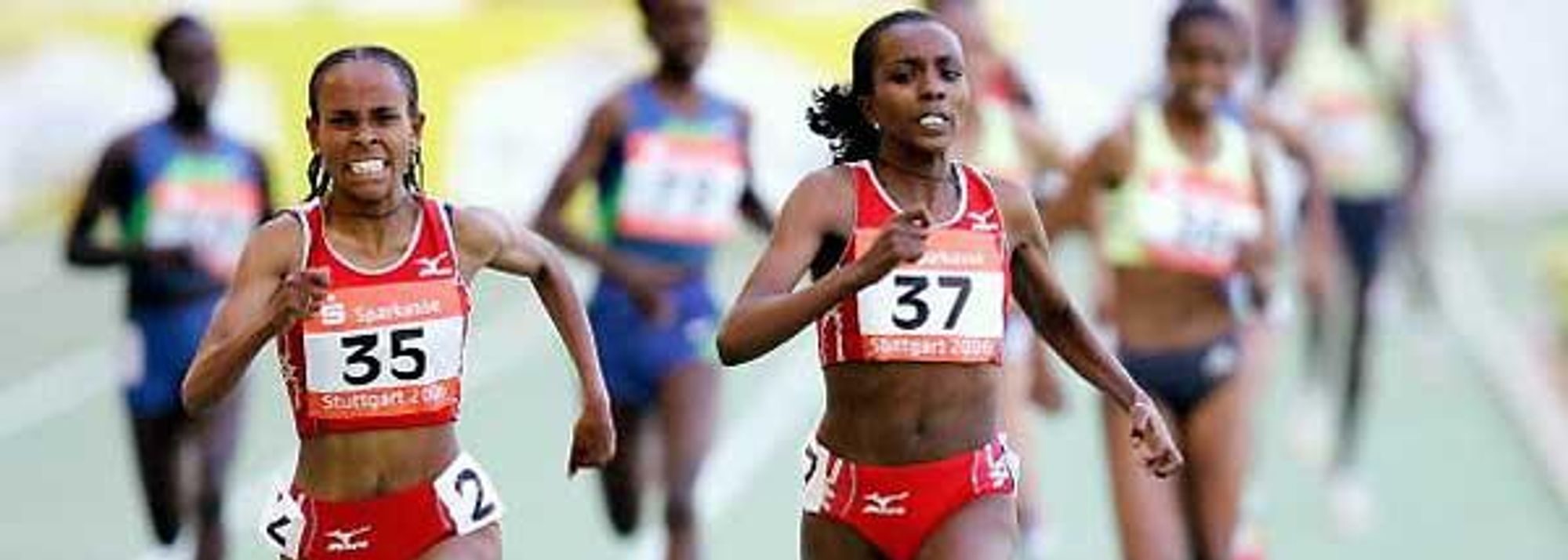


Defar (l) and Dibaba (r) duel in Stuttgart over 5000m (© Getty Images)
Stuttgart, GermanyLong after the opening day of the 4th IAAF World Athletics Final had finished, a legendary figure of the track was in the middle lane of the home straight preparing for a television interview.
Those who were left in the Gottlieb-Daimler-Stadion may not have noticed Steve Ovett being quizzed about his thoughts on the afternoon’s events.
Turn the clock back 25 years, and in athletics, there were no bigger names than Ovett and his British middle-distance teammate and rival Sebastian Coe, who swapped World records like they had gone out of fashion. Their rivalry was among sport’s greatest, and it could not have been more fitting that one of them was on this track on this Saturday evening.
Less than an hour earlier, the 30,000 spectators here had been treated to the sport's modern day version of the classic distance duel.
Ethiopians Tirunesh Dibaba and Meseret Defar have developed a head-to-head confrontation that is arguably one of the greatest the sport has ever seen.
Simply, when one races, the other joins in - and together the outcome is not only breathtaking, it is just unpredictable.
Coe and Ovett rarely met away from the major championships; Michael Johnson normally had the better of Frank Fredericks over 200m; Haile Gebrselassie was heading to track retirement as the star of Kenenisa Bekele grew.
But at this moment in time, athletics has a 5000m women's event which has every ingredient.
Dibaba, just 20, is the double World champion at that distance and the 2005 gold medallist at 10,000m too - and she is known as the ‘baby-faced destroyer’; Defar, 22, is the 5000m Olympic champion and World record holder and just does not concede destruction.
Throw all those elements into the air, and what lands is what entranced the crowd here and the millions of television viewers across the world on Saturday afternoon.
Amazingly, Dibaba and Defar met for the 21st time, with the latter leading 12-8 beforehand. It was a race ran at an excruciating slow pace before, a metre or two before the bell, Dibaba set off. Defar went with her. They were neck and neck. Defar was in front. Dibaba took over again.
The home straight arrived. Dibaba, on the inside, had the edge, Defar battled back. The line approached. Dibaba looked as though she just made it first, but Defar thought victory was hers when she raised her arms in celebration.
The moment of tension which followed this exhausting 57.5 final lap was immense, before the result showed that Dibaba had indeed triumphed in 16:04.77 from Defar in 16:04.78.
What more could athletics want? Not only does the sport have its best two at the distance, you can forget the share of glamorous titles and records they hold. When they meet, which is whenever they can, they slug it out like two old fashioned fighters, and you can never be sure who will win until long after the final bell.
Even here, as Dibaba went off on her lap of honour, Defar left the track full of protestation, insisting on seeing the pictures of the photo-finish. It was because it meant so much.
Six days earlier, at the final IAAF Golden League meeting of the summer (Berlin, 3 Sep), the fortunes (literally, in Dibaba’s case) had been reversed when Defar beat her in the home straight in similar style and deprived her Ethiopian rival of the $125,000 additional bonus for a share of winning all the races in the series.
Dibaba at least recovered some of that money with the $30,000 she earned with this triumph and as she said: “After the race in Berlin, which I only just lost, I was not afraid of her and another possible sprint finish.”
Their tenacity, their desire to beat the other, their amazing confrontation despite Dibaba saying they are likes sisters and not enemies has one underlying factor: their age.
They could be slugging for years to come and for now, perhaps the best is still left on this weekend in Germany.
At 16:20hrs Stuttgart time (14:20 GMT) today they are back again, in the 3000m, and the sound advice is that whatever you are doing, stop, because, arguably, there will be no greater eight minutes of sporting drama anywhere today.
Richard Lewis for the IAAF