

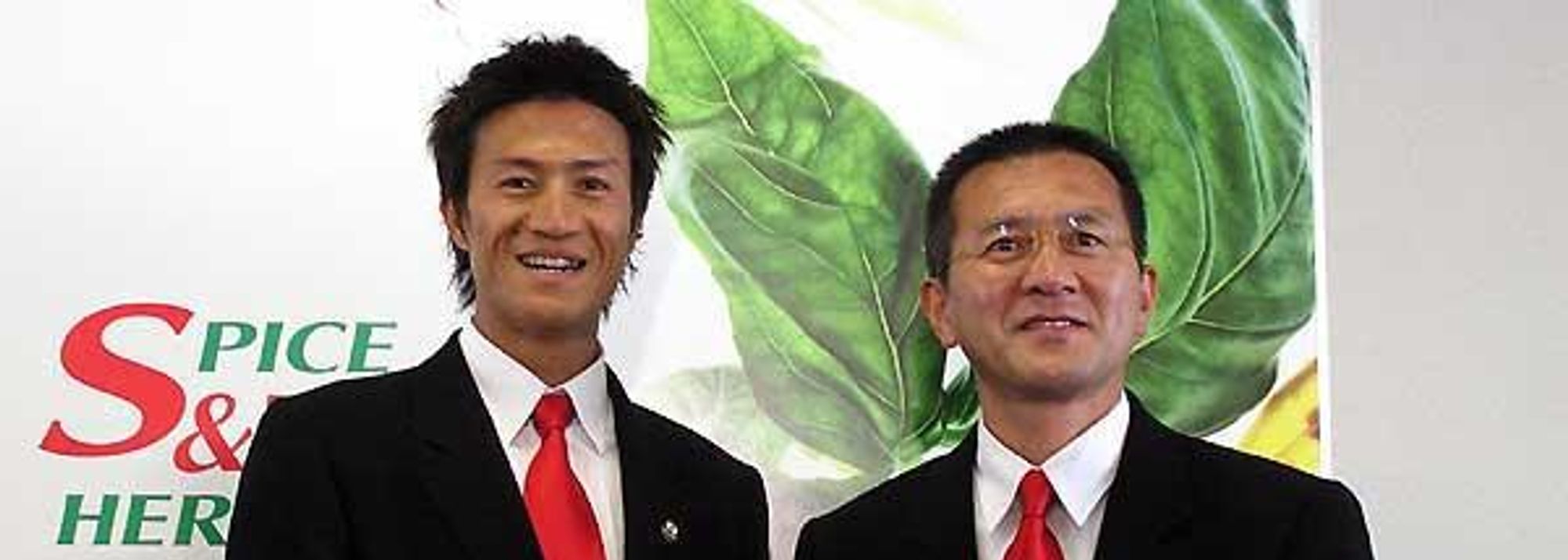


Kunichika with Seko (© Rikujyo Kyogi Magazine)
“Had I won the Olympic gold medal, I probably would not be coaching now,” says Toshihiko Seko, the legendary marathon runner of the 1980’s.
But no Olympic glory
Seko was undefeated in all the major city marathons - Boston, Chicago, London, Fukuoka and Tokyo - from 1980 to 1987.
However, he failed to win a medal in the Olympic Games. With a boycott forcing Seko to miss the 1980 Olympic Games, he was a co-favourite in the 1984 Olympics, however, he could only finish 14th in Los Angeles. Then in the last marathon of his illustrious career, he was 9th at the 1988 Olympic Games.
Since his retirement Seko has been coaching the S&B track team, which consists of only distance runners. His goal, of course, is to guide his runner to a coveted Olympic marathon gold medal.
Seiko’s runners have run track races in the Olympics. They also have run the marathon in the World Championships. For example, Katsuhiko Hanada ran the 5000m and 10,000m in the Sydney Olympics as well as the marathon in the 1997 World Championships in Athens. Takayuki Nishida finished 9th in the marathon at the 2001 World Championships in Edmonton. Seko coached them both.
However, for 14 years Seko was unable to send his runners to the Olympic Marathon. It all changed this year. “I am happier than when I was selected for the Olympic team,” said Seko when Tomoaki Kunichika, who has transferred to S&B track team to seek Seko’s coaching, was selected for the Olympic marathon team.
Baseball’s loss was Athletics gain
Born on April 22, 1973 in Hikari, Yamaguchi prefecture, Kunichika’s first exposure to sports was with Aikido and Baseball. Although he joined the track team in junior high school, he was far from a dedicated runner. Several times in his career Kunichika has almost quit running. After graduating from junior to high school, he had to be persuaded by his older brother to stay with track in high school. After graduating from high school, Kunichika declined the offers to run for a college track team because he did not want to run for another four years. He joined the NTT West track team instead. His plan was to run for the corporate track team for a few years before concentrating on the real job.
In school, he was a mediocre runner. He failed to make the final of the 3000m in the national junior high school championships and finished only 13th at the 1500m in the national inter-high school championships. Even after joining NTT West, a corporate team located in Hiroshima, Kunichika improved slowly, taking 3 years to record his first sub 14 minutes 5000m.
Thinking of the Marathon
“I continued to run for the team because I didn’t like my job then,” recalls Kunichika. Gradually his attitude toward running starts to change. Because of the marathon success of his training mate Koji Shimizu, Kunichika started to think, “Perhaps I can also run the marathon.”
Kunichika’s first marathon was the 1998 Tokyo Marathon where he was sixth in 2:11:28. He was the first Japanese home, which gave him a confidence. His second marathon, the 1999 Fukuoka marathon, was the Olympic qualifying race. Although he was short on training, he felt confident of making the team. However, he was sixth in 2:10:10, and was not selected for the team.
Kunichika always idolized the S&B track team where Seko coaches. He hoped to join the team, and thus whenever he had a chance to talk to a S&B track team member, he let his wishes be known to them. Eventually, Kunichika was able to talk to Seko about joining his team, and in April of 2000, his dream became a reality.
However, it was not smooth sailing for Kunichika. He had many injury problems and he started to lose confidence. His next two marathons left lot to be desired. He dropped out of the 2000 Fukuoka Marathon and finished 8th in 2:15:59 at the 2002 Fukuoka Marathon.
Nothing to show for the effort but then…
He continued to train with a strong desire to excel, but had no results to show for his efforts. Seko tried to encourage him: “I know how hard you train. I know how fast you are.” Pressure was on Kunichika, because he needed to justify his move to S&B track team. He pushed on.
Then in February of 2003, he won the 10 miler with a personal best, and his confidence was back.
He was suddenly on a roll. He recorded 2:10:42 at the 2003 Lake Biwa Marathon in March. In June, he finished second at 10,000m in the national championships and then set a personal best at the same distance three month later.
2:07:52
With his eyes on the Olympic team berth, in October of 2003, Kunichika covered 1350Km in training. He was ready to run sub 15 minutes 5Km pace. In the 2003 Fukuoka marathon, Kunichika followed the leaders till 40Km, as Seko told him. Then he surged away from the leaders including Toshinari Takaoka, the national marathon record holder, and won in 2:07:52. Three month later, Kunichika, who has not made any international team before, made the Olympic marathon team.
After examining the marathon course in Athens back in April, Kunichika started his Olympic marathon training. In April and May, Kunichika ran over 1000Km a month including hard cross-country training. “After running my tough training course, Athens course should feel easier,” said Kunichika who covered over 1300Km in June.
Ready for the heat of Athens
In 1984, neither Seko nor his coach Kiyoshi Nakamura knew how to train for the summer marathon. In order to be ready for the expected hot weather in Los Angeles Seko trained in the middle of the day, which led him to breakdown due to heat exhaustion.
Learning a lesson from the Seko’s mistake, Kunichika is training in northern island of Hokkaido. As with other Japanese marathon runners, Kunichika and Seko have analyzed the Athens course and possible tactics in details. Hitoshi Mimura of ASICS made custom-made shoes for Kunichika after he had examined the marathon course himself.
Two-time Olympian Katsuhiko Hanada, who also ran in the 1997 World Championships marathon, was consulted by both Seko and Kunichika about the course. “It is important to conserve energy during the first half. One must especially be careful with downhill part of the course. Personally, I think the course is easier than Barcelona, Atlanta, or Sydney Olympics,” assesses Hanada, who estimates Kunichika’s chance as, “He can finish in top 8 in the Olympics, but he needs some luck to medal.”
“Ideally, if you can, you ought to breakaway at 25Km. Even if you cannot do so, it is important to be with the leaders at 32Km, top of the hill, for it is not possible to make up the ground on the downhill part of the course. I expect 5 or 6 runners to in the lead pack at 32Km and I would estimate the winning time to be 2:13 to 2:15,” says Seko who like to show the world that he can coach also.
“It is important to run with the minimum energy expenditure until 32Km. I expect the race to start slow and I am planning to run this phase with a marathon ‘shuffle’. In the last half of the race, I expect a lot of tactical surges and I am planning to run this phase in a full stride,” says Kunichika, who goes for the gold with Seiko's dreams on his mind.


