

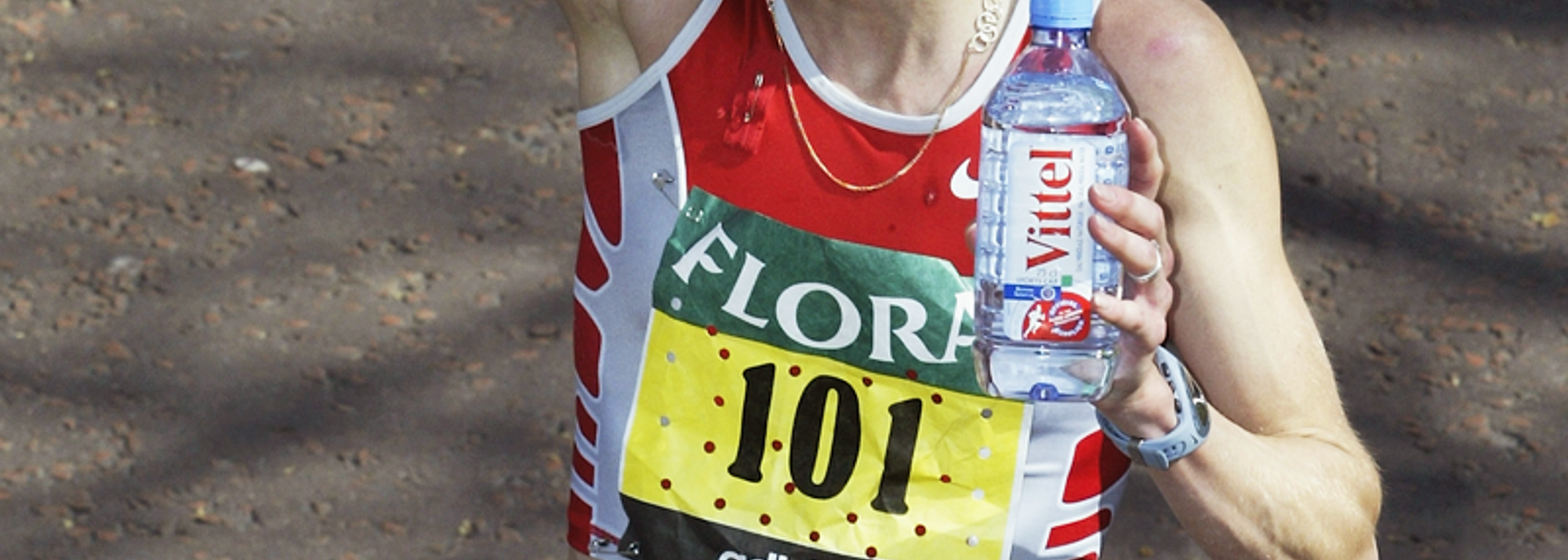


Paula Radcliffe waves a salute after the 2003 London Marathon in which she ran the fastest marathon ever by a woman (© Getty Images)
London, UKPerhaps it is the very contradictions of the Marathon that hold so much of its fascination, the way the event somehow manages to merge reality into sporting myth and legend. It was the perverse nature of the Marathon that once prompted Emil Zatopek to remark: “If you want to win something, run the 100 metres. If you want to experience something, run the marathon.”
The reality of the Marathon is that its history is littered with brave failures, modern day counterparts of the legend that gave birth to the event.
Pheidippides was the messenger reputed to have delivered the news to the Athenians of victory over the Persians at the Battle of Marathon, having hot footed it from battlefield to city. “Rejoice! We conquer!” he said. And then he dropped dead.
This legend of Pheidippides was annexed and embellished by Baron Pierre de Coubertin and the founders of the Olympic movement so that the 1896 Greek organisers embraced it and projected the Marathon as the most important event of those first modern Games.
The organisers’ efforts were suitably rewarded with a romantic ending, with 100,000 people lining the road between Marathon and the great, white marble stadium in Athens to witness Spiridon Louis, a 24-year-old Greek shepherd, win the inaugural Olympic Marathon by seven minutes, wearing a pair of shoes bought for him by his fellow villagers. A legend, and an even of legends, was born.
The Marathon has proved to be the cruel anvil upon which Olympic hopes have been smashed. Thus the omens for Britain’s Paula Radcliffe are far from promising.
It is in Radcliffe’s very dominance of her event that lies the potential for her downfall. As the holder of the world record, at 2:15:25, Radcliffe is more than three minutes - almost half a mile - ahead of her closest challenger. Such superiority, in any other event, would normally ensure her success.
But not in the Marathon, and not on the classic course from Marathon to Athens, where the road winds uphill for the first 22 miles, and the searing heat beats down from the Mediterranean sky. In the Marathon, if your opposition do not beat you, then the course, the heat, the hills, or even your own self-doubts, will.
Another Briton, Steve Jones went into the 1986 European Championship Marathon with an even greater margin of superiority over his rivals. “I suppose in the end, I didn’t know how to approach the race, whether to stick with the pack or go out and run away from them at a pace they could not handle,” Jones recalled.
In the event, Jones stayed with the pack through the early miles before setting off at a pace that even he could not handle. Three minutes clear of his rivals at one point, Jones eventually finished tailed off, near last, dehydrated and exhausted.
The images of favourites and long-time race leaders collapsing close to the Marathon finish - Dorando Pietri in 1908, Jim Peters half a century ago - have become the stuff of the modern legend of the Marathon. Four years ago, Radcliffe ran herself to collapse at the Sydney Olympics, leading for 24 laps of the 10,000 metres before being out-sprinted over the final 400 metres and left in despair in fourth place. How many more agonies might she endure in an event that is 20 miles longer?
The Olympic Marathon will be tough. After winning a rehearsal event on the course in 2002, Kenya’s Mark Saina said it was “the toughest course I've ever run”, and Saina finished seven minutes outside the course record that has remained unbeaten for 35 years, since Coventry’s Bill Adcocks enjoyed his day of days in 1969.
Adcocks typified the no-nonsense approach of his era. Adcocks ran from Marathon to Athens in 2:11:07 wearing nothing more sophisticated than a pair of Woolies plimsolls and a handkerchief tied around his neck. “It didn't seem anything special at the time,” says Adcocks, now 63 and one of the backroom staff at UK Athletics.
Adcock’s tale of the ancient marathoner is one which Radcliffe would do well to heed. “From 20km to 32km, the course rises 650 feet,” he says. “There are a lot of hills and some are very hard. Paula's not going to set a World record there. A time of 2:22 would be phenomenal and hopefully still leave her clear of anyone else.”
Adcocks, like Radcliffe does today, regularly used to run 120 miles a week in training, although the woman from Bedford has been doing her mileage at the high altitude of Font Romeu, in France, replicating the preparation she enjoyed two years ago when she managed to win the World Cross Country title, break the marathon World record, and then, later in the summer go out and win Commonwealth and European titles on the track.
“My training continues to go well and I'm very happy with my progress,” Radcliffe said recently.
“Although I feel very fit, I decided not to race before Athens. Earlier in the summer, I did think I might race again but I don't need to. The most important race this year is the Olympic Marathon and I want to go into that feeling completely fresh.
“I've also decided not to join the rest of the team at the British Olympic Association holding camp in Cyprus. I want to replicate what I did before my other marathons in Chicago and London and going to Cyprus doesn't really fit in with that.
“I think about the Olympics, of course. I often visualise parts of the Olympic Marathon during my training sessions. Sometimes it’s the hills or the finish or even the start. I like to visualise the feeling of racing.
“I want to go to Athens in the sort of shape I was in for the marathons in Chicago and London. I've been working towards this for years and I want to win it but I respect the quality of the competition, the course and the conditions.”
Steven Downes for the IAAF


