

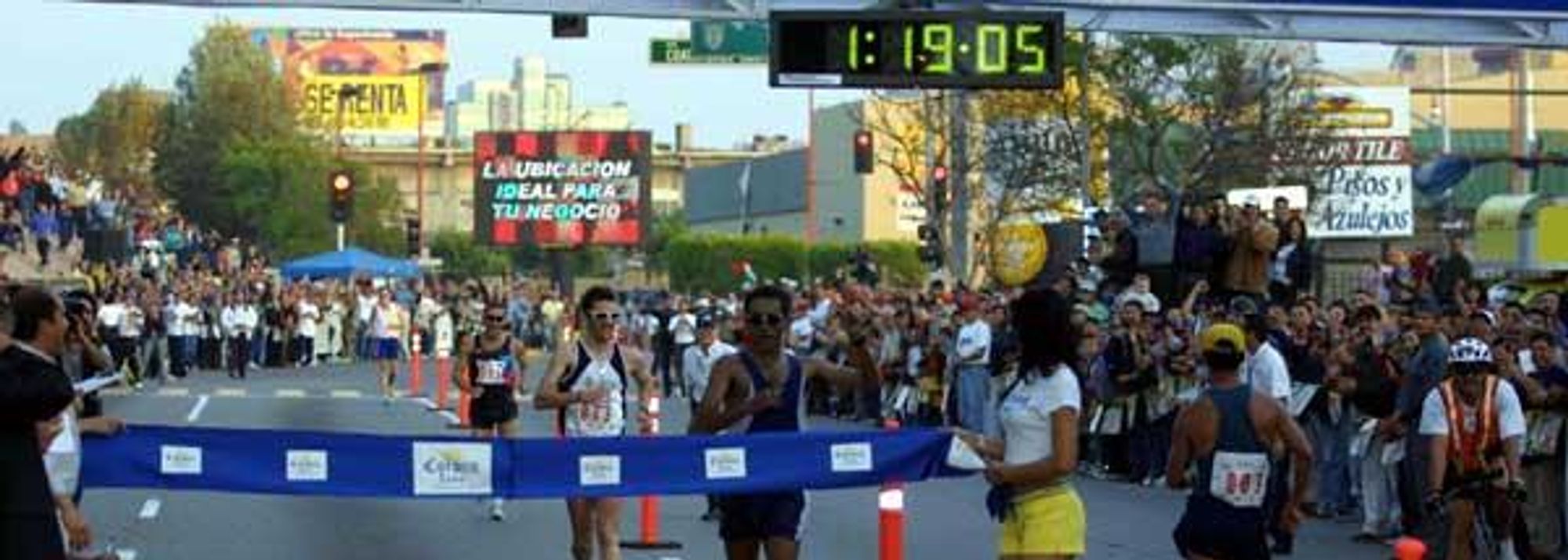


Bernardo Segura (MEX) approaches the 20km finish in Tijuana at the IAAF Race Walking Challenge (© Juan Ramón Piña de la Fuente)
Tijuana, MexicoSome spectators would be willing to swear that Cuauhtemoc beamed down over the city this past weekend. The 16th century ruler, the last emperor of the Aztecs, is represented by an imposing monument in the middle of 'El Paseo de Los Heroes' in Tijuana, the avenue where the inaugural event of the IAAF Race Walking Challenge was held.
Along with Cuauhtemoc more than 60.000 onlookers in summer like temperatures, lined up along Mexico’s equivalent of the Champs-Elysées to acclaim the world's best Race Walkers and to sing traditional tunes.
"This first leg of this new challenge was a real success," believes Poland's Robert Korzeniowski, the multi Olympic and World Championships gold medallist. "This is what happens in Cracow (Poland), and how Race Walking ought to be: it should welcome the competitors into the heart of major cities. It didn't matter whether they chanted 'Adelante Mejico, Adelante' (Go Mexico, Go), it still felt nice to be supported by such a crowd."
Although Mexico "breathes, eats and smells football" as Riverio Juanez, a retired elementary teacher put it, the Central American country has traditionally been enchanted by Race Walking. Mexico has indeed been organizing 'La Semana Internacional de Marcha" (the International Week of Race Walking) since 1977, and in Tijuana alone, a city which now boasts close to 2 million inhabitants, thousands of kids are said to practice this Olympic discipline.
The expression of joy on people's faces when Bernardo Segura of Mexico City broke the tape in the men's 20km on 8 March, was just another proof of their passion for this individual sport.
"Every year, thousands of spectators come to see the 'marchedores' and they all go crazy when a Mexican does well. Walking is really popular here. Look at them all,” Patricia Obligado, a local police woman, said after pushing the fans back behind the barriers. They had ecstatically invaded the circuit as Segura just as if he had scored the winning goal in football’s World Cup final.
Tijuana suffers from a bad reputation. This booming city, nestled in a valley just a few miles south of San Diego, is the main gate of entrance for illegal immigrants lured by the ‘American Dream’. To many, it is associated with tourist traps and violence. To many Tijuana is an adventure, and almost everybody leaves the city with a story to tell.
"We want the athletes, the people and the press to remember that our city was welcoming," said Carlos Mercenario, winner of the IAAF 1991 and 1993 IAAF World Race Walking Cup over 50km, who helped set up the competition.
His wish is fulfilled. The athletes all applauded the crowd while the spectators flocked to the streets on both days to see the races. Their traditional music accompanied the walkers and the city showed itself off for this special occasion.
I, as a journalist, will not remember the loss of our TV equipment at the airport. Nor will I recall our two-day-long struggle to find a camera with an appropriate battery, but I will always have etched in my memory the look of joy on the faces of two little boys standing next to the finish line, as they saw Bernardo Segura triumph. "The walkers are real heroes in this country. This is a good example of success," added Korzeniowski.
Tijuana set the note. Race Walking is on a path paved with gold. "At last, walking is recognised. I hope we showed the world that this Olympic event is attractive," explained Cesar Moreno, a Mexican member of the IAAF Council. "Every country is interested in this sport, and I am glad that Mexico was given the opportunity to share this passion with many. We will do it again."
Patrick Merle for the IAAF