

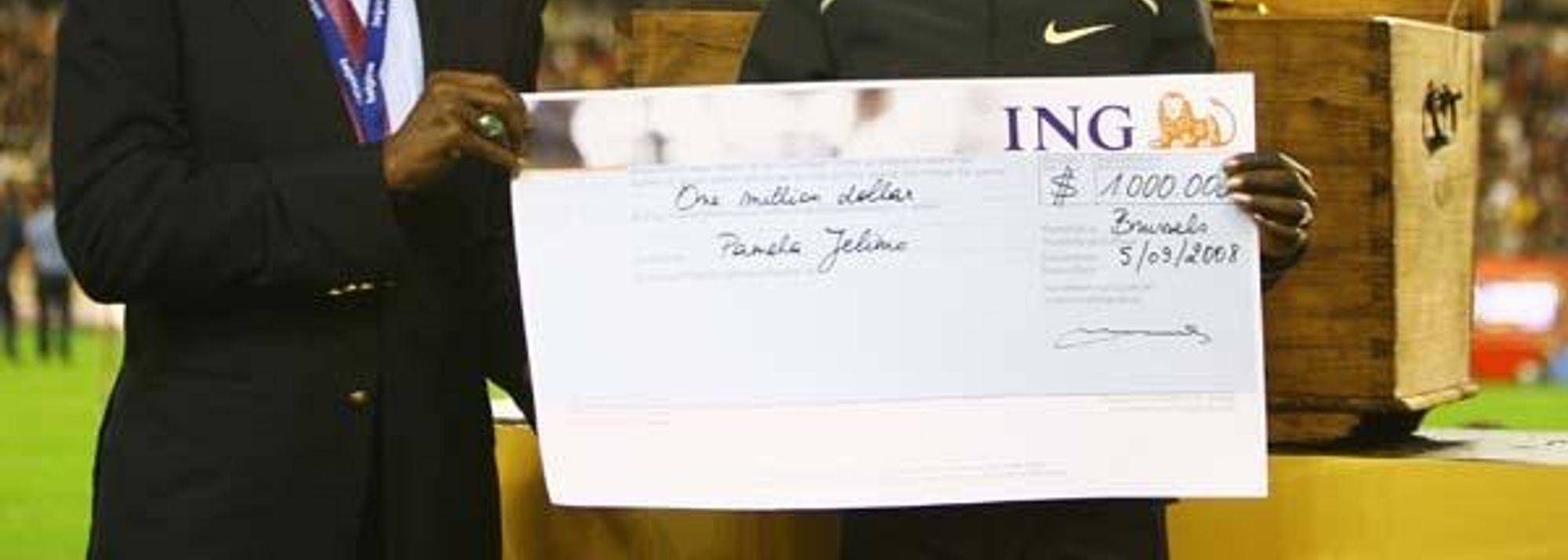


Pamela Jelimo of Kenya receives the Golden League $1 Million Jackpot from IAAF President Lamine Diack (© Getty Images)
At just 18 years of age and in only her first season on the international circuit, Pamela Jelimo won the 2008 ÅF Golden League $1 million jackpot outright, became the first ever Kenyan woman to win an Olympic gold medal and set five World Junior records and four African senior records. And this is just the beginning…
Extract from IAAF Yearbook 2008
Lord Sebastian Coe was watching from the main stand of the King Baudouin Stadium in Brussels on the night that the 2008 ÅF Golden League reached its climax. He was in his element, following the sport he loves, and witnessing another dominant performance from Pamela Jelimo at 800m, the distance at which Coe held the World record for 18 years. Coe is in charge of the 2012 Olympic Games in London and Jelimo looks destined to be a seasoned global star by then.
How different that would be from her first Olympic journey. In four months Jelimo went from unknown runner to Olympic gold medallist. By the end of the season, with the $1m Golden League jackpot to back up her Olympic title, the 18-year-old Kenyan from a family of modest existence was heading for a life transformed. From having a road named after her, to a private audience with the President, Jelimo was now a girl in demand. Men greeted her return home brandishing ‘Pamela Marry Me’ placards.
Jelimo began the year as a raw novice who finished 39th in the Kenyan Junior Cross Country Championship. She was not even among the 400 athletes listed in the Peter Matthews edited International Track and Field Annual for 2008. But, from April to September, she proved unstoppable, winning all 15 of her races.
She became Kenya’s first Olympic women’s athletics champion, took the African title, scooped $1m as the only athlete unbeaten in six Golden League meetings, and triumphed at the World Athletics Final. Yet that was only half the story. From the moment she first made her mark on the World Athletics Tour, in Hengelo in May, Jelimo was a record-breaking machine. She lowered the World Junior record five times and the African record four times.
By the time that Jelimo returned to Kenya at the end of the season, her anonymity had been blown forever. She was now her country’s biggest celebrity. Senior government officials, including Cabinet ministers, were at Nairobi’s Jomo Kenyatta International Airport to receive her. At President Mwai Kibaki’s office, in downtown Nairobi, she was met by the President and also the Prime Minister, Raila Odinga.
From Nairobi, Jelimo headed for her home village of Kaptamok, near Kapsabet, with all of Kenya her new friend. As she toured her Rift Valley home area, huge crowds turned out to see her. Thousands lined the route as a convoy of nearly 200 vehicles followed Jelimo, resplendent in her flowing pink dress, up the dusty road from Eldoret to Kapsabet, where there now exists Pamela Jelimo Road. The road links Kapsabet to the Kipchoge Keino Stadium, the monument to the 1968 Olympic 1500m champion. As befitted her celebrity status, a helicopter was on standby to fly Jelimo back to Nairobi.
The fourth-born of nine siblings – she has five sisters and three brothers – Jelimo was reported to have earned nearly 100m shillings (US$1.37m) from her debut senior international season while the Kenyan Government and local companies chipped in with bonuses worth 3.55m shillings (US$52,000). All this for a girl whose family home cost less than US$1000 to build and whose single mother could not afford shoes for all her children.
Two weeks prior to her glorious homecoming, on the eve of the decisive Golden League meeting in Brussels, Jelimo had been talking in the foyer of the athletes hotel about what she might do with the money if she won. “I will start with my family,” she said. “I can help my mother because she is single. I can help her to raise the school fees because my brothers are still in school.” So much was depending on this inspirational young woman winning in Brussels.
Yet there was no change in her philosophy of bold front-running, no hesitation, no weak-kneed collapse. Following the Russian pacemaker, Svetlana Klyuka, to 550m, she was out on her own once the rabbit stood aside. With another sub 1:56 run – she recorded seven during the season – Jelimo crossed the line unchallenged. It may have been relatively slow compared with the 1:54.01 she had clocked in Zürich seven days earlier to go third on the all-time list but it was still a meeting record.
Coe watched in total admiration. “She’s a stunning talent,” Coe enthused. “She’s come on the scene so quickly that I think most of us have been slightly taken aback. But she’s poised, she’s balanced, she has got an extraordinarily good power/weight ratio, and she moves remarkably well. There is efficiency and an economy of effort, yet she is moving very quickly.
“What I like in her - and there’s always been a slight pejorative use of the word frontrunner, but front running is a perfectly good, laudable tactics - is that she is not giving people a chance to get in the race.” And her potential to break Jarmila Kratochvilova’s World record of 1:53.28 set in 1983, two years after Coe set the men’s world record for the second time?
“I remember it very well, it was my era,” Coe said of Kratochvilova’s record. “Let’s put that in perspective. When we saw Jelimo run 1:54.01 in Zürich she was still seven-tenths of a second off that record, which is probably eight, eight-and-a half, or nine strides. That is not an easy record but you have to say that, at the age of 18, with what she is doing now, and the maturity and all the other things that will take place in the next two or three years, yes she should get there.”
And could Jelimo do a Kelly Holmes, a Svetlana Masterkova, a Tatyana Kazankina and double successfully at London 2012? If she proves herself over the 1500m, Coe would move to ensure that the programme accommodates her attempting both events.
“I would love to see what she is capable of doing at 1500m,” Coe said. “One of the sadnesses in the sport at the moment is that we don’t have as many people doubling up as I would like to see. The programme does not always lend itself to that so I would love to see her really have a go. If she dominated the event you would look to accommodate her in the programme.”
Ellen van Langen, the 1992 Olympic 800m champion, is another who has been persuaded that Jelimo is the two-lap World record holder in waiting. “I didn’t think much about it when she was two seconds away from it but, now she has run a few times (four) in the 1:54s, then you start thinking about it. You think that she will be able to break the World record because she is running 1:54 consistently.
“She is still very young so I think she still has to grow in that role of being an asset (to the sport). She has won every race, she is Olympic champion, but still people don’t know her really well. She needs a bit of time because she is new on the circuit. But she is young and can be around for a long time.”
Projecting the right image is something that both Jelimo and Marc Corstjens, her manager, are aware of. Asked whether she could have imagined a year ago that she would be in this position now, Jelimo replied: “You cannot say it’s crazy. I’m doing my best in everything. You can even improve your personality.”
Corstjens described Jelimo as “a very clever young lady” but, at the same time, she is still a newcomer. “She is still a girl of 18 years old, thinks like a teenager, acts like a teenager,” Corstjens said. “The combination of sport and being a youngster is very special and you have to be very careful handling this.” To keep the ship steady, Jelimo will continue to train under Zaid Aziz, the coach who discovered her, in Kapsabet.
“She lives for the sport, she trains very hard – that is the reason why she is this high – and, in the meantime, she rests and travels,” Corstjens said. “There is not much time to do hobbies. When she is relaxed she likes looking at sports on Eurosport – even football.”
Jelimo, whose previous biggest success was her 400m gold medal at the 2007 African Junior Championships, caused her first ripple on April 19 with her 2:01.02 victory in the Kenyan trial, in Nairobi, for the African Championships. Then, in Addis Ababa on May 4, she won the African title, defeating Maria Mutola to win in 1:58.70. But it was her performance at the FBK Games in Hengelo, 20 days later, which set the athletics world buzzing over the arrival of a significant talent.
Running 1:55.76, Jelimo set her first World Junior record. Another eight days later, on June 1, she clocked 1:54.99 in Berlin and the Jelimo show was on the road. But she was not, as had been widely reported, a newcomer to 800m in 2008. She had some previous experience, although nothing to speak of. She had run a few races between 2004 and 2006 but her best time that she could recall was 2:12. “At that time I was not good at 800m, I was better at 400m,” she said.
Interviewed in Zürich, Jelimo had never met Kratochvilova, never even seen a photograph of her. “I know only her name and the time she ran for a World record,” Jelimo said. Now, as the world gets to know the young Kenyan, increasingly we will be willing her on to break Kratochvilova’s mark. It is good to know that she has a head for the task.
For as Aziz said: “Although she is very happy with what she has achieved, Jelimo is still the same girl who wants to succeed even more. She can handle all the anxiety brought about by expectations that will be placed upon her now that she is star.” The Maputo Express may have retired but the Kapsabet Express has left the station.
Pamela Jelimo
Born on 5 December 1989 in Kenya
Olympic champion at 800m
African champion at 800m
2008 Golden League Jackpot winner
PB: 1:54.01