

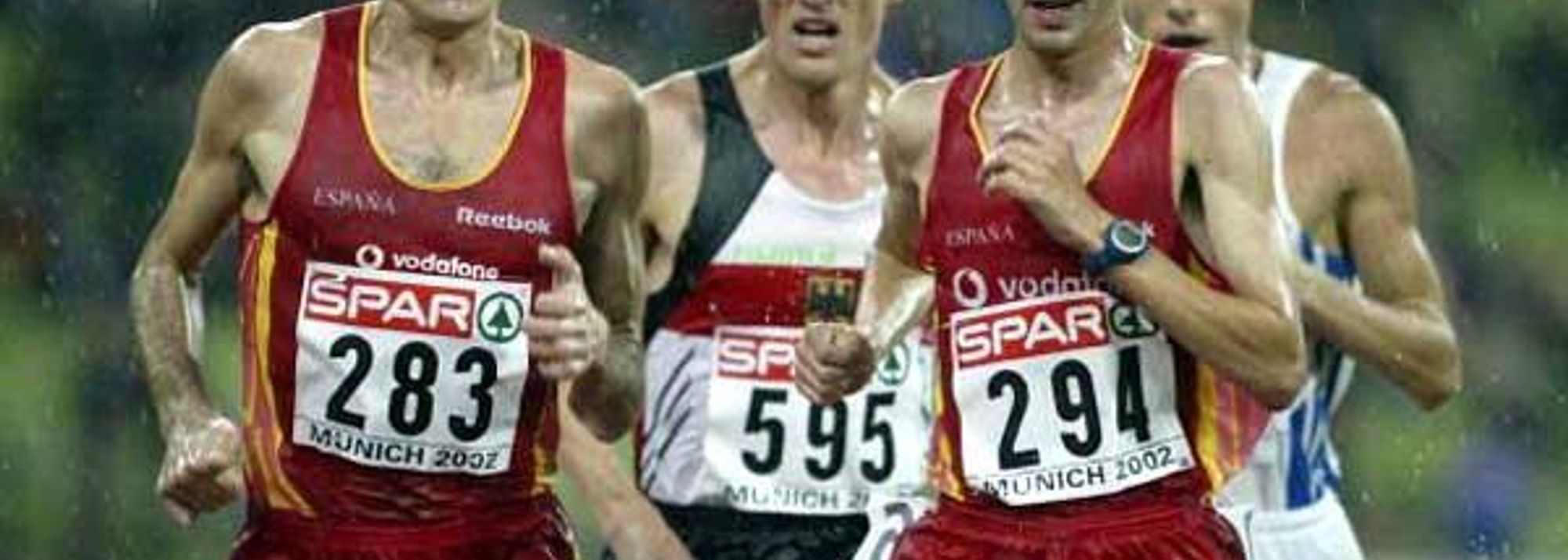


Manuel Martinez (283) of Spain running in the 2002 European 10,000m final (© Getty Images)
José Manuel Martínez is a rather common name in Spain, shared by a large number of men nationwide. Yet since last August most people now know one in particular, the man who clinched the 10,000m title at the European Championships in Munich reports Emeterio Valiente.
Aged 31 now, the Spaniard recalls that unforgettable feat, “it was fantastic. I had watched on TV Dieter Baumann’s 5000m victory at the Barcelona 92’ Olympics, and now I have had the experience of having taken gold with a packed stadium cheering him.” Baumann finished a close second.
However, it was not the win itself but the manner in which Martínez took the gold that amazed most. Unlike all other occasions he employed patience as a strategy.
”I used to be a front-runner to compensate for my lack of speed. But eleven days prior to the Munich final I won a low-key 3000m race in Spain and clocked 1.09 for the last 500m. This sprint gave me confidence to believe that I would be able to defeat anyone in the closing stages of the Europeans.”
Once in Munich, his last quality training session was another morale booster. “I made some 200m reps each ending in around 25 seconds with three days remaining to the final. I felt as fast as any other athlete, so I was determined not to make the pace at any time."
The European Championships 10,000m race was held on 7 August in slight rain, and it developed into a three-way battle with his team-mate José Ríos quickening the pace at the bell, and only Baumann and Martínez still in close attendance. The latter overtook Ríos with 270 metres to go and succeeded in holding the German at bay in a desperate sprint finish.
“I saw on the video score board that I had opened a two-metres gap and thought: ‘they are not running faster than me, I can do it’.”
He did it, snatching gold in 27:47.65 by the narrow margin of 22/100th of a second from runner-up Baumann, with the last 400m taking 56.6 seconds. European season's leader Ríos, came a close third in 27:48.29.
For many, Martínez’ 10,000m success came as a big surprise. In fact, the pre-race favourites seemed to be the 37-year-old German hero Baumann, and Ríos who had beaten twice Martínez earlier in the season - 27:38.82 to 27:47.25 at the 10,000m European Challenge in early April, and 27:35.13 to 27:41.76 at the National Champs in mid-July. But both Martínez’s times were personal bests.
Why though had it taken 31 years for Martínez to finally become an international champion?
“It was not until 1996 that I decided to be a full-time athlete, once I finished my degree in Physical Education. I took up Athletics as a child but at that time I also used to play basketball, ski, handball, volleyball, football...I’m very keen on all sports. At university I preferred to be focus on my studies rather than my athletics career. Now, I have been following a hard, rigorous work for the last seven years and it paid off last year. For instance, I made three altitude-training camps, which garnered 80 days during 2002” says a proud Martínez.
With the Munich gold medal in the bag, Martínez then dramatically lowered his PB at both 3000m and 5000m to prove that his championship performance was no fluke. He ran 7:41.25 and 13:13.57 in San Sebastián and Zurich, respectively.
Martínez believes his 10,000 PB of 27.41.76 does not demonstrate his true abilities at the distance.
“Last year I could have run much faster than that but I didn’t perform over that distance at my peak. Honestly, my real time in the 10,000 should be in the 27:25-27:30 range. I am confident of running those kind of times this coming summer”.
Martínez first appeared on the international scene by taking the 10,000m gold medal at the World University Games held in Palma de Mallorca back in 1999. Only one month later, he contested his first major championships at the IAAF Worlds in Seville’99 (19th), and improved to 12th in Edmonton 2001.
Winning the Spanish Cross Country Championships in March 2002, was a clear turning point in his career, “that race changed my mind; I felt I was a winner and capable of anything.”
He got married to Olympic hockey player Nuria Moreno two years ago, and far from a typical first wedding anniversary, Martínez celebrated the special day last year by making his Marathon debut in Rotterdam.
“We had not scheduled my debut in the Marathon for 2002 but after setting my 10,000m PB in 27:47.25 during the European Challenge, I realised that my chances of breaking the 2:10 barrier were high. I went through the Half Marathon in 1:05:18 and ran a negative split to finish in 2:09:55. At halfway I was running outside the first ten places but took the third spot at the tape, so it was an encouraging experience.”
Despite finishing 17th in the recent IAAF World Cross Country Championships held in Lausanne, Martínez’s primary goal for this first half of the 2003 season was again the Rotterdam marathon.
“This winter and early spring was about building up for the 42,195m event and my final preparations for Rotterdam included 8 weeks covering 216 kms on average”. In the race on 13 April 2003, Martínez equalled his placing from the previous year coming third but ran 1:46 faster to clock 2:08:09.
“I am so happy with my performance, as I ran at a 3.00min/km pace for much of the race (until the 36th km). It was too hot at the end and the wind also made me lose some seconds. It was only my second outing in the Marathon so there is room for improvement and I still have so much to offer; the Marathon is the event that suits me most, definitely”.
“I have realised that I can challenge anyone in the Marathon”, but despite this optimistic statement he has yet to decide whether he will contest the 10,000m or the Marathon at the 9th IAAF World Championships in Paris next August.
“I am really in doubt. Realistically I have more chances in the Marathon but we will have to wait and see how my training and feelings develop. There will be no early decision, but there is one thing beyond all doubt: I want to run the Marathon at the Olympics in Athens and fight for everything there.”
First though Martínez has to fight even to get to the Greek capital. Amazingly, he only ranks 9th on the all-time Spanish list thanks to his recent 2:08:09, and six of such a classy top eight are still active runners, each having an eye on Athens.
Some days ago it became known that the Olympic marathon start will be scheduled for 6 pm but Martínez has no fears. “I don’t care about the timetable, the rivals....I am convinced it’s not positive to pay too much attention on this kind of things, I prefer to keep my energy to use it when it really matters.”
Martínez’s climb to the top has been aided by his dedicated support crew: coach Fernando Lozano. “We were in the same year at university and he became my coach seven years ago. Fernando has taken me to where I am now, so I have to thank him for all he has done for me”, along with the physical therapists and the doctor from the Spanish Federation. “Actually, the crucial decisions are taken by myself, my coach and my doctor Juan Manuel Alonso, who is also an IAAF Anti-Doping Commission member” reveals Martínez.
The 1.76m tall Spaniard who has a four year contract with the clothing company Nike, was inspired by Haile Gebrselassie and Paul Tergat at the beginning of his athletics career, and has an unusually low heart rate. “My pulse rate at rest is under 30”,
Martínez is full of praise for the two athletes who have shone most so far this year, Ethiopia’s Kenenisa Bekele and Britain’s Paula Radcliffe.
“Bekele is a legend in the making and I’m sure he will be able to reproduce on the track the outstanding standard he has managed on cross country. He is Gebrselassie’s successor, absolutely.”
With regard to the stunning new marathon world best of 2:15:25 set by Radcliffe, Martínez declares “Coming from her, I can’t be surprised. Her clocking seems a male’s one and she is redefining the women’s distance history. In some ways I feel identified with her because of her methods of training, with altitude training camps and the fact that we both took gold in Munich and first tackled the Marathon last year."

