

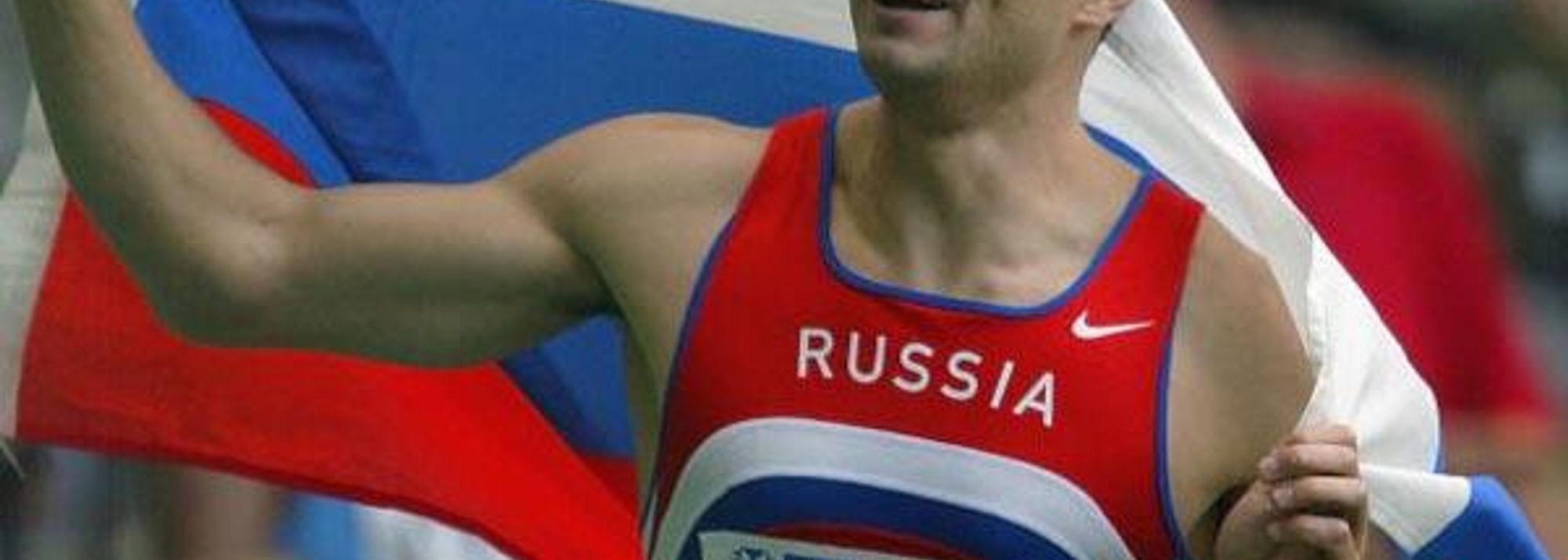


Sergey Makarov celebrates winning the javelin throw final (© Getty Images)
“We must not be deluded by the victory at the World Championships in Paris,” confirms Russia’s World Javelin champion Sergey Makarov and his father and coach Aleksandr. “In comparison with the training built up during the winter (2002/03) in South Africa, the summer results were still not as good as had been expected. Something had gone very wrong.”
Only thrower over 90 metres
Sergey Makarov at 30 years of age is now the captain of the Russian team and dreams of the Olympic gold in 2004, having won nine of his eleven competitions (finals) during the 2003 season, which ended with a 85.66m victory in the inaugural IAAF World Athletics Final in Monaco on 14 September.
The only thrower to breach the 90 metres barrier in 2003, Makarov has a personal best, the Russian national record, of 92.61 (30 June 2002).
He began the summer of 2003 with an impressive 90.11m throw in Dessau, Germany on 30 May, and it looked like everything was going in accordance with their plan for the year. But as his season got fully underway with four more victories in June, his distances were not improving, quite the reverse. 88.61m in Kassel, Germany on 13 June, descended to a 85.61m win at the first IAAF Golden League meeting in Oslo on 27 June.
Over-training
At the time Makarov told his father that his body didn’t feel right, he was straining, as his muscles were not working as they should, a result that they analysed was due to over training during the winter. Yet Makarov did not panic as he was still taking the victories.
“I know that Sergey had done too much work during his training camp in South Africa,” explains Aleksandr Makarov, who was a world class thrower in his own right having taken the 1980 Olympic silver medal in Moscow. “At his training sessions in January and February he was achieving 88-91 metres and at the same time did very intensive work to develop his strength. It was a serious mistake.”
”Last year (2002) he showed only in the 82-83m range when in South Africa during the winter but his average summer result was 88 metres. Now in the summer of 2003 his average result was 86. So he actually lost two metres!”
We did not expect that 85m would be enough
”At the same time we were confident that in Paris he would show his best. We thought that he would need to throw 87-88 to be the first at the World Championships. But again the distances did not come.”
Makarov is sure that his performance was also not so good because there was no javelin practice field near the Stadium for him to properly warm-up in. “To make it possible to take some practice throws before the competition you needed to leave the village some 2 hours before the competition.”
“Because of such a long way to the stadium I lost my concentration, and when we reached the arena I was feeling that I had to show my best throw in the first attempt, and as it happened I managed to win with this first throw (85.44m)."
"We did not expect that 85 metres would be enough to win a gold medal. We observed the results of our main rivals and made the conclusion that any of them were capable of producing a good throw.”
Aleksandr Makarov, 52, agrees with his son that the absence of a suitable warm up field for javelin throwing at the main stadium badly affected the competition results, and says that all the finallists lost about 3 metres. He also points to the increasing trend that in major competitions that the best throws are becoming concentrated in the first two attempts.
No rivalry only friendship with Zelezny
Despite his Paris win where Makarov took the World title away from three-time champion Jan Zelezny of the Czech Republic, the two throwers remain very close friends.
On the way back from the Stade de France after the final Makarov remembered asking the World record holder and reigning three-time Olympic champion why he could not throw better 84.09m for fourth.
“What did happen with you, Jan?” asked Makarov. “Something with the rhythm of my running,” replied Zelezny. “It was difficult to run which is strange because the evening before the competition I was feeling very good, and did not have any difficulties.”
There was no any rivalry or bitterness in the conversation between Sergey and Jan on that day, just a recognition from Zelezny that he had to face the reason for his failure in himself.
Winter training in Africa again
The two athletes remain on very good terms, and Zelezny has once again invited Makarov to train with him this winter in Africa.
However, this time Aleksandr will accompany his son to South Africa in an effort to prevent him from over doing his training and loosing two much energy in the process.
”We are paying for this one month trip out of our own money, costing about $5000USD each,” confirms Aleksandr.
In 2004, it is possible that Makarov will start his season quite early and then go back into a period of training just prior to the Games. He is going to compete in about 15 meetings and his main goal is obviously to win an Olympic gold. Then he will try again to be at his very the best at the IAAF World Athletics Finals in Monaco.
Sergey took the bronze medal at the 2000 Sydney Olympics, while Aleksandr also missed the Olympic gold in Moscow twenty years before, and so father and coach says his son will be on a double mission in Athens to take one gold medal for the both of them!

