

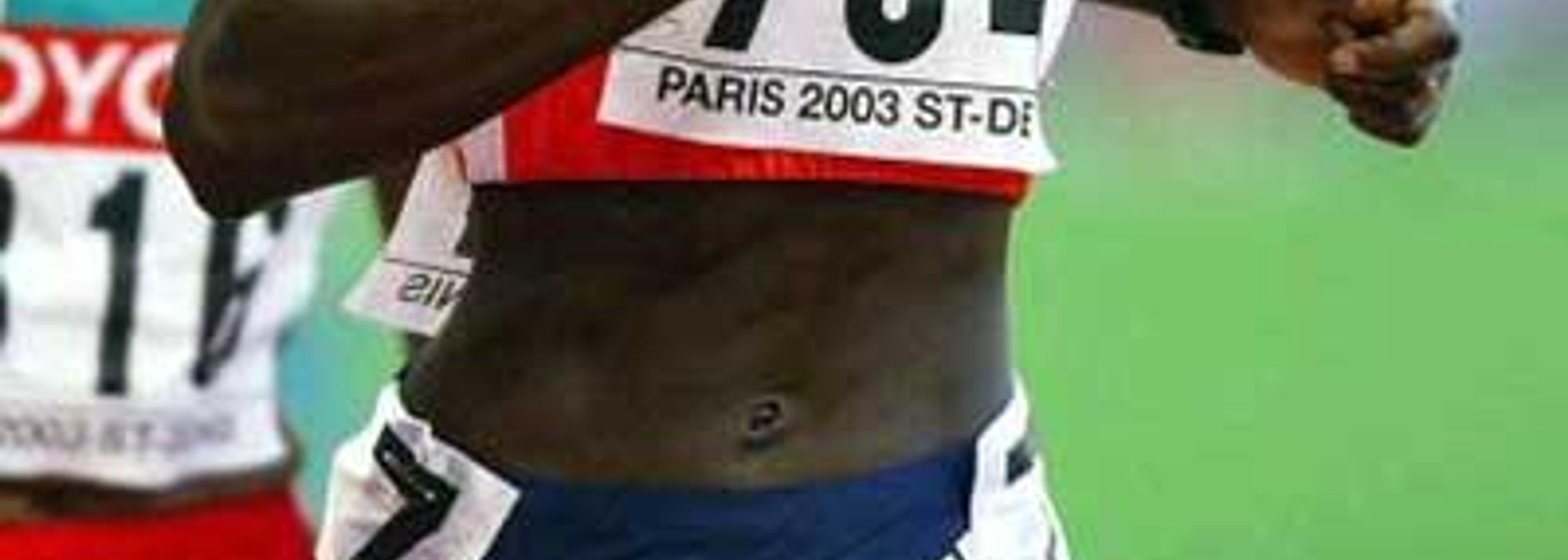


Lornah Kiplagat (NED) running in the 2003 World 10,000m final (© Getty Images)
The biggest 10km road race exclusively for women in Britain has become the exclusive preserve of Lornah Kiplagat. The Kenyan-born Kiplagat, running in Dutch colours since marriage to coach Pieter Langerhorst, won the Britannic Asset Management 10k in Glasgow on Sunday (15 May) for the sixth consecutive year.
Her time of 31:44 was exactly half a minute outside her course record, but this was her most testing victory yet in the Scottish city where a record 14,512 entered. In the inaugural race 13 years ago, just 800 started.
Famous opposition but training partners take minor honours
It was just five weeks since her victory in the Rotterdam Marathon, and the field was a formidable international one, including former London Marathon winners Joyce Chepchumba and Tegla Loroupe, and the former double World Cross Counry champion and European track gold medallist at 5000 and 10,000 metres, Sonia O’Sullivan. All three of them had raced in London exactly four weeks earlier, and the additional week’s recovery for Kiplagat may just have helped tip the balance.
However, it was her own two training partners, Hilda Kibet and Doris Chengeywo, from a training camp she has established in Kenya, who pushed Kiplagat hardest in bright sunshine on a warm day. Kibet finished eight seconds down and Chengeywo a further 13 seconds back.
Loroupe was fourth and Chepchumba fifth, followed by another Kenyan, Catherine Mutwa, and Ethiopian Mulu Seboka. Ireland’s O’Sullivan was eighth, just ahead of the leading home runner, Susan Partridge, who had booked her Commonwealth Games Marathon place in London.
Lead group of 7 broke clear quickly
Within just 500 metres, a leading group of eight - seven African-born runners, plus O’Sullivan - had already broken clear. With the opening kilometre covered in 3min 05sec, the pace was already taking its toll.
O’Sullivan was 15 seconds back, and the lead group was down to four: Kiplagat, Kibet, Chengeywo, and Loroupe. The double London Marathon winner, Chepchumba, after having taken five flights from her base in Kenya, to arrive just the previous afternoon, perhaps not surprisingly slipped 30 metres off the back as 3000m was reached in 9:28.
Loroupe, suffering from a cold, slowly faded after 5k was reached, and Chenggeywo joined her soon after. Urged on by music from the traditional lone bagpiper stationed at every kilometre post, Kibet continued to threaten through parkland populated by wide-horned shaggy Highland cattle, but the ninth kilometre, fastest of the race at 3:04, finally broke her.
Kiplagat came home to a resounding welcome from a carnival crowd at least 10 deep lining the long finish straight through an avenue of trees.
“I’ve so many friends here,” said Kiplagat. “I’d like to keep coming back, even if it’s just to jog round with the rest.”
Kenya - Glasgow sport accord
Remarkable links have been built between Kenya and the Glasgow community.
Kiplagat is honourary patron of the Glasgow Athletics Squad, and has had several city athletes to train with her at the altitude camp she has established in the Rift Valley.
The Glasgow City Council has made funds available to allow leading local athletes to go there. Kiplagat established the camp to give women a chance to run and earn a living in her country’s male-dominated society. Her father, despite having 12 children by two wives, was particularly enlightened among parents from her culture. “He said if he caught me working for my brothers, obeying their orders, he would break my hands,” said Kiplagat.
Elsewhere, Kenyan women from a rural farming community might expect to be closely confined at home, before being married off, frequently at an early age.
Kiplagat’s camp, where men are welcome provided they share the domestic chores, has already launched 20 women into international athletics, or into economically useful careers.
“Some, who did not make the breakthrough in running, are successful in business,” said Kiplagat. “There are another seven in the camp now, and eight girls, who are at high school, come and train at the camp during holidays. They are more receptive. I am their mentor.”
A different way of thinking
“One of the biggest successes for us has been bringing Scottish athletes to train at the camp. Mixing has been so good for the Kenyan girls. They have learned different ways of thinking, and feel international without ever having gone to Europe. It has opened their minds in a way you would not believe.”
If the exchange has yet to produce a world-class successor to the likes of the Scots’ iconic Liz McColgan, the former World 10,000m champion who is now the national athletics body’s president, Camp Kiplagat is already paying dividends for Kenya.
New stars emerging
Kibet and Chengeywo both served their apprenticeship there. Indeed, Kibet, a cousin whom Kiplagat has helped put through physiotherapy college in Holland, has proved a fierce rival, already beating Lornah in an international cross-country event in Scotland over the winter. “I thought she was going to beat me again here today,” said Kiplagat.
“Now that I have graduated, I have more time to train,” Kibet explained. “I am going for it now, and really believe I can be good. I just thought it was better to study, and have something for the future.” The eldest of 10 childen, she knew there was running talent in her family.
Her sister, Sylvia, was second in the World Junior championship 1500m in 1999. “I am the eldest, but she started running first,” said Hilda.
The college where Kibet trained is about to renew its sport facilities. The old ones, including a substantial gymnasium, are being packed into two vast containers, and freighted to the Rift Valley, for the benefit of her camp.
Bridges are being built by the sport in all directions. Chengeywo used this race to recover from bitter disappointment after she was overlooked for the Kenyan team for the IAAF world cross-country in St Etienne-St Galmier this year. She was told she had qualified and her sudden surprise exclusion provoked uproar in Kenya’s media. “It was most unfair,” said Kiplagat, and Chengeywo admitted: “After they left me out, I stopped running for a bit - about a week. It was very hard for me. I was angry, but I knew my chance would come later.”
Loroupe’s Peace Foundation
On a day when more than £1m was raised for local and national charities, it was humbling to hear Loroupe talk of hopes for the Peace Foundation of which she is president.
It has impacted on cattle rustling and reduced fatalities between factions with whom her Pokot nation has been in conflict, and a further series of peace races have been planned, following on from the success of earlier events where warriers laid down their AK 47s, and raced. Guns are rented for a week’s rustling at a going rate of two cows.
Loroupe flew to Scotland after a successful Peace Race in Uganda - the Pokot straddle the Kenya-Uganda border where a single strand of barbed wire is a less than effective barrier.
Her initiatives have led to dialogue between Ugandan and Kenyan politicians, and further races are planned this year in southern Sudan, on the Tana River, and in her home area of Kapenguria. Already she has drawn up plans for a sophisticate school, for about 200, for which she hopes her foundation can raise funds.
Loroupe’s fourth-place yesterday, in 32:40, despite the cold and her arrival in Europe just a day ahead of Chepchumba, suggests there is still plenty running in the tiny legs of this giant-hearted woman.
Kiplagat and O'Sullivan will renew rivalry in Manchester this coming weekend, again over 10k.
Doug Gillon - The Herald - for the IAAF
RESULTS
1, L Kiplagat (Ned) 31:44;
2, H Kibet (Ken) 31:52,
3 D Chengeywo (Ken) 32:05,
4 T Loroupe (Ken) 32:40;
5, J Chepchumba (Ken) 32:52;
6 C Mutwa (Ken) 33:22;
7, M Seboka (Eth) 33:30;
8 S O’Sullivan (Eire) 34:31;

