

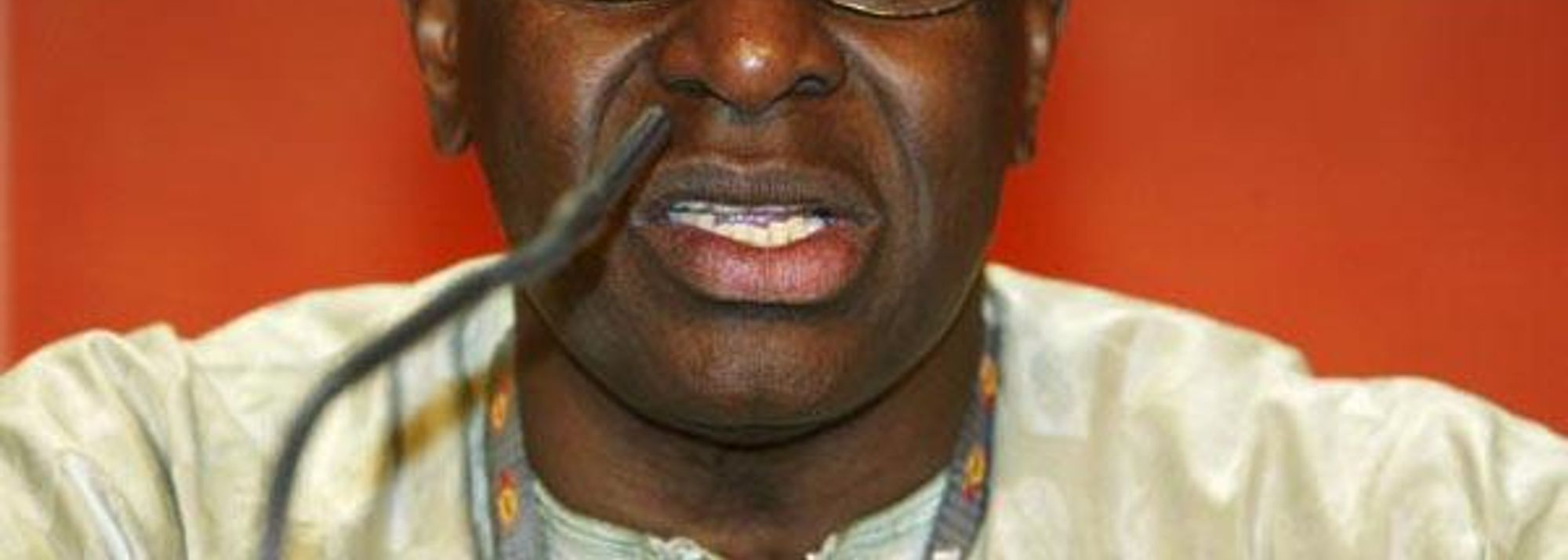


Lamine Diack during the IAAF Congress at the Carrousel du Louvre (© Getty Images)
On behalf of the IAAF, It gives me great pleasure to be here with you today on the eve of the 9th edition of the IAAF World Championships which opens in two days time in the splendid Stade de France.
Over recent weeks, the local organising committee has accelerated its efforts to turn all its careful plans and theories into action, supported at every step by the IAAF and other partners. We are all united, as we approach the finishing line, in our determination to ensure that this edition of the World Championships offers a fitting stage for the best athletes in the world, and that Paris St-Denis, is recalled by athletics fans in the same way as every edition that has taken place over the past 20 years.
Since the first edition of the IAAF World Championships in Helsinki in 1983 the sport has been transformed. Thanks to the fantastic performances of our best athletes, supported and nurtured by their National Federations, the World Championships has grown in status and appeal so that it now fully deserves its status as one of the top 3 world sporting events, in terms of participants as well as TV ratings. I am pleased to report that more than 179 countries and territories have confirmed that they will broadcast the competition, and it is estimated that more than 4 billion television viewers around the world will tune in to see the world’s best athletes in action.
Today, I am delighted to tell you that a record number of IAAF Member Federations have accepted an invitation to be part of these World Championships – with the addition of East Timor which was confirmed yesterday as a new member of the IAAF – 203 MFs are here in Paris. In terms of athletes, there will a total of 1,902, 1,054 men and 848 women. I am pleased that following last year’s 90th Anniversary of the IAAF, the largest ever gathering of its members is taking place here in France’s capital.
I believe that the major achievement of the 44th IAAF Congress, which ended today with a careful study of a new IAAF Constitution and a new World Plan for the future of our sport, was the realization that the biggest challenges facing us today is to ensure the continued worldwide development of athletics, but only by simultaneously searching for new, creative methods, while consistently respecting traditional values. To properly secure the interests of our movement and secure its future we must have one eye on the future, but another firmly placed in the realities of today’s world. The IAAF is in a healthy financial position at the moment, our membership is greater than ever, and our sport enjoys a relatively high profile, thanks to our continuing position as the number 1 summer Olympic sport, and to the success of our Competition system.
But, like every single athlete, we must never rest on our laurels but must be looking for new challenges – for new barriers to break. Our sport needs to become more professional, and we need to encourage all our stake holders – including federations, athletes, officials, Media, Sponsors and TV – to work closely together as a united team. Athletics faces strong competition these days – not just from other sports, old and new, but from changes in culture and society, that affect all sports, not just ours. My hope is that athletics can once again find its way to the heart of school curricula, as it was during my youth, when every active sportsperson, was once an athlete.
One of the attractions of athletics is that it combines the excitement of competition – the hand to hand struggle between talented athletes – with the challenge of setting new limits of performance. Every season’s best, or personal best has value to an individual athlete of course, but the ultimate performance remains the official IAAF record.
For this reason I am pleased that, with the support of two IAAF partners, (TDK for the men and Toyota for the women) the IAAF World Record Programme will ensure that any athlete breaking a world record can claim a $100,000 cash award. Of course, that is on top of the Competition Awards that are available for all 8 finalists in each event.
The IAAF is also determined to ensure that these Championships highlight our commitment to anti-doping. In collaboration with the French authorities, the IAAF has planned to carry out approximately 400 doping tests, both during the competition and before, when we will carry out around 50-to-60 surprise tests for EPO.
As many as 50 different countries could win medals in Paris 2003, compared with just 25 in 1983. I believe that this edition of the World Championships is the most open ever. For the first time in my memory, it is extremely difficult to predict winners in advance. Our athletes seem to be in a period of transition, as one generation passes the baton to the other, but this makes for a very exciting competition. Sport thrives on the element of surprise, and I know we will all have plenty of these during the 9 days of competition.
But while the success of the IAAF World Championships can be measured in terms of results, it also comes to life in TV images and radio sound bites, in column inches and dazzling photographs, which is why no effort is being spared to provide the best possible service to representatives of the Media in Paris. I hope you all enjoy the show, and I would now like to pass the microphone to Prefect Jean Dussourd who will give you some more specific details about the organization of this World Championships.

