

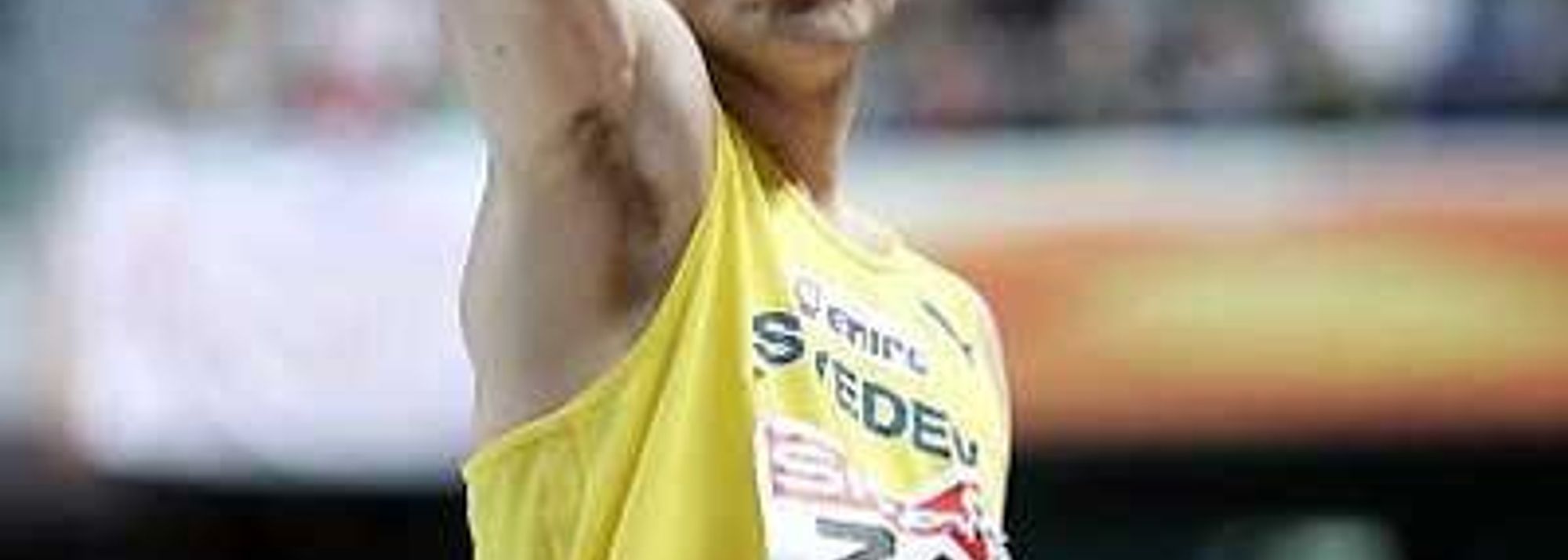


Stefan Holm celebrates - Madrid (© Getty Images)
Madrid, SpainA 2.40m championship record leap for Sweden’s Stefan Holm to win High Jump gold was the undoubted highlight of the men’s competitions on the final evening of what has been an impressive 28th European Indoor Championships in the Spanish capital’s Palacio de Deportes Comunidad de Madrid.
Yet a straw poll of the jubilant Spanish crowd would mostly likely have given that top billing to Joan Lino Martinez whose victory in the Long Jump finally secured the host country’s long awaited gold medal at these championships.
Holm wins historic joust with Rybakov
The men’s High Jump which had attracted ten 2.30m+ season performers as entrants in Madrid, and which yesterday saw all eight finalists qualify at the automatic height of 2.30m, always promised to be one of the standout events of the three days of competition, and tonight it did not disappoint.
The top six places in the final were all secured at a minimum level of 2.30 but with Czech Jaroslav Baba (2.30 4th) and Russian Pavel Fomenko (2.32 PB – bronze) finally out of the competition, we were left to focus on the two main protagonists. Olympic champion Stefan Holm (SWE) and European outdoor gold medallist Yaroslav Rybakov (RUS) had travelled up from 2.20 (Rybakov – entered at 2.24) through to 2.34 together, with first time clearances – 2.24, 2.27, 2.30, 2.32, 2.34 – before Rybakov cleared 2.36, a height which his Swedish opponent passed. With the Russian jumping first each time, they both took 2.38 on their second tries – a new personal best for Holm and equalling the Russian’s recently set national record.
The world had not seen a 2.40m clearance of any kind since 5 August 2000 (Vyacheslav Voronin). Longer still, there had not been an indoor competition at this level since Javier Sotomayor jumped this height on 26 February 1994!
However, such distant statistics were no discouragement to Holm who on his second approach to the bar took 2.40 exceptionally cleanly. Sweden had effectively won gold, for Rybakov who had already failed twice moved for his final effort to 2.42 and failed again. Holm then tempted the crowd with three near efforts at 2.42m which would have equalled the European indoor record.
“I had physical problems one month ago and didn’t know how well I could perform here,” confirmed Holm. “The European Indoor title was the only one lacking for me and now I have it. I’m getting closer to Patrick Sjöberg’s national indoor record of 2.41 and I have broken the championship record of 2.39 which was set back in 1988. This medal is dedicated to my wife and son Melwin.”
Bogdanov subdues early Spanish hopes
Russia’s Dmitriy Bogdanov held on in a desperate sprint battle in the final 50 metres of the men’s 800m to deny Spain’s Antonio Reina and the host country their longed for gold medal. The Russian who is a training partner of Olympic champion Yuriy Borzakovskiy came from behind at the bell to take the title which his colleague had won in 2000.
Despite some rough physical tactics in the first three laps which particularly enveloped France’s Antoine Martiak, The Netherlands’ Arnoud Okken and Britain’s James McIlroy, the race didn’t really develop decisively until the bell sounded when Bogdanov made his move into the lead past Okken and McIlroy, with Reina whose simultaneous attack had been repulsed by the Russian’s move, running in fourth.
Reina fought hard down the back straight to get into a position to attack the Russian and finally moved into second on the final bend. However, despite the loud encouragement of the spectators, as much as Reina gained on Bogdanov, the last few metres still eluded him. Bogdanov crossed first in 1:48.61, ahead of Reina (1:48.76) and his Spanish team mate Juan de Dios Jurado - who had made his own move to get into the lead in lap 3 – fighting through for bronze (1:49.11).
Dashed again
With three home athletes qualified for the men’s 1500m, team tactics were likely to be employed in the hope of denying the World’s fastest man of 2005 the chance of gold. However, Ukraine’s Ivan Heshko was not going to let anyone deter him and he forced himself to the front of the field at the end of the first lap. Essentially that was ‘game-over’ for Spain, as Heshko was never to be headed again, though he was followed doggedly by Arturo Casado and Juan Carlos Higuero, who were later joined in pursuit by Reyes Estevez.
The Ukrainian’s lead grew without challenge and by the finish he had a 10 metres advantage over Higuero who led the Spanish trio home. Heshko’s time of 3:36.70 was a championship record. Higuero took silver with 3:37.98 – his season’s best – with Reyes Estevez just catching Casado on the line to take bronze – 3:38.90 to 3:38.94.
Expectations at last fulfilled
In the very last event to be decided at these European Indoor Championships Spain finally got its victory with a fourth round leap of 8.37m in the Long Jump thanks to former Cuban Joan Lino Martinez. In a low key winter for this event, Martinez’s distance was also a world lead, topping the 8.24 (19 Feb) of France’s Salim Sdiri, an athlete who had failed to reach this final. The performance demoted Romania’s Bogdan Tarus who had led until then with a season’s best of 8.14m. The two men were the only finalists to go over 8 metres. The audience didn’t care. Spain had gold.
Sebrle - the master wins again
With a four second advantage needed in the Heptathlon 1000m by defending champion Roman Sebrle to defeat Russia’s Aleksandr Pogorelov, the event leader after six disciplines, the Czech Olympic champion found his task very straight forward when his opponent lacked energy and stayed at the back throughout the final event.
Sebrle finished the 1000m in fourth place, his time of 2:39.64 giving him 877 points, a huge margin in time and points ahead of Pogorelov (2:56.32 – 701pts) who finished 13th and last. The Russian took silver. In bronze was Austria’s Roland Schwarzl who finished 8th in the race (2:42.76 – 843).
The final Heptathlon points – Sebrle (6232), Pogorelov (6111) and Schwarzl (6064).
It was very close for the next places with fourth taken by The Netherlands’ Chiel Warners (6055) and Hungary’s Attila Zsivoczky in fifth (6024). The Hungarian had been second in the 1000m (2:36.49 – 913), while France’s Nadir El Fassi was first (2:36.31 – 915) – overall 9th (5746).
“When I knew he was so slow (Pogorelov) I decided not to push the race so much (in the 1000m),” confirmed Sebrle. “The mission is fulfilled. I was not focused on these championships and without specific training I was able to win.”
Germany’s ‘Unger for 200m gold is answered
A very evenly contested 200m Final brought gold to Germany from lane six. Tobias Unger, already the continent’s fastest this winter with 20.56 (20 Feb), improved that mark and German record to 20.53, ahead of Britain’s Chris Lambert (20.69 PB) in the next lane inside him, who did his best to close out the stagger. Defending champion Marcin Urbas of Poland took the bronze with 21.04. Following an EAA decision last year this is the final time this distance will be contested at the European Indoor Championships.
Doucouré takes solo win
Three false start disqualifications led to the dismissal of the main opponents of France’s Ladji Doucouré before the Final of the men’s 60m Hurdles properly got away. The French record holder whose 7.43 was the season’s lead had recently been looking for a way to improve his notoriously bad starting technique which had led him into difficulty in the Olympic Final last summer. However, his poor reaction time was probably his saving this evening, as at least he was left to fight for gold when the race got away for real on the fifth time of asking.
Dourcouré’s winning time was 7.50, and from the remains of the depleted field Spain’s Felipe Vivancos (7.61) got the silver, with Sweden’s major championship veteran Robert Kronberg picking up bronze (7.65). But this was an unopposed run by Doucouré who went clear as soon as he got fully into his stride after another sluggish start.
4x400m up roar!
All looked to be going Spain’s way for another medal at these championships until 5 metres before the final change-over of the relay when the runners from France, Poland and Spain collided, and the latter two hit the deck. France was clear in the lead and to the boos of the 9500 packed stadium of mainly Spanish spectators who wished to vent their anger on something, Marc Raquil brought the French home for gold (3:07.90). Poland recovered enough for second but were eventually disqualified for jostling, so letting Britain’s late drive take silver (3:09.53), and Russia the bronze (3:09.63).
Chris Turner for the IAAF

