

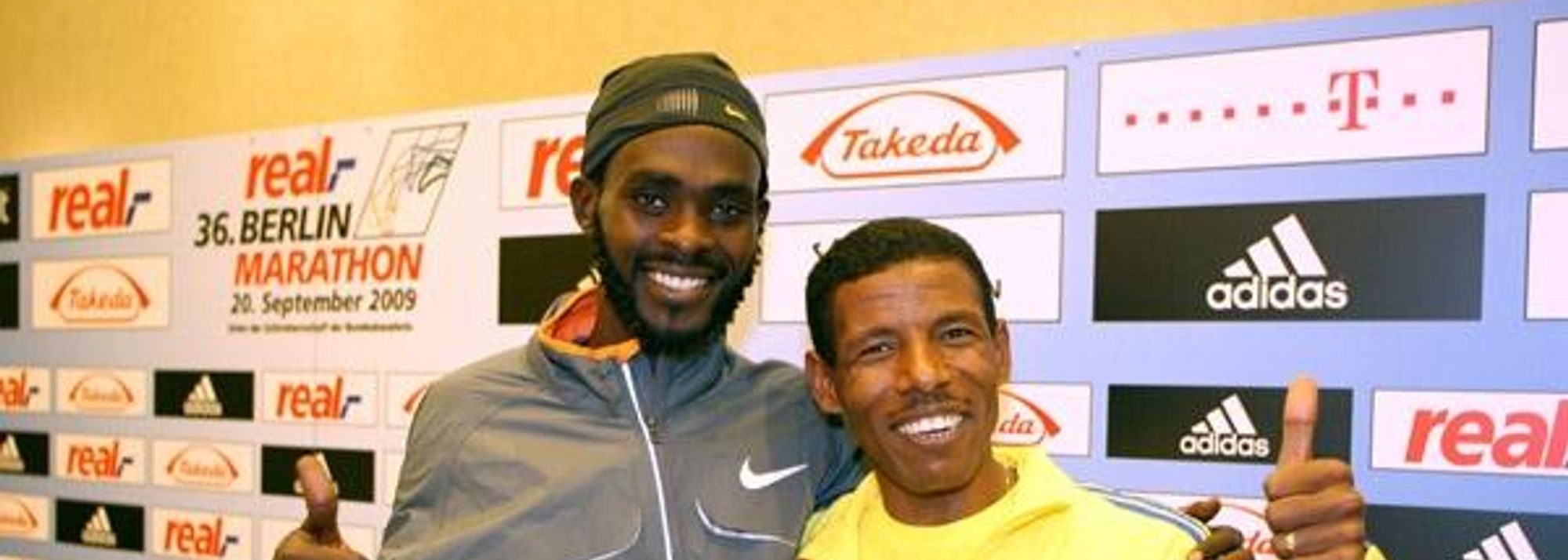


Duncan Kibet with Haile Gebrselassie at the Berlin Marathon press conference (© Victah Sailer)
Berlin, GermanyFor Haile Gebrselassie Sunday’s real,- Berlin Marathon is the real marathon. For the fourth time in a row the great Ethiopian comes to the German capital to run this race.
The real,- Berlin Marathon is an IAAF Gold Label Race and it belongs to the World Marathon Majors (WMM).
“Coming to Berlin almost feels as if it is my own marathon,” explained Gebrselassie during the pre-race press conference in the German capital. On Sunday (20) the 36-year-old could become the first runner to win the biggest and most spectacular German marathon for the fourth time. After his initial success in 2006 he broke World records on Berlin’s superfast course in 2007 (2:04:26) and 2008 (2:03:59).
Having broken 19 official world records plus seven more world bests during his unique career Gebrselassie appeared to be reserved when it came to World record talk during the press conference.
“When you run in Berlin it is always about time, because it is a superb course. And I expect it to be another great and superb race. But you also have to see that winning such a race is a major achievement – a World record is something very special,” explained Gebrselassie, who had started his preparation for Berlin back in June.
However, around ten days ago Gebrselassie had said in an interview: “My aim is to win with a World record. Principally I am in a better shape than last year and also I did not have any problems like last year with my calf.”
The split time goals Haile Gebrselassie mentioned during the press conference clearly indicate that he wants to attack his own World record.
“I want to run the first half not slower than 61:30 minutes. And at the 30 k point I want to be faster than a year ago (note: in 2008 he had reached that point in 1:28:25). Then we will see what will happen on the final 12 k. Of course warm weather would not be helpful,” said Gebrselassie. Weather forecasts currently suggest temperatures of up to 25° Celsius for Sunday, however in the morning it will be relatively cool. So may be the elite runners will be lucky and once more will find good conditions for marathon running in Berlin.
The main topic this year obviously is the much inticipated duel between Gebrselassie and Duncan Kibet (Kenya), who had joined in at the end of the press conference for a photo. There were photo flashes for several minutes – something you probably only had seen in athletics this year, when Usain Bolt had turned up – when the two runners put arms around each other. It was a picture that once more reflected running as a sport people can sympathize with. It is an honour, Kibet had stressed a day earlier, to be able to run against Gebrselassie in Berlin. The Kenyan became the second fastest marathoner ever, when he took the Rotterdam Marathon in April in 2:04:27.
“I can not say beforehand how hard a race this will be,” said Gebrselassie, when he was asked about the duel with Kibet. “Everyone talks about Duncan Kibet – and of course he is a very good and strong athlete. He has surprised me with his great winning time in Rotterdam, though in general I was not surprised that the Kenyans came that close to my record. But there are other runners in this race as well. However we want to provide a great show for the spectators,” said Gebrselassie
“Marathon is something different than other disciplines. It is not so much about your opponents or a certain athlete. You are first of all running against the distance. Before a race of 42 kilometres you will never know what will happen. The distance is your main opponent – it is much harder than any rivals,” said Haile Gebrselassie, who had already raced in Berlin at an Ekiden relay when he was 18 years old back in 1991.
Again during the recent interview he had reflected more on the likely duel with Kibet.
“Of course with Duncan Kibet in the race it will be a big challenge. But also in 2008 there was James Kwambai who was running with me until 34 k. However, if we would still be together at 35 k it might become a tactical race. And we may then miss the World record, unless he is in the shape to break it himself,” Gebrselassie said.
When asked about his training and his mileage he replied: “You can imagine that measuring kilometres in Ethiopia is very complicated. I don’t always run on normal roads or paths. So I don’t know how many kilometres I exactly run each week. But I guess it is between 200 and 240 k. 240 would be my maximum, but many weeks I train about 200 kilometres. My longest single training run was three hours.”
“I have watched the World Championshipson TV at home. A lot of good things have happened there. It was fantastic for Ethiopia to see Kenenisa Bekele win the 5000 and the 10,000 metres.”
“Of course the long distance events were the most important ones for the Ethiopians, but they also watched the 100 metres. Usain Bolt is a miracle. I am not only refering to his results but also how he manages to draw so many people that the stadiums are filled. I wish I could do this. It is very good for our sport of athletics,” said Gebrselassie before adding: “But may be I can say that I draw a lot of spectators to the marathon course.” In fact around one million people are expecting to line the streets of Berlin on Sunday.
Jörg Wenig for the IAAF

