

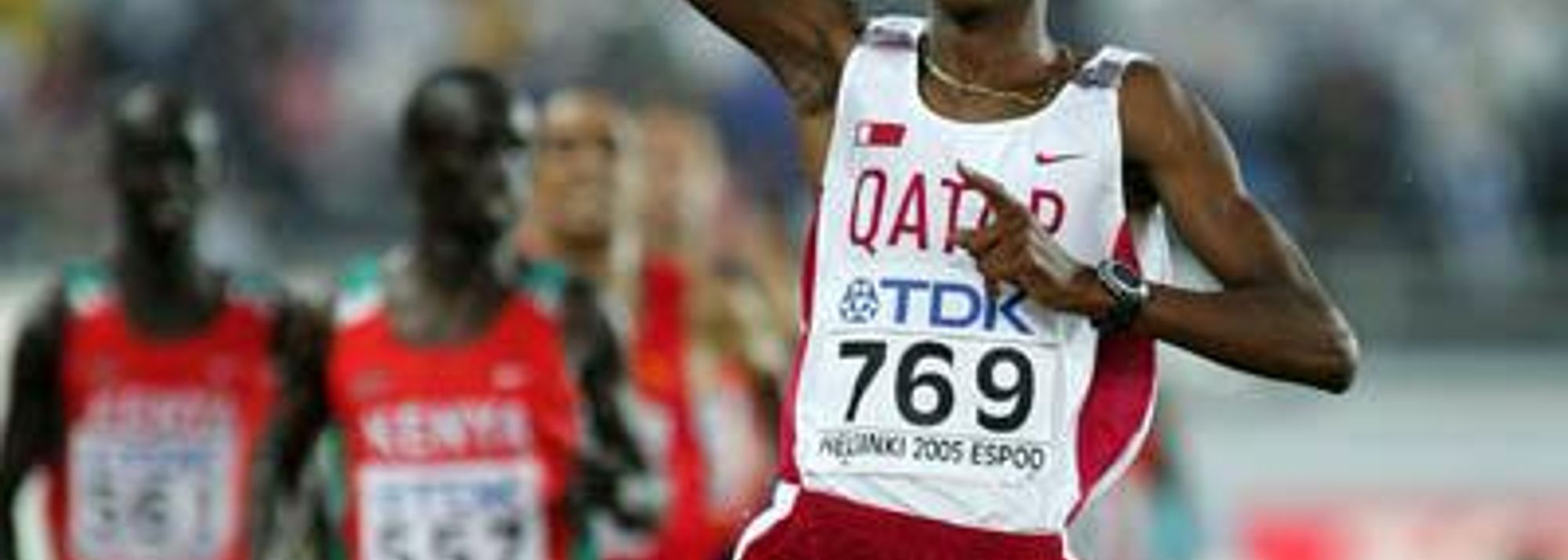


Saif Saaeed Shaheen of Qatar wins the 3000m Steeplechase in Helsinki (© Getty Images)
Facing the possibility of his event being postponed while an horrendous thunderstorm delayed the programme by some two hours, Saif Saaeed Shaheen did what any self respecting athlete attempting to defend a World title would do - he slept inside the call room for forty minutes.
Taking four seconds off his World record is the aim
Shaheen then went out and comfortably beat his Kenyan friends Ezekiel Kemboi the reigning Olympic champion and Brimin Kipruto Olympic silver medallist on the slick track wearing the burgundy and white uniform of his adopted country, Qatar. That he had left it until two laps remaining to tackle the front runners said much about his confidence.
Draped in a Qatari flag the 22-year-old set off on a lap of honour as the rain poured down. A year ago he was prevented from running in the Olympics as the struggle with the Kenyan federation raged on. The victory here was small consolation.
“Well, I knew I didn’t go to the Olympics and so it was a consolation for me,” he would admit later, “When I came here I thought ‘I am not complete I have no Olympic medal’. So when I came here I just wanted to run fast enough to win.”
Shaheen, or Stephen Cherono as his parents back in Iten, Kenya, still call him, put aside plans to double up in the 5000m in Helsinki.
“What made me change my mind was when I saw the weather,” he explained. “Someone told me one month ago that the weather here is not conducive and also I wanted to run fast in Zurich and Brussels. That is why I said this time I am not going to try the double. If I did the double now maybe I would get exhausted.”
In any case he has set himself some more financially rewarding challenge to break his World record in the steeplechase in Brussels. Three times he mentioned the object - 7:49 just in case no one was taking him seriously. What makes him think he can remove four seconds off his own World record?
“The level of training I did,” he replies staring right into his inquisitor’s eyes. “I think I am very sure. Four weeks, one month ago I spoke with the race organiser in Brussels and he assured me that he would look for very, very good pacemakers. That is why I have full confidence.”
From wet training to wet competition
Earlier this year he ran 7:56.34, the year’s fastest time, then insisted on going back to Kenya to train at the camp he has built in Iten. Among the athletes training there are others from his village whom he supports financially. As a matter of interest he also pays his siblings school fees with the money he earns from athletics. The training programme designed by the coach, Renata Canova, was severely affected by inclement weather.
“We were in Kenya all of July,” his coach Renata Canova reveals with a smile. “It was a problem because every day it rained. Everyday. When it rains in Kenya the roads are muddy the tracks also. So it was a very tough period.”
“Every day we would take the car and drive around and find a place where we could find three hundred metres that is dry. It was really bad from a technical point of view. We did everything for losing not for winning. This is the last year I am going to Kenya.”
Concentrating on flat races in 2006
Shaheen is thankful that he still has the choice whether to go back or not. When he switched citizenship two years ago he surrendered his Kenyan passport willingly. But others have not done so causing the Kenyan sports minister to threaten deportation of all those athletes who have changed citizenship. Shaheen calmly explains he did not change for the enormous sums of money that have been bandied about for two years.
Rather, he wanted to ensure that he could go to the World championships and the Olympics without having first to contest the Kenyan national championships. And of course he will receive $1000 a month for life.
Next year he will run only one or two steeplechase races he claims. He will instead concentrate on flat races - 1500m, 3000m and 5000m. Buried by all his steeple success is the fact he has run 5000m in 12:48.81 when he was 20.
“What I am looking for is motivation,” he says. “Sometimes you win, you win, you win and you need something new. The best thing is try something new!”
Paul Gains for the IAAF

