

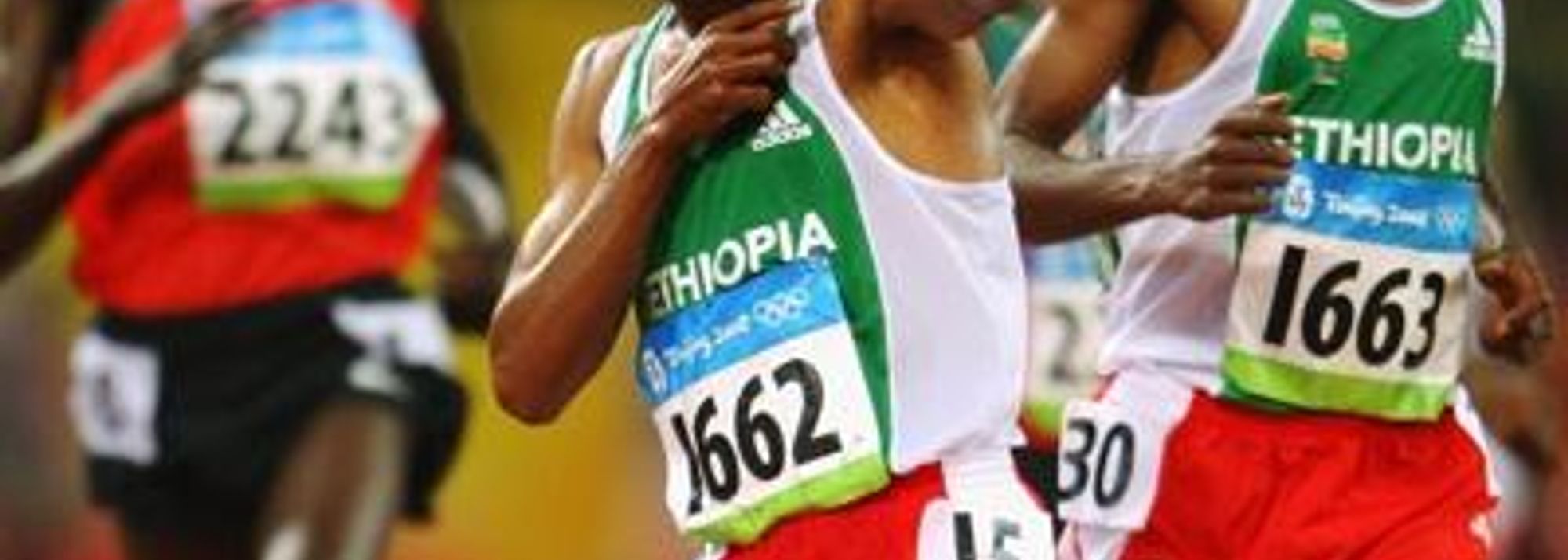


Kenenisa Bekele celebrates his second Olympic 10,000m victory (© Getty Images)
18 August, 2008BeijingIt is one thing trying to follow in the footsteps of Haile Gebrselassie as arguably the greatest distance runner of all time but another entirely seeking to do it with matching personality. Kenenisa Bekele, Gebrselassie’s fellow Ethiopian, took a big step forward in both endeavours last night.
The argument for Bekele as the greatest continues to build. He picked up a second successive Olympic 10,000m title here in the National Stadium to go with his three successive 25-lap wins at the World Championships and record 12 individual World Cross Country gold medals.
The fourth man to have won back to back Olympic 10,000m titles, Bekele succeeds Emil Zatopek (1948/52), Lasse Viren (1972/76) and Gebrselassie (1996/2000). But he can be the first to win three at the 2012 London Olympics and don’t think he will be bored by then.
Still only 26 – and with another nine years ahead if he continues to the age at which Gebrselassie is still breaking records now – Bekele left nobody in doubt after his latest victory that his appetite is as hungry as ever.
“For the future, I want to have many, many Olympic golds, many World Championship golds,” Bekele said. “I want to continue to make history for myself and for my country.”
So far as the personality part is concerned, it was significant that Bekele gave his post-race press conference in English, rather than his native tongue. Even as recently as after his record sixth classic distance race victory at the World Cross Country Championships, in Edinburgh, in March, he used a translator.
Now, on the biggest stage of all, Bekele showed a willingness to express himself in the sport’s first language and did so all through with an engaging smile. Part of the Gebrselassie success story was in him recognising long ago that his value to sponsors, to the media, and to the sport in general, would be raised significantly if he could speak English. Soon he was fluent.
Gebrselassie has gone on to be World record holder in the Marathon, a distance which Bekele will get round to one day. Yet still the great pioneer, Gebrselassie, returned to the track at the age of 35 to play his part and take sixth place. Where there was once a finishing sprint, now there is only marathon runner’s legs and he missed out on a medal.
With the greatest respect he has for Gebrselassie, Bekele said of his effort: “I think it is not a bad result for him. He came from the Marathon. He is the best in the Marathon so it is not easy for him to run against 10,000m runners.” Gebrselassie has chosen to miss the Olympic Marathon for fear of the smog and humidity.
Gebrselassie never won a World Cross Country title so that is one area in which Bekele clearly outranks him. And, having won Olympic 10,000m golds in 1996 and 2000, Gebrselassie was fifth in 2004. So that is another department in which Bekele seems now to have an excellent chance of outstripping him. Furthermore, here on Saturday, he can succeed in another category in which Gebrselassie failed to score.
Although Gebrselassie won two Olympic and four successive World 10,000m titles, all between 1993 and 2000, he never won a 5000m gold medal. Bekele hasn’t won one either yet, although he came close in Athens 2004 when, in a battle between two men seeking a second gold medal of those Games, Hicham El Guerrouj, the 1500m champion, narrowly got the better of him.
With each championships that passes, Bekele’s statistics need updating. He is the only man to do the World Cross Country long and short course double and he did it five times. When he passed John Ngugi and Paul Tergat to become sole owner of a record six classic distance triumphs in Edinburgh it was probably his finest achievement.
Bekele’s triumph in Edinburgh closed the saddest chapter of his life. He celebrated victory in the presence of his wife of four months, Danawit Gebregziabher, an Ethiopian movie actress, in marked contrast to the tragic circumstances surrounding his 2005 victory in St Etienne/St Galmier, France.
It came two months after the death of his fiancée, Alem Techale, while the pair were out on a training run. The subject still comes up at press conferences and last night was no different. Had he considered giving up after she died, he was asked. “I can’t give up running because running is my talent, my gift, my job.”
Well said young man. Well said in English.
David Powell for the IAAF


