

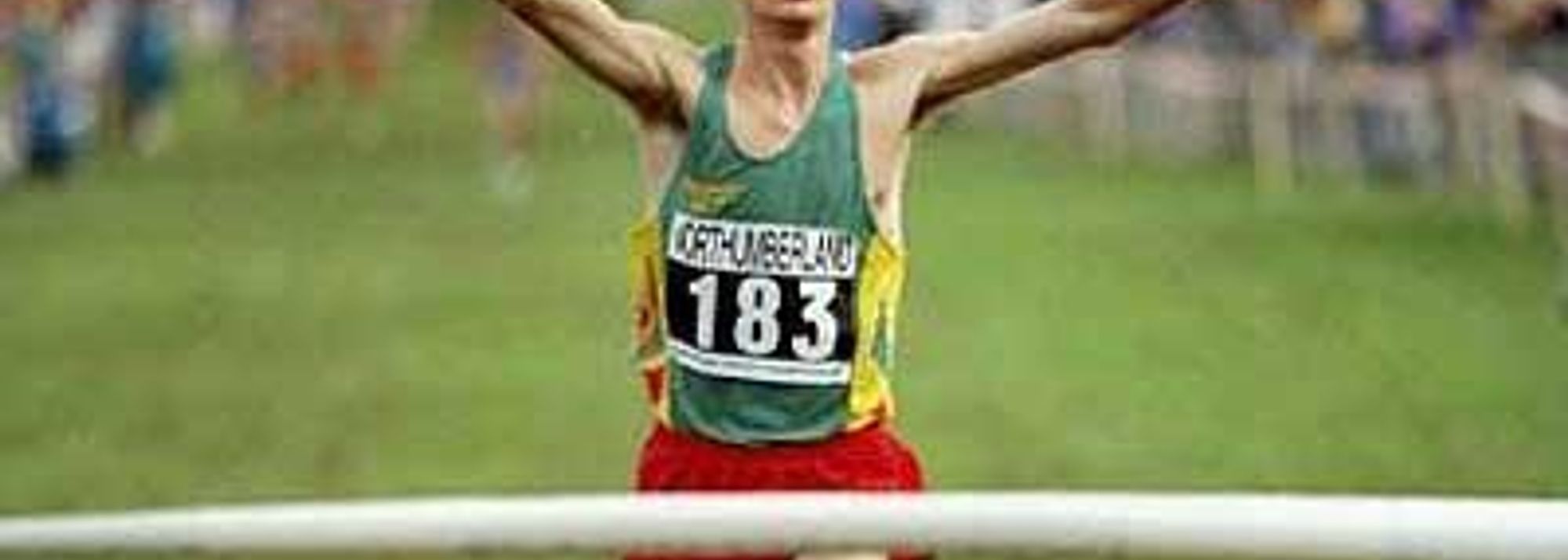


Paulo Guerra (POR) wins the inaugural European Cross Country men's title in 1994 (© Getty Images)
Edinburgh, UKWhen you consider that one leading runner in the international cross-country championship once ripped his shorts so badly that he was arrested for indecency, it perhaps explains why barbed-wire fences are no longer fashionable in races!
Much more has changed since the early days of the sport, but now cross-country is going home. Perhaps not to wire fences, gates, and hurdles, but at least to the land where it all began a century ago, and a course as tough and demanding as it now gets in modern cross-country running.
100 years of the cross
The tenth Spar European Cross Country Championships are being staged in Edinburgh this weekend (14 December), finally taking the sport home after 100 years.
The event is in Scotland to mark the centenary of the first international championships, in 1903. These were held over Hamilton racecourse and the adjoining grounds of the palace of the Duke of Hamilton. Alfred Shrubb, the world’s leading endurance runner of his day, led England to a convincing team victory ahead of Ireland, Scotland, and Wales.
Shrubb’s ability was evident five years earlier when he is said to have beaten a fire appliance to a blaze. He retained the title in 1904 and during his career broke every world record from 2000 yards to one hour. Some of them survived until Finland’s Paavo Nurmi attacked them in the 1920s. By then Shrubb had long since been banned by the Amateur Athletic Association for having claimed and received inflated expenses.
Shrubb was one of those who said the international race be made annual. A vote was taken in the train returning from that very first run at Hamilton. France joined in 1907, Belgium in 1923, and Italy, Luxembourg, Spain, and Switzerland in 1929, Holland in 1950, and Yugoslavia in 1953. The first non-European country was Tunisia, in 1958; New Zealand were first from Oceania, in 1965; and the USA followed a year later.
Global champs since 1973…European since 1994
The sport became truly global only after the IAAF took over the organisation in 1973. Just 21 countries took part then, but a record 76 nations ran in 2000.
The European Athletic Association launched their event in 1994, acknowledging that African domination was becoming a disincentive on the continent which had given birth to and nurtured cross-country.
Offal and author
To mark the 100-year link the European Championships are being held on Sunday (14 December) in the shadow of Holyrood Palace, royal residence in Scotland of Elizabeth II. The course lies adjacent to a small loch, or lake, in the park where the kings of Scotland used to hunt deer. Those caught poaching the royal stags were hanged.
The park lies around Arthur’s Seat, an extinct volcano upon which Italy won the 1995 World Mountain Running Trophy. Only one of the smaller hills in the park, Haggis Knowe, features on the cross-country course. Visitors need not search for the mythical beastie. The hill is simply shaped like a haggis, and it is a reasonable bet that competitors will not be sampling the Scottish national delicacy which is a large savoury pudding made of oatmeal and sheeps’ offal. Or at least not until after the race!
The venue for Sunday’s championships has an even longer cross-country tradition than Hamilton racecourse, leaving aside those running for their lives to escape the lethal wrath of guardians of the royal venison. Students of Edinburgh University used to race and train in Holyrood Parl, and in 1871 cross-country was facing it’s first participation crisis. Scottish author Robert Louis Stevenson (author of Dr Jekyll and Mr Hyde, Treasure Island, Kidnapped, etc) lamented in the student magazine of that year, that: “no more does the merry medical student run eagerly in the clear wintry morning up the rugged sides of Arthurs Seat.”
Indecent exposure
It was a Scot, also, who featured in perhaps the most remarkable international race in the history of the sport. George Wallach held a clear lead as he approached the finish of the 1910 international championship in Belvoir Park, Belfast. He had an even more obvious tear in his white shorts, having ripped them on a barbed wire fence. A police officer leapt from the crowd and physically tackled him, arresting him for indecent exposure. He was not permitted to finish.
Sergiy Lebid, of Ukraine, defending his title this Sunday against four-times winner Paulo Guerra of Portugal, need not worry. There are no fences or wire at Holyrood.
Wallach ran 10 times in the international either side of the Great War, winning silver and bronze in a career which lasted 14 years, but never took the title.
Frenchman Jean Bouin, runner-up to Nurmi for Olympic 10,000m gold in 1920, was first to win three in a row (1911 - 13). England’s Jack Holden was next to do so, and took a fourth in 1939. He became Empire and then European Marathon champion aged 43 in 1950, and among British runners his six senior world individual medals is matched only by another marathoner, Paula Radcliffe.
Women’s races have arrived late
Radcliffe is a former winner of the World and European titles, but women¹s cross-country has a far shorter history than men’s. Four women’s races were staged in the 1930s, four in the 1950s, all unofficial international championships. They have been staged officially and annually only from 1967 at world level. Gladys Lunn, of England won the first, in 1931, and Diane Leather, who was first woman to go under five minutes for the mile, took the last unofficial event in 1957. Doris Brown, of the USA, then won four in a row. In the last of those years, 1970, a rival event was staged, and won by Italy¹s Paolo Pigni.
The European event has been held annually since 1994, with four individual and team events taking place for senior and junior men and women (juniors since 1997). The first senior individual winners were Paulo Guerra of Portugal in the men's and Ireland's Catherina McKiernan in the women's categories.
This year in Edinburgh Paula Radcliffe, queen of UK athletics, who won the European title in 1998, hopes to help crown her country senior women's team champions. Britain has won every other team title at least once, but never the women's one.


