

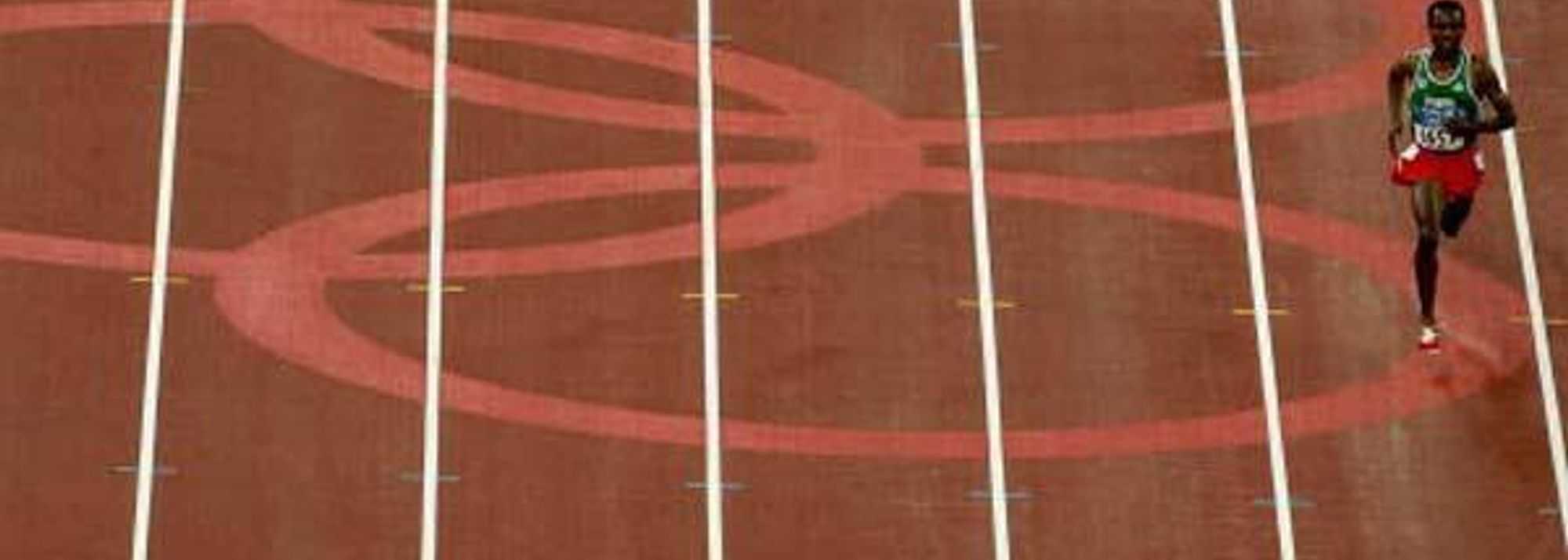


Kenenisa Bekele in Athens - the newly crowned Olympic 10,000m champion (© Getty Images)
When Olympic 10,000m champion Kenenisa Bekele was officially proclaimed as the IAAF World Athlete of the Year for 2004, it confirmed the Ethiopian’s reputation as the planet’s best Athlete. But as the 22-year old tells Elshadai Negash, the award and his outstanding year are just beginning of bigger achievements to come.
Kenenisa Bekele has won many races, obliterated records, and recorded astonishing feats in his relatively short career, but when he walked from his seat at the Grimaldi Forum in Monaco to receive his World Athlete of the Year award, he instantly knew that this was something very different from what he had already stacked in his medal and trophy cabinet back home in Addis Ababa.
For one thing, this award was a bronze statue, not a medal or a trophy that he was used to.
“To win this award, I knew that I had to stand out against the best of the best in Athletics and not just long distance running,” he says. “I am happy to have won it and it is a big encouragement to try and achieve better results in the coming years.”
It was the ultimate prize for an Athlete who had come close to win this award on two previous occasions. As a 19-year old in 2002, Bekele arrived on the world stage by winning his first World Cross Country double in Dublin, but his chances of winning the award were dampened when his entire track season was wiped out due to an Achilles heel injury.
Last year, Bekele won his first 10,000m World title in Paris in August to add to another World Cross Country double in Lausanne, Switzerland months earlier, but he had to settle for third place in the award behind Moroccan Hicham El Guerrouj and Qatar’s Saif-Saaeed Shaheen.
This year, however, Bekele has been in a class of his own. Apart from defeat to Hicham El Guerrouj in the Olympic 5000m final, Bekele has been unstoppable achieving ‘impossible feats’ and for the first time in his career breaking records.
“This year has been great starting from the indoor season to the Olympics,” he says. “Some of it was difficult, but overall it was quite satisfying.”
It was not that Bekele had been overwhelmed by his rivals in previous years. In 2004, Bekele truly came of age with equal success in all categories of long distance running i.e. indoor, outdoor, and cross country.
The Bekoji-born star might have started 2004 as the World 10,000m and the All-African Games 5000m champion, but he had to learn the tricks of running indoors. Before January 31, Bekele had never run an indoor race, but his first season under closed roofs could have gone better.
He made his debut in Stuttgart taking the 3000m in a season’s leading 7:30.77 and has fond memories of his first experience. “Since it was my first time indoors, I was happy with the time I ran [7:30.77 for the 3000m]. The surface was different, the atmosphere was different and I had to adapt to that quickly.”
It was also in Stuttgart that he learned his first major lesson in indoor running. “Normally, I would be satisfied with a win, but I learned that indoor running was not about winning,” he recalls. “Unless you run really exceptional times, you cannot be praised. It is all about fast time and records, not only about winning.”
If indoor performances could be graded, then Bekele learned his lessons and passed his final exam on February 20 in Birmingham with an A+. In his first ever 5000m indoor race, he ran 12:49.60 to take just over a second off Haile Gebrselassie’s World record time to open his own account of World records.
“It was my first record and it felt like very good,” he remembers. “I was happy because some people had said that I am only a racer who is not capable of breaking records. I was happy to have proven people wrong.”
And proving his doubters wrong is what Bekele seems to do best. A month later, he confirmed his billing as the ‘Undisputed King of the Cross Country’ winning his third short and long course double at the 32nd IAAF World Cross Country Championships in Brussels, Belgium.
“I had not really intended to run both races again,” he confesses. “But when I knew that it was something that no one had ever done, I wanted to see how hard it really was.”
His achievement was such that compatriot Gebre-egziabher Gebremariam’s double silver over the race weekend in Brussels hardly got a mention. “I would like to apologize to Gebre,” he laughs.
In each of the three previous editions of the championships, Bekele had come up against quality opposition like Kenyans Charles Kamathi (2001 World 10,000m champion), Jon Kibowen (2001 World Cross Country champion); and Sammy Korir (2002 Commonwealth 10,000m champion), but all of them were reduced to also-runs as he surged to the top of the all-time cross country legends list ahead of the Kenyan duo of Paul Tergat and Paul Ngugi.
Tergat needed six years to win his 14 medals, while Bekele needed only four to achieve 16.
After successful indoor and cross country seasons, Bekele made a smooth transition to the track in May breaking the Addis Ababa stadium record to take the 5000m title at the Ethiopian Championships. His time of 13:34.10 was respectable given scorching temperatures of 28°C and an altitude of 2400m above sea level, but most importantly Bekele sounded the most serious warning of what was to come later in the summer.
“I am now ready to try and break the 5000m World record in Hengelo in two weeks,” confirmed the young man who had run alone for the last two laps to slash a massive five seconds off the previous best time set by Sileshi Sihine a year earlier.
And he was true to his word. With the reigning World record holder Haile Gebrselassie and others looking on, Bekele sliced two seconds off his mentor’s World record time in Hengelo. Eight days later in Ostrava, Czech Republic, he again took two seconds off the 10,000m World record (also previously held by Gebrselassie) stopping the clock at 26:20.31.
After winning a 3000m race in Gateshead, England in July, Bekele returned to Addis Ababa to fully concentrate on preparing for the Athens Olympics a month later and already the big question was whether Ethiopia’s most coveted youngster would try and emulate his compatriot Miruts Yifter’s achievements in winning the 5000m and 10,000m double in Athens.
“Originally, I did not want to run both races and although I still do not know why, the Federation wanted me to run either only the 5000m race or both,” he says.
Bekele’s double attempt was now fast becoming a National issue and the pressure came from all sides. “We discussed a lot with the Federation and it was finally decided that I should run both races,” he says.
In Athens, Bekele’s race plan for the 10,000m went according to the script as he won the title in an Olympic record time of 27:05.15, but the 22-year old flew directly into Ethiopian hearts when he slowed down the pace to wait for Haile Gebrselassie, who was struggling several metres back clearly feeling the effects of the Achilles heel injury that had threatened his participation at the Games.
“I lost nothing by waiting for Haile [Gebrselassie],” he says. “I always wanted to win gold and that was what I got. But also, I believe that teamwork is necessary and I could not simply leave him struggling like that. My heart would not let me.”
Depending on which context one chooses to look at it, Bekele’s gesture can be translated as either a selfless good deed or a suicidal act equivalent to shooting oneself on the head, although Bekele disagrees with both.
“It was too early in the race and I knew that no-one in the field could do anything at that time,” he says. “It would be impossible for someone to kick furiously before the race reached midway. But the truth is that we were running together and our race plan was to get all three positions on the medal table.”
With mission number one executed efficiently, the world was now expecting Bekele to take the win the 5000m, but he knew that he had to get passed a world class field including Morocco’s 1500m Olympic champion Hicham El Guerrouj and Kenya’s reigning World champion Eliud Kipchoge. But Bekele fell to the power of the Moroccan who won his second gold of the Games after going after one for eight years.
Although he was disappointed by the outcome, Bekele says that he has learnt a lot from his first Olympic double attempt.
“Before the start of the race, I was not 100% confident of winning the 5000m race,” he says. “The most important lesson I got from Athens was never to try something I am not completely confident of achieving.”
At just 22, Bekele came away with gold and silver in his first appearance at the World’s showpiece event, but he has learned many more valuable lessons.
“The only thing that makes the Olympics different is the fact that it comes once every four years,” says Bekele. “Other than that, each event is just another race and I was wrong to think that it was a matter of life and death just like everyone wanted to make me believe.”
In terms of the end product, however, his races in Athens 2004 have been more than any two typical contests for Bekele. Just like Haile Gebrselassie in the 1990s, the name Kenenisa Bekele is now a synonym of success and Ethiopians everywhere recognize that the future of distance running is already here.
“Everywhere I go people stare at me and tell me how much they admire me,” he proudly says. “Sometimes it is difficult to entertain everyone’s wishes, but I try my best.”
When he was only 14, Bekele saw Ethiopia’s distance running legend Haile Gebrselassie and became inspired to take up the sport, but now he is finding himself feeling Geb’s shoes as “The Emperor” edges closer to the end of his career.
And Bekele is aware that he can use his influence for the betterment of society as a whole. Recently, he has graciously accepted the role as the Goodwill Ambassador for the United Nations Children’s Fund (UNICEF), a title he says he has earned only through his achievements in Athletics.
However, Bekele says that he will only be the true Ambassador and champion of such a cause when he starts to show the same courage and passion he has exhibited on the track to give hope to orphans and vulnerable children.
“When they [orphans and vulnerable children] hear encouraging words from me, it gives them hope that they can make a difference in their lives,” he says. “It is necessary to advise them, so that they don’t look after other people’s help. I want to share with them my experiences and advise them to be able to give them hope and courage to fight life’s battles on their own.”
It has been a successful year for Bekele in all aspects and his love life was given a big boost also this year when his fiancée of the last two years, reigning World youth 1500m champion Alem Teshale, agreed to his proposal of marriage.
“I will be married in April 2005,” says a delighted Bekele. “I think that marriage is a big commitment and I have chosen to take that big step sooner rather than later.”
Unlike Bekele, Teshale was forced to seat out much of the 2004 season with injury, but will she be his training partner in 2005? “I really don’t know yet,” confesses Bekele.
But when asked whether he intends for her to retire after marriage in order to stay home and watch after their house and future children, Bekele’s voice takes a different tone.
“By all means, no,” he says. “We have not discussed anything about children yet, but I don’t want her to be my housewife. I want her to be in the public and run for her country and make a name for herself.”
There is also a lot to look forward to for the Bekele family in the coming season with younger brother Tariku, who is the World junior 5000m bronze medallist, soundly progressing through the ranks smoothly. The 17-year old won his first race outside Ethiopia in September in Rovereto, Italy, but Kenenisa remains cautious about his brother’s prospects.
“I really cannot say except wish that he would run against me someday,” he says with a wide grin. “He might not be strong enough now to challenge me or the other big athletes, but I am sure he will get there.”
Bekele has won so much in his young age that he keeps guessing what more could he want from his Athletic career. But Bekele says that he is refusing to seat on his laurels.
“This is only the start and I want to run many more races and break as many records as I can,” he says.
“I think running is like any profession. People become doctors or teachers or have other professions and just because a doctor saves one patient or a teacher helps his students graduate, they will not stop working. Running is the same. I want to run at the top level for as many years as I can. As long as I am able to do that, I will continue.”
Now that he has reached the top, Bekele says that he is motivated to stay there. “The most important thing now is to maintain consistency,” he says. “It has been difficult to reach the top, but I want to continue to remain there until the next Olympics.”
And considering that he has been a man of his word until now, there is little doubt that he will continue to set the standards for years to come!
Published in IAAF Magazine Issue 4 - 2004