

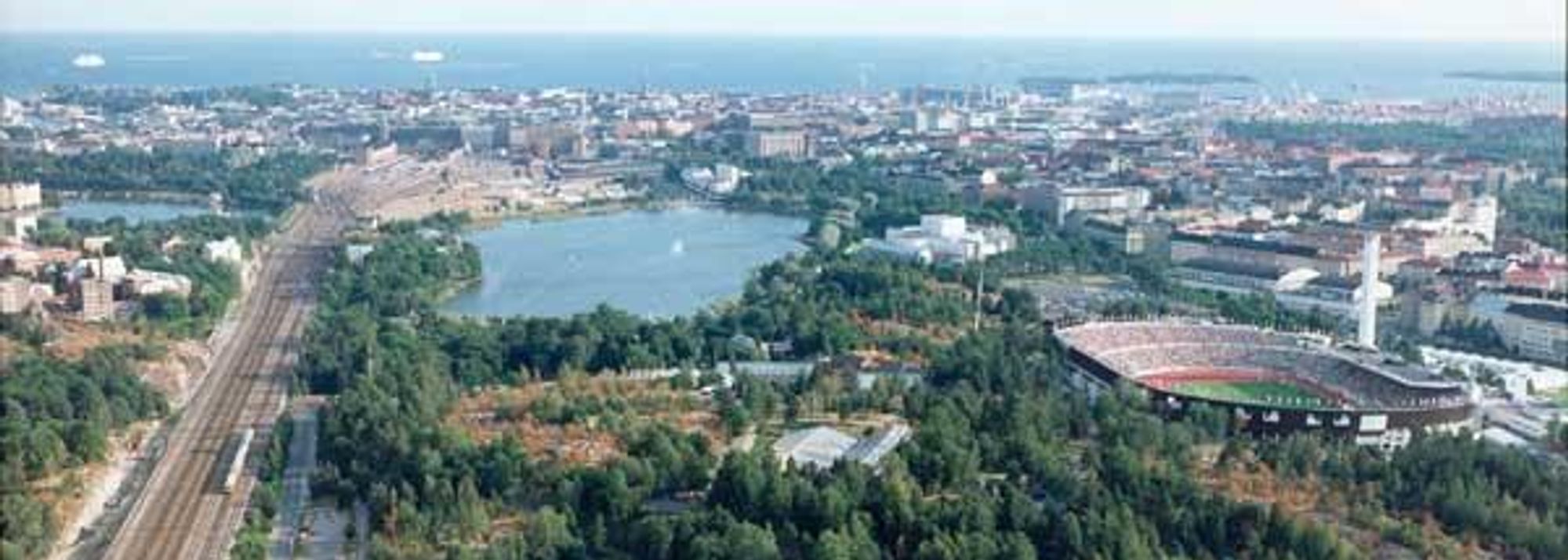


Eläintarha Sport Ground, Helsinki - foreground, with the 1952 Olympic Stadium seen in the background (right) (© SUL)
It is just a warmup track nowadays. Yet over a dozen World records were set in this stadium, most famous of which being Paavo Nurmi’s 1500m and 5000m double on the same afternoon of 19 June 1924, with just a 50 minute rest in between races.
A short stroll back in time
On a short walk northwards from Helsinki’s city centre, once reaching the Olympic stadium take a stroll around the left side which houses the National Sports Museum, and you come to the arena’s athletes entrance. Walk another 30 metres and you come to the beginning of a tree lined roadway which intersects a large outcrop of granite rock. This is one of many small picturesque wood covered hills which divide the city.
Hidden from view at the left-hand-side of the road, only the most observant on a quiet non-competition day will spot a large door which opens to reveal the mouth of a wide tunnel (about a car’s width). Enter this cavern and continue your amble for a couple of minutes more and you come as close to stepping back into athletics history as is possible.
Lying unseen little more than a few 100 metres on the other side of the hillock into which this underground path opens out is a glade in which you’ll find the Eläintarha (Zoological Gardens) Sports Ground.
It is a small unassuming stadium ringed by birch and pine trees and a perimeter fence made of the same materials. Built alongside the finishing straight is a small wooden spectator stand and a pavilion, both of early 20th century construction, next to which stands a more utilitarian club house built in more recent years. Except for the synthetic track and a line of modern changing rooms which have been erected to the rear of these three buildings, in all other respects Eläintarha has been unaltered by time.
A dozen World records
Yet in its heyday, before a bigger temple to sport was built near by to the south, a dozen or more World records were established within it’s pine confines, boasting the names of such athletics gods as Paavo Nurmi, Ville Ritola and Matti Jarvinen.
39 ratified World records have been set in the Finnish capital since the establishment of the IAAF, and of these marks over a dozen have been carved out at Eläintarha. As well as Nurmi’s famous double which he undertook in preparation for that summer’s Paris Olympics, the stadium among many other accomplishments also witnessed World records from Ville Ritola (10,000m - 1924), Lauri Lehtinen (5000m - 1932) and Matti Järvinen (Javelin - 1936).
Yet since the inauguration of the Olympic stadium on 12 June 1938 Eläintarha has served as merely the warm-up track for its bigger cousin at so many famous sporting events, such as the 1952 Olympics, the inaugural World Championships in Athletics in 1983, and two European Championships (1971 & 1994).
Olympic champions aplenty
Eläintarha remains the home track of the capital’s most famous athletics club Helsingin Kisa-Veikot which was founded 95 years ago. Many world class athletes have graced the club’s entirely white strip including – albeit for some, not for the entirety of their careers - Olympic champions such as Hannes Kolehmainen, Armas Taipale, Albin Stenroos, Elmer Niklander, Toivo Loukola, Volmari Iso-Hollo and Matti Järvinen. The most recent club member to strike Olympic gold was javelin thrower Arto Harkonen in 1984.
But perhaps the most legendary of all the names is Taisto Mäki. He established six World records including two at 10,000m, the latter of which made him the world’s first sub-30min runner in history. Mäki, the 1938 European 5000m champion was never able to test his mettle in Olympic competition as WWII intervened, leading to the cancellation of the 1940 Helsinki Games.
Mäki was a child of the new Olympic stadium generation of club members, with all his major successes played out a few 100 metres away, but he did appropriately play a major role in the hurrah of Eläintarha’s last World record. On 28 August 1937, America’s Archie San Romani Sr. established a World 2000m record (5:18.8), with Mäki finishing just under two seconds adrift in second place.
Today when we speak of the Helsinki stadium we think just of the Olympic venue which of course has 23 ratified World record marks of its own to boast about. The clearly lined functionalistic style of the stadium - which once could seat over 70,000 spectators but has a smaller capacity of 40,000 these days - that Yrjö Lindegen and Toivo Jäntti designed with its distinctive 72 metre tower is rightly famous worldwide.
But athletes, officials, media and spectators who visit the Olympic stadium for next summer’s 10th IAAF World Championships in Athletics should, even if they can’t make their own pilgrimage to Eläintarha, at least spare a thought for that older temple to our sport which is but a javelin’s throw, or two, away.
Chris Turner
IAAF Editorial Manager


