

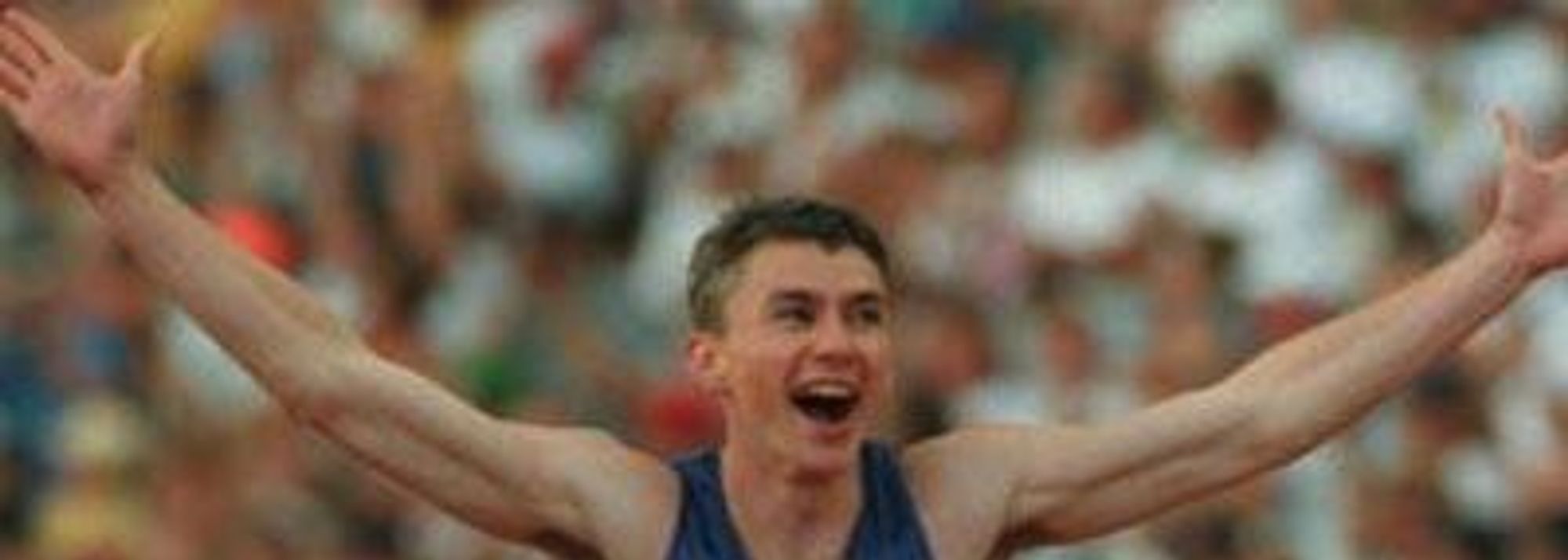


Jonathan Edwards celebrates his world record jump in Gothenburg 1995 (© Getty Images)
If faith can carry the devout upon wings of eagles, then Jonathan Edwards may yet soar to the Triple Jump title at the ninth World Championships in Athletics, Paris 2003 Saint-Denis in the Stade de France.
If that looks improbable, given the manner in which he limped through qualifying here for Sunday's final with 16.94m, even qualification is a feat which seemed beyond mortal flesh when he was carried, apparently crippled and on a stretcher, from the arena two weeks ago in the London Grand Prix.
Interpreting his dramatic recovery from an ankle injury as a miracle and a message from God, the 37-year-old Edwards nevertheless, said with profound emotion that these championships mark the last event of arguably the most remarkable career among British athletes.
The reigning World Triple Jump champion and World record-holder had intended defending his Olympic title next year in Athens, but thought his career was over.
"I use the word advisedly, but a miracle has taken place," he said. "Something amazing has happened, as I should not be here."
Faith appears to have made Edwards whole. Those of a religious disposition might be forgiven for feeling divine purpose is at work. Who can truly say? The Lord giveth, and the Lord taketh away.
For years Edwards avoided Sunday competition, believing it was an affront to God. Then, given a dream of the runway clearing, he was persuaded otherwise.
And so a jumper of modest talents was transformed. He secured two firsts, a second, and a two thirds during five successive World championships, plus Olympic gold and a World record of 18.29 metres (exactly 60 feet). He also jumped 18.43m with wind assistance. It was prodigy to match that of the 1968 US Olympic long jumper, Bob Beamon, and the fruits of Edwards' efforts could last even longer.
Edwards first took the World record with 17.98m in Salamanca in 1995. He completed the European indoor and outdoor double in 1998, won the Commonwealth title last year, but never the world indoor. Third this year in Birmingham was the closest he came, but he won the World Cup twice and the European Cup six times.
Of the 10 men to have gone 17.85m or better (a total of 19 jumps), Edwards has eight. Of the six beyond Willie Banks' 1985 world best of 17.97m, Edwards owns five. Only Kenny Harrison, in winning Olympic gold in Atlanta, has gone over 18.00m without wind assistance. Edwards lost to American Harrison in 1996 with 17.88m, the furthest losing distance ever.
Edwards had choked with emotion and was forced to brush away tears when he revealed his retirement decision at a team press conference in the prosaic surroundings of a student commonroom at the athletes' village in the City University of Paris (22 Aug).
The Scottish 400m runner Lee McConnell, sitting next to him, was also overcome by the occasion. "It was amazingly moving," she said. "I was quite upset."
A devout Christian, Edwards quoted from the Bible. Proverbs chapter 16, verse 9: "'A man's heart deviseth his way, but the Lord directeth his step.'" He believed God had directed his path off the triple jump track at Crystal Palace two weeks earlier, and that it signified the end of his career.
"I thought I'd broken my ankle, or ruptured ligaments at the very least. If the end of my career was to be on a stretcher, then so be it. It would not have haunted me for the rest of life, but God has allowed me to make a measured decision in the cold light of day."
"As I lay in the pit I thought I had broken my ankle or ruptured my ligaments at the very least. I could not have walked off if I'd wanted to."
"I was getting quite emotional, but I'd a wry smile on my face that I was going to end my career on a stretcher."
"My ankle went completely over. I was on crutches when I got back to Newcastle. I was walking gingerly without crutches on the Sunday, and doing drills at the stadium on Monday. It should not have happened."He said his coach, Norman Anderson, "who is no believer, certainly thinks it's a miracle. I feel I have been given the opportunity to announce my retirement in a calm, measured way, with a certain amount of dignity, I hope."
He had announced his decision before the event because he: "did not want to be reactive, responding to defeat, or injury."
He acknowledged a historic precedent in this city. Paris was the venue, 79 years ago, at the last global outdoor athletics event staged here, for a devinely-inspired sporting triumph of faith, when Scotland's Eric Liddell won Olympic gold. He switched to the 400m because he believed God did not wish him to run the 100m which was to be run on the Sunday.
His feat inspired the Oscar-winning film, Chariots of Fire.
Edwards recalled how, before he raced, a supporter had handed Liddell a text from the first book of Samuel, 2:30 - "'Them that honour me, him I will honour.' "That could be an inspiration," he said.
A casual glance at the library shelves immediately beside Edwards as he spoke, proved spookily hair-tingling. The books, in order, were several volumes of "Spirit", "Today, history,", a row of volumes entitled, "The History of the Church," and finally, several volumes: "Great Dynasties of Europe."
Edwards has been the greatest exponent of the triple jump, pushing the marker where no mortal had the right to expect to go. An ordinary man transformed from a a 12.65m jumper in 1981 to 17.43 in 1991, and finally a full metre further in his annus mirabillis of 1995. Yet 1981 was his only other season over 18.00, with 18.01m.
Sweden's Christian Olsson, who as a 15-year-old programme-seller watched as the Englishman broke the World record in Gothenburg, is marked by Edwards himself as his successor. Olsson, leading qualifier on 17.56m remains the likely winner, though Edwards pointed out that even without injury, he himself could well finish down the field. He is only third best in the world this year, at 17.61 metres.
Romanian world number three, Marian Oprea failed to qualify as did European under-23 champion Dmitriy Valukevich (Belarus), and Walter Davis (US).
The three Cubans, David Giralt (17.31), Yoandri Betanzos (17.26) and Yoelbi Quesada (16.97), fill the next three qaulifying places behind Olsson.
"It's sad Jonathan is ending his career," said Olsson. "I am very honoured that he has said I am the one to take over from him, though I would have been surprised had he not mentioned me. I'm glad Jonathan is in Paris, because it will make the competition better."
Edwards said: "If my ankle holds out, I'm capable of jumping a long way. It's only five or six weeks ago that I jumped 18 metres in my first competition, even though it was a slight foul.
"There is a risk to my ankle, and I don't want to hobble out. I hope that will not happen, but I won't be thinking this is my last competition. I'll go out there as a competitor, and won't retire until it's finished."
Following on the heels of the retirement of the World 110m hurdles record-holder, Colin Jackson, and with the imminent departure of four-times European champion and former world record-holder Steve Backley, this very much marks the end of an era of unprecedented British achievement.
It was touching that in evaluating the great memories of his career, that Edwards should include his days as an 18-year-old at a school camp at West Buckland: "fantastic."
Fun and enjoyment have always been his goal. Now he just prays for one last leap of faith . . . three steps to heaven, and an eternity of retirement.


