

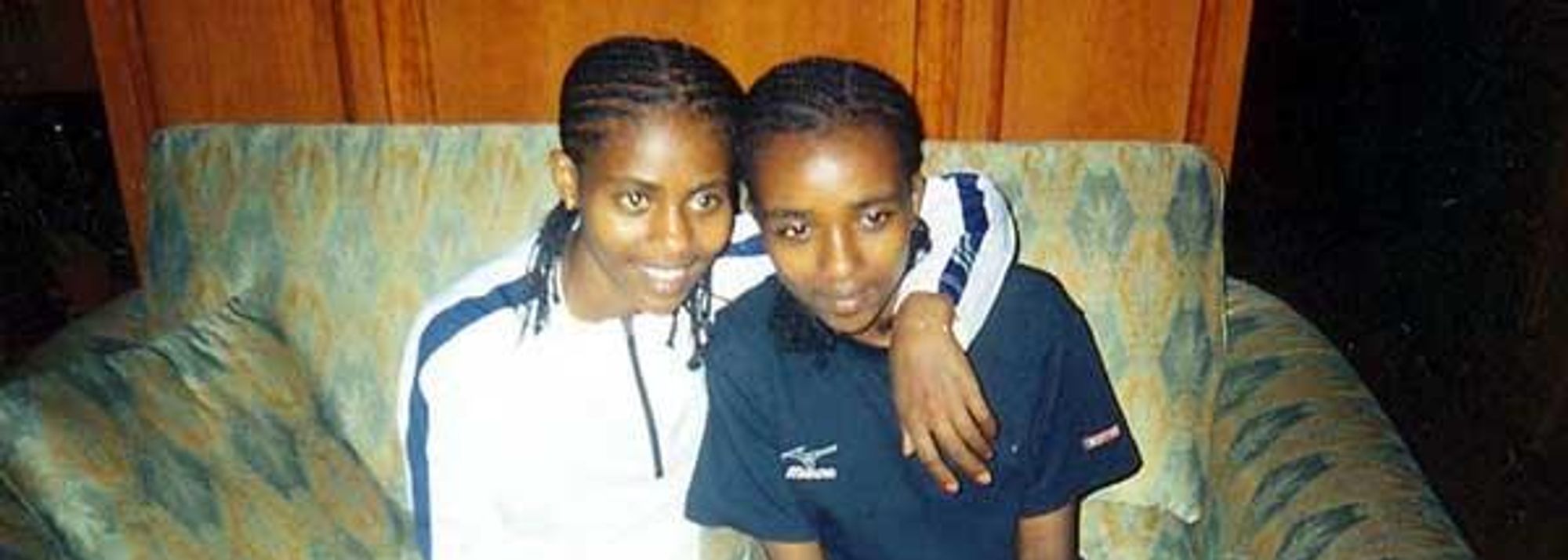


Ejigayehou Dibaba (left) with sister Tirunesh (© Elshadai Negash)
For Ethiopian distance runner Ejigayehou Dibaba, her sport is a family affair.
The 21-year old is the elder sister of World 5000m champion Tirunesh Dibaba and the younger cousin of two-time Olympic and 2001 World 10,000m champion Derartu Tulu. The dynamic duo have won distance gold medals in the last two World Championships and if the success continues its journey in the family tree, E. Dibaba will be crossing the line first in the 10,000m final in Athens.
But in a typical modest Ethiopian way, E. Dibaba refuses to be carried away about her prospects in Athens. "It is nice that you came up with the sequence," she laughs. "But I have achieved nothing yet and the real battle is in front of me."
Post-Paris dramatic raise
Success is not a right that is passed on in the family, but E. Dibaba's performances in the past year have transformed the runner from an also-ran to a genuine medal contender for Athens.
At the 9th IAAF World Championships in Paris last year, she could only manage ninth in the 10,000m, but since then, she has been running as if though she has a serious argument to settle.
In October 2003, she won two 10,000m titles at the 8th All-Africa Games in Abuja, Nigeria and the 1st Afro-Asian Games in Hydrabad, India. In March 2004, she was again on the medal podium taking silver in the 8km senior race at the 32nd IAAF World Cross Country championships in Brussels, Belgium.
On the European circuit this summer, the 21-year old lowered her personal best for the 5000m by a massive nine seconds from 14:41.67 to 14:32.74, the fourth fastest time of the year. And in July, she ran the second fastest time of the year for 10,000m (30:43.39) in Barakaldo, Spain beating her cousin Derartu Tulu by a convincing seven-second margin to book a place in the Ethiopian 10,000m team as a reserve (since changed to squad runner, after World champion Adere’s withdrawal – 15 Aug).
A year ago, E. Dibaba was a silent member of the Ethiopian team, but her impressive form leading up to the Olympics have seen the plaudits pour in from all over the country. "She is probably one of our best medal hopes," says Endalk Kelemwork, Technical Director of the Ethiopian Athletics Federation.
So, what are the reasons for her impressive form?
"Hard work and rethinking," says E. Dibaba, who has put in extra loads in an already-grueling training programme. But most of all, her failure in Paris has seen her go soul-searching for the reasons that she took up the sport in the first place.
"After Paris, I sat down and thought about why I decided to run at the first place," she recalls. "I tried to blame injury for my failure, but all fingers pointed back to me. I knew that I had to do something about."
The response was instant and electrifying as the athlete turned her career on its head to qualify for both the 5000 and 10,000m Ethiopian teams. It was a dramatic turnaround for an athlete who had contemplated a career as a run only her dreams.
Strong Athletics Background
Life for Ejigayehou begun in Bekoji, in the Arsi region of South-eastern Ethiopia. She was the fourth child in a family of four other sisters and a brother and in the typical norm of the village, her parents lived off the proceeds from farming and cattle herding. They lived a subsistence living, but still had the strength to send their children to school.
Even as a child, Ejigayehou had enough around her for inspiration. She went to school at the Bekoji Elementary School, the same school where Tulu had first learned her trade. She remembers being active in sports even at an early age, although academics always came first. "I used to be a good student in school," recalls Ejigayehou.
Soon enough, however, the major accolade she was getting at Bekoji Elementary was from the school's sports coach. "He used to say that I would make a very good runner," she remembers. Even today, Ejigayehou is indebted to him for his instinct.
Apparently, he was not talking without reason. After demolishing her opponents in several inter-school meetings, she was selected for the Arsi region in the Oromia Cross Country championships winning her first race in the 8km. She had caught the eye of selectors from the Oromia Prisons, a club which she soon joined in 1998. Success continued on the track when she won a 5000/10,000m double for Oromia in the Ethiopian Championships two months later.
Running now became a major part of her life, but still she was good enough to keep her concentration and finish sixth grade after which she moved up to Addis Ababa to live with her elder sister Bekelu, who was also a runner. "Bekelu had lived in the Addis Ababa for four years and asked me to come live with her," she says.
Her early days in the big city were a constant struggle. Bekelu left to live in Belgium leaving her sisters Ejigayehou and Tirunesh, who had also come up to Addis Ababa to live with her. "I knew that we could manage," Ejigayehou says. "Tiru [Tirunesh] was not a difficult sister and that made it simpler."
Ejigayehou Dibaba continued to train, but it took her another two years before she made her major break through in 2003 when she qualified for the World Cross Country Championships in Lausanne, Switzerland. "I was not strong enough for the cross at the time," says Ejigayehou who finished tenth in the senior women's long course race.
After Lausanne, she focused her attentions on making the Ethiopian team for the Paris World Championships, which she did, thanks to a 31:02.72, the second fastest time of the year behind Werkinesh Kidane.
Paris 2003 was a debacle for an athlete who had set her sights on a podium finish, but she was consoled when sister Trunesh surprised everyone when she became the youngest ever individual gold medallist in the history of the world championships. "Tiru (as he affectionately calls her sister) consoled me in Paris. She made me very proud and we still talk about it."
My sister, my inspiration!
Ejigayehou enjoys a strong relationship with her sister who is three years younger. "She is not only my sister," E. Dibaba explains. "She is my inspiration and my best friend. I am proud of her and she is too."
The sisters share more than the same parents and family name (called ‘father’s name’ in Ethiopia]. They are training partners and live together in a rented house in one of the residential quarters in Addis Ababa.
Like the rest of the Ethiopian Olympic team, the duo have been living temporarily in the Ararat Hotel on the outskirts of Addis Ababa and training twice a day for six days for the last three months. They still leave and train together to the point that some people say that they are inseparable twins. They laugh off such suggestions, but stress the importance of staying together. "We are one," says Ejigayehou. "Tiru is not only my sister, but also my best friend. She means everything to me."
Shared Earnings!
The money the sisters get from running is deposited in a bank for their future. "We do not want to worry about money now," says Ejigayehou. "We are young and we leave modestly and save our money when we stop running."
Some of their earnings, however, have gone into building a new and modern house, which will be completed in the coming months and ready by the time they return from Athens. They have arranged for ultra-modern furniture and decoration, but when asked whether they are preparing a medal cabinet for their expected haul from Athens, E. Dibaba replies, "That is a secret!" and bursts into laughter. We will soon find out!
Elshadai Negash for the IAAF


