

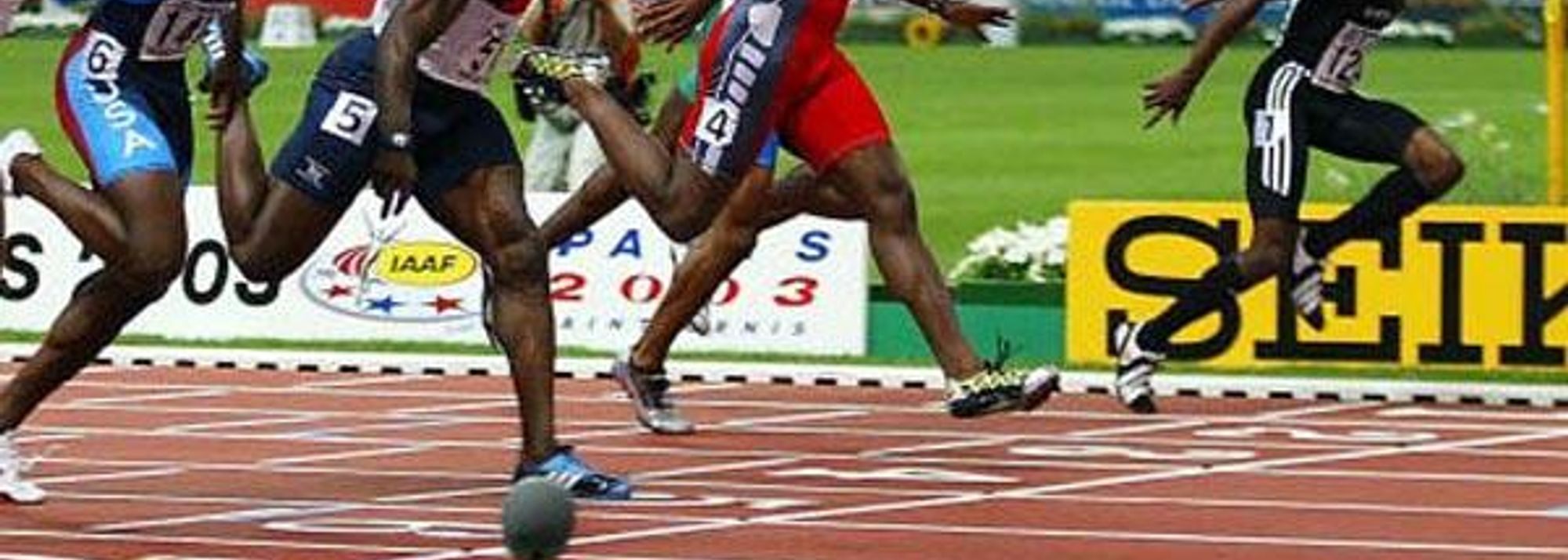


Kim Collins dips to the finish to win the men's 100m final (© Getty Images)
Kim Collins, crowned the world's fastest man after the tightest 100 metres finish in the history of the World Championships, claims he is, "all raw talent . . . the most natural sprinter in the world." He also admitted he is the laziest.
"I'm not one of those hard-working sprinters," he confessed after his shock victory in the Stade de France. "I'm an easy-going guy. When I don't feel like going to training, my coach is going to get a phone call, and he appreciates that.
"I don't believe in lifting weights, or pumping iron. There are a lot of things I don't believe in. So it's great he accepts that, and lets me do the work I want to."
Collins, from St Kitts, in the Leeward Islands, which does not even boast a running track, finished in 10.07 seconds. You could have thrown the proverbial blanket over the first four. Darrell Brown, Darren Campbell, and Dwain Chambers filled the next three places, all timed at 10.08.
USA challenge - conspicuous only by its absence
The US challenge in Paris, which comprised the defending gold, silver, and bronze medallists: Maurice Greene, Tim Montgomery, and Bernard Williams, was conspicuous only by its absence.
Olympic champion Greene's six-year global reign ended when he was eighth in his semi, which he finished clutching a leg. "As soon as I got out of the blocks, I felt a small pop in my quad muscle," he said.
Montgomery, who relieved Greene of the world mark here in Paris less than a year ago, with 9.78, was fifth in 10.11, while Williams, who beat Montgomery for the US title, was two hundredths behind. It was only the second time in the history of these championships that the US had blanked on the podium.
The slightly-built Collins, who evokes memories of Calvin Smith, who set a World 100m record 20 years ago, and won the first two World 200m titles, underpinned his fragility when he said: "My hamstrings are not strong - I really don't feel you should kill yourself in training."
He had seemed an unlikely winner when just fourth, with 10.16 in his semi-final, and his success shocked even the cognoscenti, just as it had when he won Commonwealth 100m gold in Manchester last year. On that occasion his time of 9.98 was the slowest in 16 years, while only when Carl Lewis took the inaugural World crown, in 1983, also with 10.07, has the world winning performance been outside 10 seconds.
Does not like to train
With most athletes mired in the rhetoric of sacrifice and dedication, the laid-back 27-year old must have demoralised his rivals with his frank confession that if he does not feel like training, he doesn't bother.
He has had to overcome asthma, which caused him to fail a dope test last year, for his inhaler, but he was reprieved without sanction.
The island of St Kitt's, in the Caribbean, covers just 60 square miles, with a total population which could have been accommodated twice over in the Stade de France. It achieved independence from Britain only 20 years ago along with it Leeward Islands partner, Nevis.
"Most people had probably never heard of it," he said, though his homeland knows all about him. The Government has issued him with a diplomatic passport, and he has a street named after him in Basseterre.
Sixth of 11 children
The sixth of 11 children, he spends three months of the year there and the remainder in the US, where he graduated in sociology from Texas Christian University.
He shared 200m bronze two years ago in Edmonton, ran in the 1996 Olympics, was seventh in the 2000 Olympic final, and was runner-up for the World indoor 60m crown this year. As Campbell pointed out, Collins had more than served his apprenticeship.
The winner dismissed what must be considered a slow time. "Over the years, my performance has been consistent. I was seventh in the Olympics with 10.07. Now it's good enough to win gold. So long as you're consistent, there's no telling what you can do."
Having suffered a leg injury in the Zurich Golden League he looked unlikely to make it to Paris. "I limped away from the track in Switzerland. I had an MRI (magnetic resonance image) scan on my right knee, in Amsterdam, to see what was going on. There was some cartilage damage, but I'd regular treatment from the Jamaican federation - thanks to them. It doesn't hurt so much, but it's still there."
He dismissed suggestions that this made him favourite for Olympic gold in Athens next year. "I don't think so . . . Mainly because the Americans are not going to take it lying down. They have the Olympic champion and the World record holder. They are going to come out firing. They don't like to lose.
"Everyone expected them to win. I had no pressure. I was very relaxed. I had been thinking about this race for a long time."
Drummond
The outcome now leaves US relay hopes in tatters, for Jon Drummond who staged a lie-down protest and refused to leave the track when disqualified for a false start the previous day, faces possible expulsion.
Collins had been critical of his behaviour: "Drummond showed everyone a bad image. I hope they find a way to stop this. We all know the rules. When you break, you got to go."
He said his easy-going temperament had helped him cope, and defuse, "the chaos of the last two days." It was the key to this success, just as in Manchester.
"All of us are men, and like to be dominant," he said. "Everyone tries to get inside your head, but I ignore that."
When Drummond's histrionics were played out, he had declined to get caught up: "I chose to keep warm, and not get involved."
Brown and Campbell
Brown, the world junior champion from Trinidad, further emphasised that he may be the long-term future of the event, with a World junior record of 10.01 in the quarters, fastest time of the championships.
The 29-year-old Englishman, Campbell, completed his match set of medals, and said he hoped it would bring him recognition.
"Hopefully now I'll get the respect I deserve," he said. "People seem to forget about me, but now I have a medal in every championships: Olympic silver (200m), Commonwealth bronze (200), European gold and bronze (100/200). The Worlds was the only thing I didn't have."
Campbell, who like Collins was due to double up in the 200m, will use his $20,000 prize to help his mother buy a house. "I might be able to afford it now. If I'd shown this form on the circuit, I might have made a lot of money. My mum brought me up right, taught me never to be greedy and chase money. I've always gone for the medals."


