

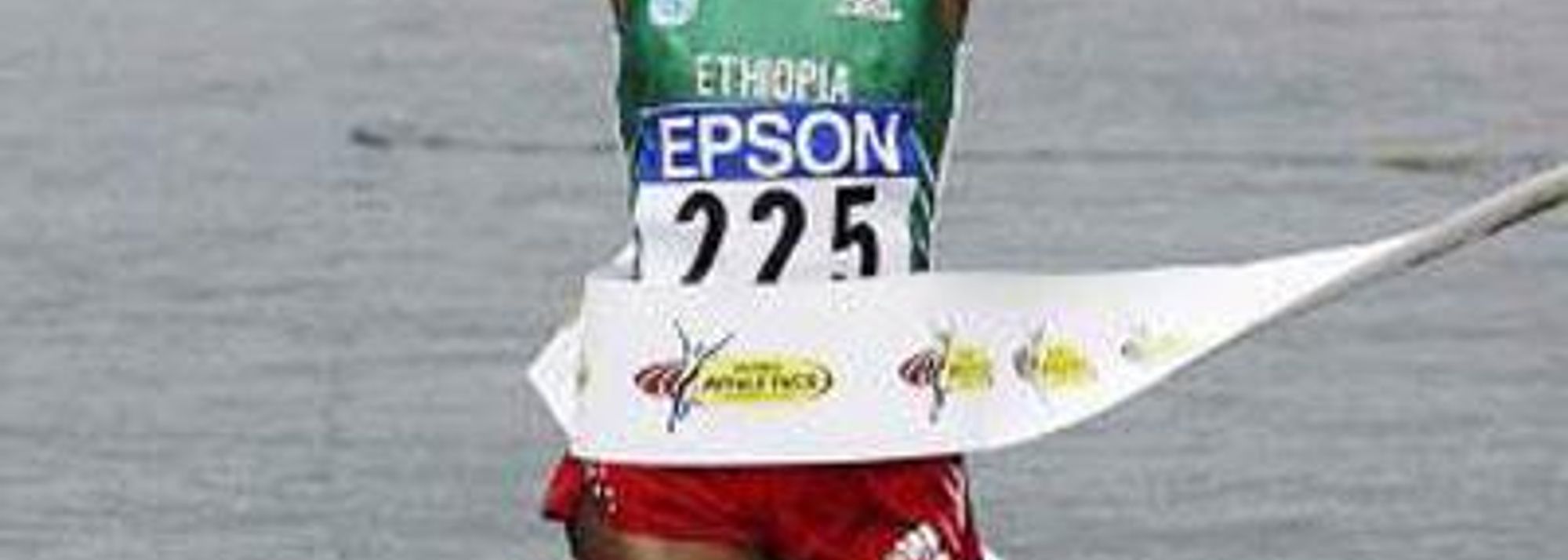


Berhane Adere (© Getty Images)
When Berhane Adere came from nowhere to win a silver medal in the final of the World 10,000m championships in Edmonton, Canada, she kick-started a career that, for sometime had failed to justify her rating as Ethiopia’s leading female Athlete. For six years, her coaches and everyone in her home country had been eagerly awaiting her rise from mediocrity. And when the time came, Adere took the opportunity with open arms and has not looked back since then.
Adere has had an incredible season both Indoors and Outdoors with the peak of her achievements came, when she slashed almost four seconds off the 3000m World Indoor record set by Romanian Gabriela Szabo three years earlier. She followed it up with two wins in the IAAF Golden League Series and a gold medal in the 5000m final of the African Athletics Championships held in Tunisia. And the 28-year old capped a memorable year with a win in the IAAF Athletics World Cup in September in Madrid.
Her efforts have not gone unnoticed. She has been nominated for the IAAF ‘Female Athlete of the Year’ award scheduled to take place this Sunday. And after enjoying her best season yet, Adere is confident of claiming at least a top-three place at the awards. “There were so many good performances this year, but I believe with the help of God that I deserve a place in the top-three,” she said.
Adere’s successful achievements this year could well be rewarded this Sunday, but she remains realistic about her chances of actually winning the awards. “Marion Jones was unbeaten throughout the whole of 2002 and Paula [Radcliffe] had an amazing Marathon debut year. I think they will be my greatest challengers.”
Therefore she remains modest about her chances of claiming the ultimate prize in Athletics. “I think the judges take all other factors into consideration,” she says. “And I think going into the awards, all of us stand an equal chance.”
The slender Ethiopian’s story is one of a typical rags-to-riches Cinderella fairy tale. Born some 28 years ago from a family of five in Sululta, Shewa District, some 100km outside Addis Ababa, she went to school in the nearby village and started running in the 800 and 1500m ‘just to pass her Physical Education exams’. “I never thought of Athletics as a living,” she says. “My family did not know anything about Sports and neither did I.”
But even then, she knew that she had the potential in her and it was not long before she started to move up the echelons of athletics. She was selected to represent her District in the inter-regional competition, where she always finished top of all the athletes represented from other regions of the country except from Addis Ababa. “They usually occupy the top three positions and I would come in fourth,” she proudly recalls.
Her performances in the inter-regionals were good enough for inclusion in the National team where she would be able to further her career on a bigger stage. But she had to wait until Edmonton to make her mark. “Before Edmonton, I used to take part in races. But the wins would not come frequently and it was really frustrating. Whenever a major international event comes around, everyone thinks that this is it… this is my opportune time. But God did not permit.”
Edmonton provided her the opportunity to resurrect her career after years in the wilderness. But the path to eventual stardom was erratic as she had to overcome the effects of a knee injury. “I had problems with my knee,” she reminisces. “I had started to train alone without the Ethiopian team before the event.”
She gave her compatriot Derartu Tulu one of the races of her career, only to finish runner-up ahead of former 10,000m champion Gete Wami and complete a clean sweep of the medals for Ethiopia. Adere ran a very intelligent race in Edmonton keeping an eye on the leading pack at all times only to be undone by her finishing tactics. “My inexperience showed then,” she said. “After Edmonton, I knew I had to work more on my finishing kick.”
And so she did. It was not long before she was reaping the rewards for a gruelsome training schedule now more intensified by the inclusion of speed and finishing-tactics training. It turned out to be a highly successful year for Adere, who attributes her success to her much-improved finishing kicks. “I used to lose races in the last lap because I had little experience,” she recalls. “I worked hard on that and gradually I managed to get things right.”
After a successful 2002, Adere is already eagerly-awaiting the start of the new season and the World Championships in July. “Although my main target is to win the World Championships, I will be running both Indoors and Outdoors between now and then to check out my form.” But like many others in the sport, the Olympics remain the ultimate goal for Adere. “With the help of God, I want to be part of the Ethiopian history makers who have won gold at the Olympics.”

