

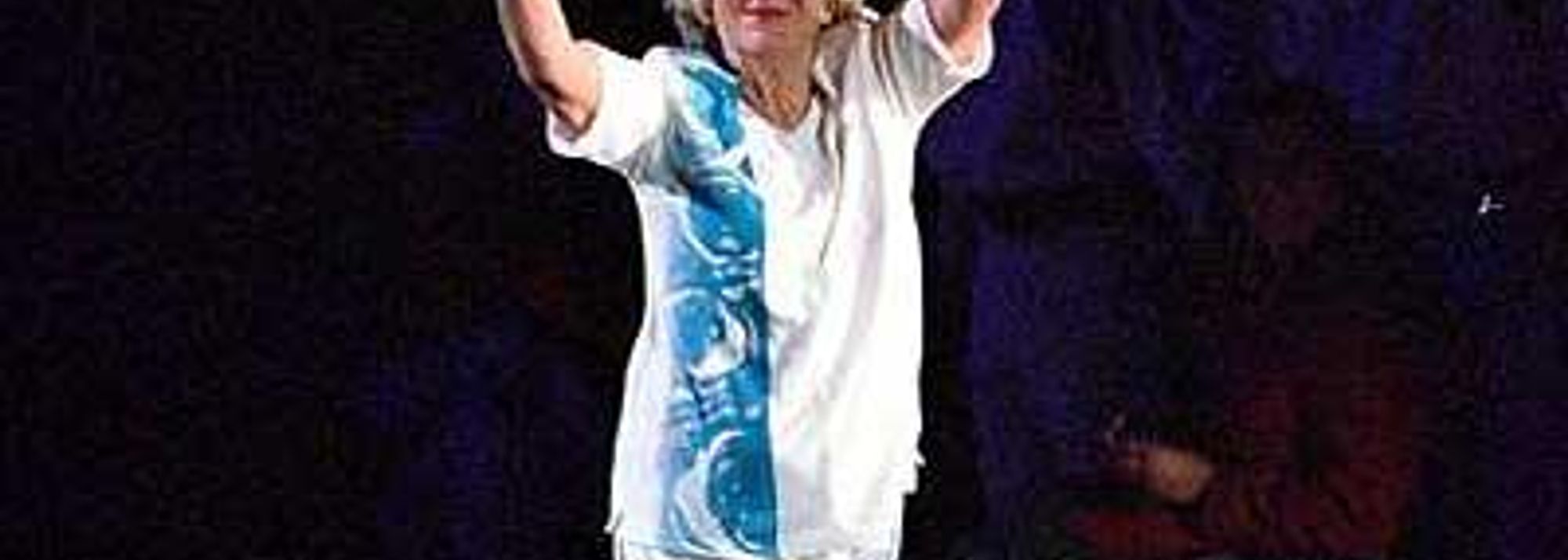


Shirley Strickland de la Hunty runs with the Olympic torch in Sydney 2000 (© Getty Images)
1952 and 1956 Olympic women's 80m Hurdles champion Shirley Strickland de la Hunty, has died at her Perth home aged 78, the Australian Olympic Committee (AOC) announced yesterday.
"That feat (of two consecutive Hurdles victories) made her the first female athlete in history to win back-to-back Olympic finals," the AOC said in a statement.
AOC president John Coates said: "Shirley was a legend of the
track, one of our greatest-ever Olympians."
Seven Olympic medals
Strickland de la Hunty with a total of seven Olympic podium finishes in her career is the most medalled Australian track and field athlete in Olympic history. As well as her two Hurdles crowns, she was a member of the quartet which won the 4 x 100 metres relay gold at the 1956 Melbourne Games, took a silver (relay) and two bronze (Hurdles and 100m) in 1948, and a bronze at the 1952 Helsinki 100m.
World records
It was in the 1952 Olympics where Strickland blazed her brightest in individual World record terms, first equalling Fanny Blankers-Koen's mark for the 60m Hurdles (11.0) in the heats, and then improving the time to 10.9 seconds when winning the final the following day.
In 1955, Strickland broke fellow Australian Majorie Jackson's World record for the flat 100m sprint (11.4, 1952) with a 11.3 clocking which was to stand for three years.
As a member of the Australian Olympic sprint relay teams of 1952 and 1956, she also played her part in three World records at 4x100m.
Sydney Olympic torch relay
Strickland Strickland de la Hunty was later an Australian Olympic team official at the 1968 and 1976 Games, and in 2002 was awarded the Olympic Order by the IOC.
A former maths teacher and university lecturer in physics,
Strickland de la Hunty is survived by four children and 15
grandchildren.
Strickland de la Hunty was part of the "Magnificent Seven" torch relay at the opening of the Sydney 2000 Games. The seven included fellow Australian Olympic heroines Dawn Fraser, Betty Cuthbert, Debbie Flintoff-King, Raelene Boyle, Shane Gould, and Cathy Freeman, who lit the Olympic cauldron.
Agencies and IAAF
--------------------------------------
Marjorie Jackson - 1952 Olympic double sprint gold medallist - pays tribute
Australia's first female Olympic medal winner in athletics, Shirley de la Hunty - better known by her maiden name of Strickland - was one of a kind. A pioneer, a Renaissance woman, writes Mike Hurst of the Daily and Sunday Telegraph, Australia.
She was also, at least statistically, Australia’s greatest athlete. By the time she had hung up her spikes she had amassed World records - both individual and relay - aplenty and won seven Olympic medals.
De la Hunty’s sudden and unexpected death at her home in Perth on Monday at the age of 78 has shocked the Olympic movement and those who knew and respected her for significant achievements on and off the track.
She was the first to demonstrate that Australian women athletes could take on the world successfully when she competed at the 1948 London Olympic Games and won bronze medals in the 100m sprint and the 80m hurdles and earned a silver medal in the Australian 4x100m relay team.
A year later when the star of London, the Netherlands’ Fanny Blankers-Koen, toured Australia de la Hunty would follow Marjorie Jackson - the Lithgow Flash - in beating the Dutch superstar.
Their upset victories - particularly those by the Lithgow teenager Jackson - would usher in a golden era in which the term 'Golden Girls' would enter the Australian lexicon.
Jackson would go on to become Australia’s first woman Olympic gold medallist when she won the 100m and 200m at the 1952 Olympics in Helsinki where Strickland won bronze in the 100m and the first of successive gold medals in the 80m hurdles. Strickland was the first woman to successfully defend an Olympic athletics title and is still to this day the only double Olympic hurdles title winner in history.
Jackson, now South Australian governor Nelson, recalled that golden age last night when she spoke of Blankers-Koen, who died only a fortnight ago, and de la Hunty.
“In those days in the 1940s and 1950s I don’t think women made very many headlines. When I beat Fanny that was front page. It started the athletics era, a golden era in Australia,” Gov Nelson told The Daily Telegraph.
“We’d just gone through a terrible world war. Nobody understood much about what the Olympics were all about. So the wins over Fanny in 1949 coincided with the rise of Don Bradman in cricket and Jimmy Carruthers in boxing and we started to realise we could be world champions.”
Yet it was not so much de la Hunty’s medal winning performances that impressed Gov Nelson but rather her qualities as an educated and worldly woman - one who would be the first to demonstrate to Australians that women could have a child and return from motherhood to achieve at the highest level in sport.
“What impressed me so much in 1952 in Helsinki was that she could speak all these languages. I envied her,” Gov Nelson admitted.
“She was intellectually so brilliant. To see her converse with all these people in their languages was something I envied. She was also a brilliant teacher.”
Strickland had given birth to her first baby, Phillip, in 1953 - the first of her four children - and then at the age of 31, she again defied convention and prejudice against her age to win the hurdles gold medal at the Melbourne Olympics in 1956.
“That was so outstanding, winning again in 1956 after having her first baby,” Gov Nelson stressed.
“It wasn’t what we did here in Australia. She was going off and having babies and then competing in the Olympics.
“Shirley paved the way for Australian women with children in sport at that high level. In those days if you got married you had to give up your job too. She couldn’t make a living out of athletics.”
But Strickland, who married geologist Peter de la Hunty, wanted to have it all. And she did.
She had graduated from University in Perth with a Batchelor of Science in 1945 with physics. In the years to come she would teacher mathematics for 23 years and she became a university lecturer in physics, calculus, environmental science and environmental history.
When not involved in the world of academia or with her family, she coached sprinters and hurdlers at the highest level.
Among them was Raelene Boyle who she guided to the 1976 Montreal Olympics where Boyle missed a medal in the 100m and was disqualified for breaking twice in her 200m semi-final.
They had an acrimonious falling out which would only be resolved in the lead-up to the Sydney 2000 Olympic Games where the Golden Girls were honoured at the Opening Ceremony. De la Hunty walked beside Boyle who pushed quadruple sprint gold medalist Betty Cuthbert in a wheelchair around Stadium Australia at Homebush.
But with swimmers Dawn Fraser and Shane Gould and hurdler Debbie Flintoff-King also looking on, it was Cathy Freeman who was the surprise choice to light the Olympic cauldron.
De la Hunty sold her seven Olympic medals to raise money for the education of her 15 grand children and to fund environmentalist causes dear to her heart. They raised $400,000 and are now on display at the Melbourne Cricket Ground Olympic museum.
She is the first of the Golden Girls of Australian Olympic sport to reach the finish line of life. Always the pathfinder, she will be missed by all who met her.

