

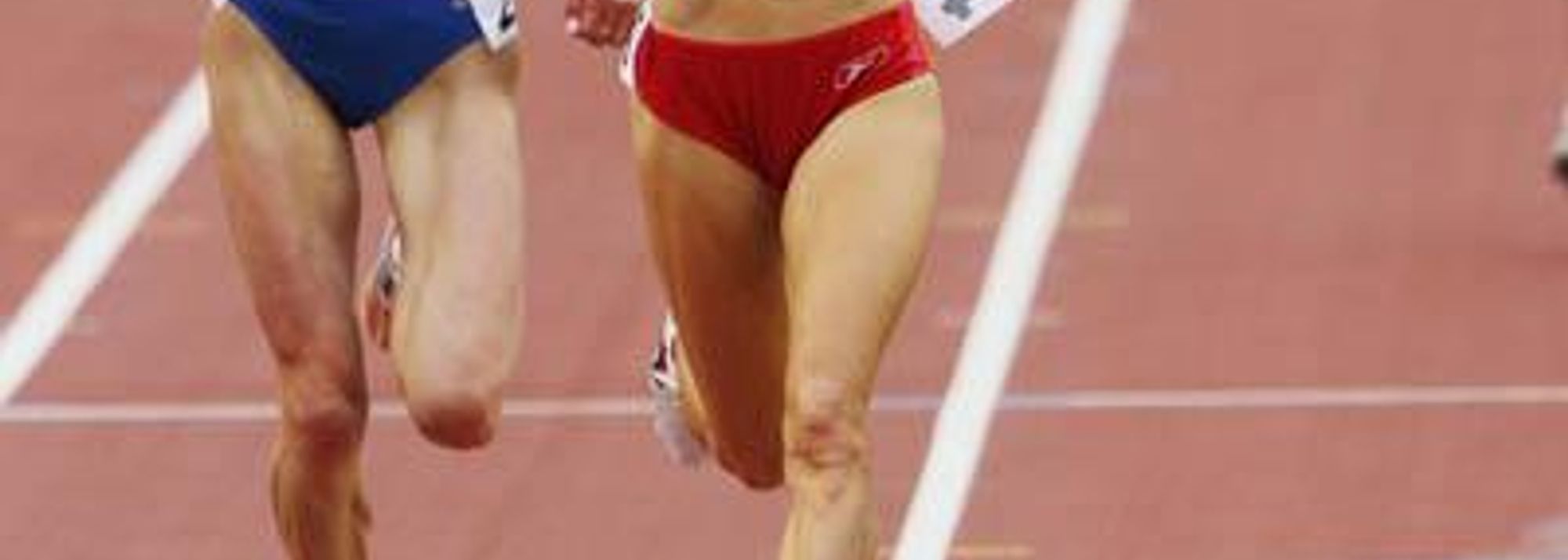


Spanish kisses for the crowd - marta Dominguez en route to her second European 5000m title (© Getty Images)
Marta Domínguez can arguably be regarded as the best ever Spanish female athlete. Pundits, knowledgeable athletics fans and athletes themselves agree her background is the most successful by far - two European 5000m titles, two World 5000m silver medals along with five more top-three finishes over 3000m indoors in continental and global competition.
But beyond those figures she is extremely admired by her compatriots for being a real fighter on the track, a born winner whose many victories have come after thrilling neck-and-neck battles in the homestraight with some of the most renowned middle-distance specialists throughout the years such as Portugal’s Carla Sacramento and Ireland’s Sonia O’Sullivan when Dominguez took back-to-back European titles in Vienna and Munich in 2002.
Initial success at 1500m
The now 31-year-old Spaniard (born 3 November 1975) first came to prominence with after her European junior 1500m at home in San Sebastián in 1993. The following year she snatched another major medal, taking the 1500 silver at the World Junior Championships held in Lisbon. Despite these successes, Dominguez soon realised that the 1500 proved to be too short for her and moved up to the 5000m after a disappointing experience at the 1996 Atlanta Olympics where she could not progress beyond the first round.
“I liked the 1500m but my speed was not enough to shine on the international scene, and that was my goal. So I didn’t hesitate to tackle a longer distance. Being only 21 by then, the 3000m would have been ideal for me but unfortunately that distance is not scheduled at major championships in summer and so I had to face the 5000m.” To confirm her words it should be noted that Dominguez won three 3000m bronze medals at the respective European indoor championships held in Stockholm (96), Valencia (98) and Gent (2000).
That decision proved to be the right one as the 1.63m tall star clinched bronze at the first Under-23 European championships held in Turku, Finland, in 1997, but her major breakthrough came the following season by adding a senior 5000m bronze to her tally at the Europeans held in Budapest, hardly one month after ducking under 15 minutes for the first time with her 14:59.49 clocking in Rome.
Successive World 5000m silver medals
By 2001, she would claim her first global silver medal after her runner-up finish in Edmonton. But her personal pinnacle would come two years later.
“I would choose the whole 2003 season as the most enjoyable one. I capped that campaign with two silver medals to my credit at a world level, in Birmingham indoors over 3000m and in Paris outdoors at 5000m.” To underscore her success, it should be remembered who her illustrious podium mates were: in Birmingham they were Ethiopians Berhane Adere, who won the gold, and Meseret Defar who took bronze, while in Paris she was sandwiched between winner Tirunesh Dibaba and Kenya’s Edith Masai.
Injury halts drive towards Olympics
But Dominguez suffered the bleakest period in her athletics career immediately after solid 2003 season. A serious tendon injury in her left foot would force her to miss the 2004 season, knocking her out of the Olympic Games in Athens.
Slowed an entire year lay-off she only managed to place 14th at the 2005 Helsinki Worlds, a weak rank for her usual standards. In addition, the superb performance displayed by the Ethiopians who made a clean sweep of medals led Dominguez to contemplate the possibility of building up for the 10,000 as the European Championships in Gothenburg approached.
“I was the reigning 5000m champion and I didn’t like to have any pressure on my shoulders so I decided to make my debut at 10,000m, a discipline I had never tried and therefore no one would expect something special from me in Gothenburg.”
Dominguez prepared for that new purpose with winter sessions of up to 180 kilometres per week before making her debut at the National championships in Aviles on 15 July, where she clocked 32:46.23.
“It was my first 10,000m experience on the track and I finished quite happy despite the fact that the time was not remarkable. I even didn’t wear spikes, not wanting to aggravate some discomfort I felt by then.”
Some coaxing to defend European 5000m title
Once at the Europeans, during a TV interview held on the track following her respectable 10,000m seventh place, where she set a national record of 30:51.69, Dominguez announced her intention of returning to Spain and therefore bypassing her defence of her European title she brilliantly took from Ireland’s Sonia O’Sullivan four years earlier. But the Spanish star had not anticipated that Spanish Federation President José María Odriozola remained absolutely determined to change her mind. Odriozola, who is also an IAAF Council member, had an informal and friendly meeting with Dominguez in the hotel lobby, where he hoped to convince her to contest the 5000 as well.
“Before the 10,000m it’s true that I was still hesitating whether or not to contest the 5000m afterwards, but my primary idea was to return home immediately.” Laughingly Marta recalls: “He brought a folder but finally he didn’t need to open it as he had very clear ideas. He said to me, “Marta, you have proved to be in awesome form by running an impressive 10,000m, and due to your finishing speed I consider your chances for retaining the title as more than high. I do believe that you shouldn’t miss this opportunity. Go for it.’ Odriozola even analysed with me my rivals one by one, and he concluded that none of them were in better shape than me.’
Amazingly, the President himself was much more confident of Dominguez’s chances of success than she was. “I asked him: ‘Do you really think I can strike gold again?’ And he answered very adamantly, ‘Yes’. It was exactly then that I set myself the goal of winning in the 5000m.”
“On paper I considered Russia’s Yuliya Shobukhova my toughest rival as she beat me in the European Cup – Superleague – in Malaga in late June thanks to a frantic 2:43 last kilometre. In addition she had set a world 3000m indoor record last February with a 8:27.86 clocking. Prior to the championships Turkey’s Elvan Abeylegesse was my number one favourite for the 10,000m title but after she dropped out in the seventh kilometre my coach, Mariano Díez, told me that I shouldn’t fear her.”
“In 2006 I have been focused on the 10,000m but it takes several years to get accustomed to a new event. In that sense I feel that the 5000m keeps on being my specialist event, a distance which I contest well after so many years performing it.”
Despite global success, still chasing national record
Ironically, the twice European 5000m champion and twice World 5000m bronze medallist is not the Spanish national record holder for the event! That honour goes to Julia Vaquero who established a 14:44.95 performance in 1996, while Dominguez’s fastest performance is 14:48.33, set in the semi-final round of the 2003 World Championships.
“Times are not too important for me as records come and go but the medals you achieve will always be yours. Once the major championships is over I lose concentration and that’s a handicap to perform well in the subsequent one-day competitions. I compete sparingly throughout the year and that way it’s not easy to improve my PB.”
For 2007, focus on Osaka 10,000m...
Dominguez has not set major goals for 2007 apart from the IAAF World Championships in Osaka next summer. Consequently, she has ruled out taking part in the upcoming European Indoor Championships to be staged in Birmingham in March despite her enviable indoor pedigree.
After her 5000/10,000 double in Gothenburg an interesting question emerged: which event(s) would she be contesting in Osaka? Dominguez’s mind was apparently already made up.
“I have decided to concentrate on the 10,000m. I have two silver medals at 5000 and I’m afraid that to become World champion, with such a quality group of Ethiopians, is beyond my capabilities. I prefer to prepare myself for the longer distance which is wide open. My training schedule includes weeks of 150 kilometres per week to get enough stamina to be competitive in Osaka.”
... and Beijing in 2008
One of the few remaining accomplishments for Dominguez is an Olympic medal.
“I have not been fortunate at the various Olympics I have taken part in. First, I competed in Atlanta but I was only 20 years of age and could not advance from the heats. But the greatest disappointment came at the Sidney Olympics when I was in the form of my life having clocked an impressive 8:28.80 for 3000m some weeks prior to the big event, but unfortunately I had a strong cold that left me completely out of action. At the Athens Olympic Games the thing was even worse as my injury prevented me of competing there after what had been my best ever year in 2003, what a shame!”
Forecasting her chances at next year’s Olympics in Beijing Dominguez is cautious. “My point of view changed a lot when I fell injured. Since then I have no plans beyond one year, only season by season but obviously an Olympic medal would be a dream come true.”
Definitely, an Olympic medal will accelerate dramatically the privileged heart rate of just 47 beats per minute (at rest) of the ever-smiling Dominguez.
Emeterio Valiente for the IAAF