

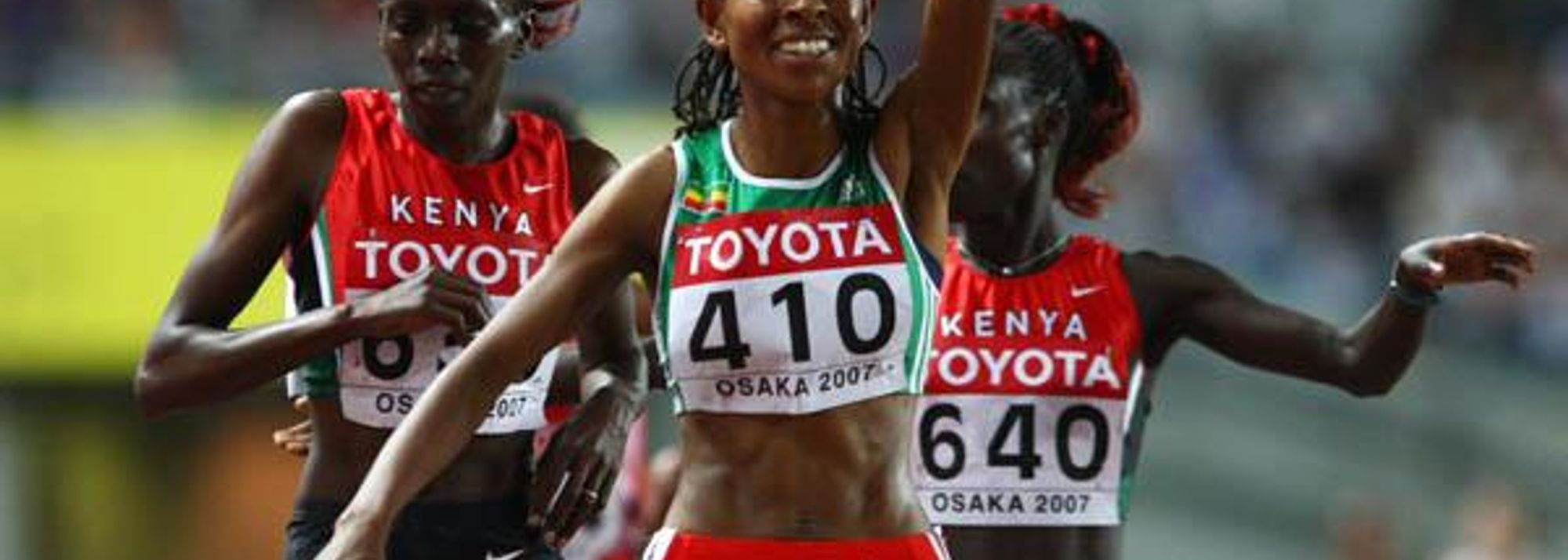


Meseret Defar of Ethiopia celebrates winning gold in the 5000m (© Getty Images)
MonteCarloIn the sixth part of their end of year review, statisticians A. Lennart Julin and Mirko Jalava continue with their appraisal of this year, here concentrating with the highlights of the LONG DISTANCE track running races which took place in 2007.
MEN - Long Distance
5000m
This was an event that in 2007 suffered severely from lack of competitive opportunities at the top level. It was staged in only two of the six Golden League meets (Rome and Brussels) and in only one of five Super Grand Prix meets (Lausanne). The year list was effectively "saved" at the very end of the season (mid-September) by the race at the Memorial Van Damme in Brussels which provided No 2-3-4-5-6-7-8-9 of 2007!
A race which clearly demonstrated that it was mainly lack of opportunity, not lack of ability, that was the reason for the lacklustre World List coming into Brussels: Those eight runners mentioned lowered their respective previous yearly best by 11, 12, 33, 18, 25, X (no previous 5000m-race at all in 2007), 43 and 2 seconds.
One could but guess what kind of times other runners could have achieved had they got the chance to run in Brussels. Among those missing were World record holder Kenenisa Bekele, World champion Bernard Lagat or World Athletic Final winner Edwin Soi:
* Kenenisa Bekele only ran one 5000m this summer, that however demonstrated his dominance as he ran the World leading time of 12:49 in a race he won by 38 seconds.
* Bernard Lagat only ran the distance in two meets, 13:30 as winner of the US Trials and 13:45 as winner of the World Championships where all the strength oriented opponents simply handed him - the 1500m champion of just a couple of days ago - the race by letting it be a slow procession up until an all decisive short finishing sprint.
* Edwin Soi missed Osaka by finishing 4th in the Kenyan trials but had won Lausanne previously and then took the WAF title when simply leaving everbody else seemingly standing with his finishing burst.
With Kenenisa Bekele nowadays apparently choosing to run the 10,000m only in the major championships there currently is no outstanding candidate at 5000m to replace him, especially as Brussels winner and Ethiopian No 2 Sileshi Sihine also prefers to take his chances at 10,000m at the championships. It should, when speculating about upcoming years, be noted that only one of the top-9 runners statistically in 2007 was 25 years or younger.
5000m - 2007 World List
10,000m
Somewhat paradoxically the 10,000m - in contrast to events like 800m, 1500m and 5000m - had a 2007 which was not below average or even average but rather the best ever statistically! Nine runners sub-27 was a new record, just like 29 sub-27:30 and 79 sub-28:00.
But of course in this event more than any other the statistical outcome is dependent on the competitive opportunities available. In recent years the European summer has offered two major chances for fast times – Hengelo late May/early June and Brussels late August/early September – but this number was increased by 50% with the addition of Neerpelt on 2 June.
The enormous significance of these just three races is immediately obvious even by just a quick glance at the 2007 World list: Out of the top-15 seven had their top mark in Hengelo, four in Brussels and three in Neerpelt! The only exception was the No 10 mark of 27:00 by Zersenay Tadese which he ran in the All Africa Games.
And the dominance of the top-3 races goes even deeper: Out of the top-36 there were 15 Hengelo, 7 Neerpelt and 6 Brussels. Only two races in Japan (Kobe and Shibetsu) dominated by resident Kenyan runners managed to get some marks into that Dutch/Belgian "monopoly".
Talking about monopoly: The East African grip upon the event was stronger than ever as runners from Ethiopia (12 runners), Kenya (16), Eritrea (1) and Rwanda (1) all of the top-31 positions on the World list – but one, the sole exception being Brasilian Marilson dos Santos in 26th position.
Especially conspicuous is the European regress as Ireland's Alistair Cragg (42nd) is the only runner from this Area within the top-70! So it was logical rather than an odd coincidence that there was no European contesting the 10,000m in the Osaka World Championships.
10,000m - 2007 World List
3000m Steeplechase
For several years now this event has been dominated by Said Saaeed Shaheen who has improved the World record a couple of times and won all his last 24 competitions dating back to 2002. But due to injury Shaheen missed 2007 completely and in his wake the "usual" No 2 – Kenya's Paul K Koech – assumed the position as No 1.
Koech ran the four fastest times (7:58 - 8:01) of the year and dominated all his races – but one. That exception proved costly as it was the Kenyan Trials for the World Championships and the selectors chose not to consider any other merits. As the three runners selected – Brimin Kipruto, Ezekiel Kemboi and Richard Mateelong – provided a perfect clean sweep of the medals in Osaka it is impossible to claim that the selectors made any mistake.
So the steeplechase remained very much a Kenyan domain this year although in 2007 they occupied only 50% of the top-10 positions on the world list. And it should be noted that none of the four new sub-8:10 runners this year represented Kenya. Perhaps the enormous Kenyan exodus in recent years from track running towards the more lucrative road scene has caused a slight "slowing down" of the previous conveyor belt of new steeple talents?
The strongest challenge to the Kenyan dominance this year surprisingly came from Sweden as Mustafa Mohamed continued his steady progression. Mohamed was a World Junior finalist (8th) already in 1998, first reached the fringes of World class in 2004 (13th in the Olympics), improved further in 2005 (10th in Helsinki) and 2006 (4th in Europeans) and this year he took that final step into the top echelon:
In late July in Heusden Mohamed won in 8:05.75 which was not only a new PB but a new Swedish record surpassing Anders Gärderud's legendary World record 8:08.02 set when winning the Montreal Olympics to the day 31 years earlier! That it wasn't just a flash in the pan Mohamed proved convincingly by dipping under the old record also when finishing 2nd to Koech at the Stockholm DN Galan and by as said seriously challenging for the medals in Osaka final in the end finishing a close 4th.
Three other major breakthroughs statistically in 2007 was achieved by Moroccans Brahim Taleb (from 8:14 to 8:07) and Hamid Ezzine (from 8:19 to 8:09) as well as by Bahrein's Tareq Mubarak Taher (from 8:11 to 8:07). However, none of them managed to support that new athletic level with a successful Osaka effort.
3000m Steeplechase - 2007 World List
WOMEN - Long distance
Meseret Defar (ETH) was the star of the women’s distance track running in 2007. The 24-year-old Ethiopian won all her track races indoors and outdoors and set another 5000m world record clocking 14:16.63 in Oslo in June. Defar also set two World Bests in 2 Miles and a fine 8:23.72 World Indoor record over 3000m distance and the Ethiopian now reigns over all competitions being the 2004 Olympic champion, 2004 / 06 World Indoor champion (3000m) and 2007 World champion in Osaka.
For the women’s 10,000m it was a quiet season with no fast races at all. Tirunesh Dibaba (ETH) successfully defended her Helsinki World title, but did it using nearly 32 minutes in the Osaka heat and the world leading time after the season was only 31:00.27 by Mestawat Tufa (ETH).
The World record was not broken in the 3000m Steeplechase, but it was not a particularly bad season for the event. A big bunch of countries saw their national record pressed under 9:30 and Russians continued to dominate the event. Yekaterina Volkova and Tatyana Petrova finished first and second at the World Championships clocking the two fastest times of the year with 9:06.57 and 9:09.19 respectively.
5000m
Defar’s season was nearly perfect. The Ethiopian started with two fast 3000m races indoors setting a world indoor record 8:23.72 in Stuttgart in start of February. Outdoors she raced five times over the 5000m distance and set another world record in Oslo in June with a 14:16.63 result which was almost eight seconds off her previous World record (14:24.53) from 2006. Defar then went on to win the All Africa Games and the World Championships bettering her silver medal finish in Helsinki 2005.
Although Defar was a clear number one, there were others who made their point during the season. 24-year-old Kenyan Vivian Cheruiyot came to the elite level in 2006 and sliced a huge 25 seconds off her personal best in 2007. Cheruiyot lowered the Kenyan national record down to 14:22.51 in Oslo finishing second in Defar’s World record race and also grabbed the silver in Osaka behind the same Ethiopian.
Kenyan has 25 athletes on the world top 100 list with Ethiopia in second with 19 and USA third with 13.
5000m - 2007 World List
10,000m
The women’s 10,000m season was a low key one. Instead of a few fast early season races and a high standard major championships final, no runner could go under 31 minutes during the 2007 season. 24-year-old Ethiopian Mestawat Tufa clocked a world leading 31:00.27 in Valkenswaard, the Netherlands, in June and won the All Africa Games later but like so many others could not stand the Osaka heat and didn’t finish the race there.
In a surprising 10,000m race in Osaka, many favourites faded to lesser placings, but the winner was no surprise. Tirunesh Dibaba (ETH), only 21 years old at the time, defended her title from Helsinki and in the end took an easy win in her only 10000m race of the season clocking 31:55.41, the slowest winning time in major championships history. In the 14 earlier women’s 10,000m Olympic or World Championships finals the slowest time before was Derartu Tulu’s (ETH) 31:48.81 in Edmonton 2001.
Japan is the best country in the event with 21 athletes on the world top 100 list. Kenya has 16 and China and Ethiopia are tied for third place with 12.
10,000m - 2007 World List
3000m Steeplechase
There was bound to be a new champion in the women’s 3000m Steeplechase. Reigning champion from the inaugural race in Helsinki, Dorcus Inzikuru (UGA), did not compete outdoors in 2007 because of her pregnancy. There was a big comeback from World record holder (9:01.59 in 2004) Gulnara Galkina (RUS) after a three-year break from the event. And indeed Galkina did get close to her world record clocking a world leading 9:11.68 in July, but in Osaka she joined a list of favourites who could not deal with the heat there and could only finish in seventh place.
Russia however, was not denied of top finish in the event with Yekaterina Volkova grabbing the gold in a world leading 9:06.57 personal best and Tatyana Petrova taking the silver also with a PB 9:09.19. Many countries made great progress with national records during 2007. Eunice Jepkorir lowered her own personal best by more than a minute during the season and the Kenyan set African record 9:14.52 in July.
Fellow Kenyan Ruth Bisibori, 19, and fourth in Osaka set two World junior records in the season ending up with 9:24.51 and Chinese junior Liu Nian created an Asian record and junior record 9:26.25 in November. Morocco, Spain, France, Ethiopia, Ireland, Belgium, Romania and USA all lowered their NRs under the 9:30 limit.
USA is the strongest country with 16 athletes on the world top 100 list. Kenya is second with eight and Russia third with seven.
3000m Steeplechase - 2007 World List
IAAF