

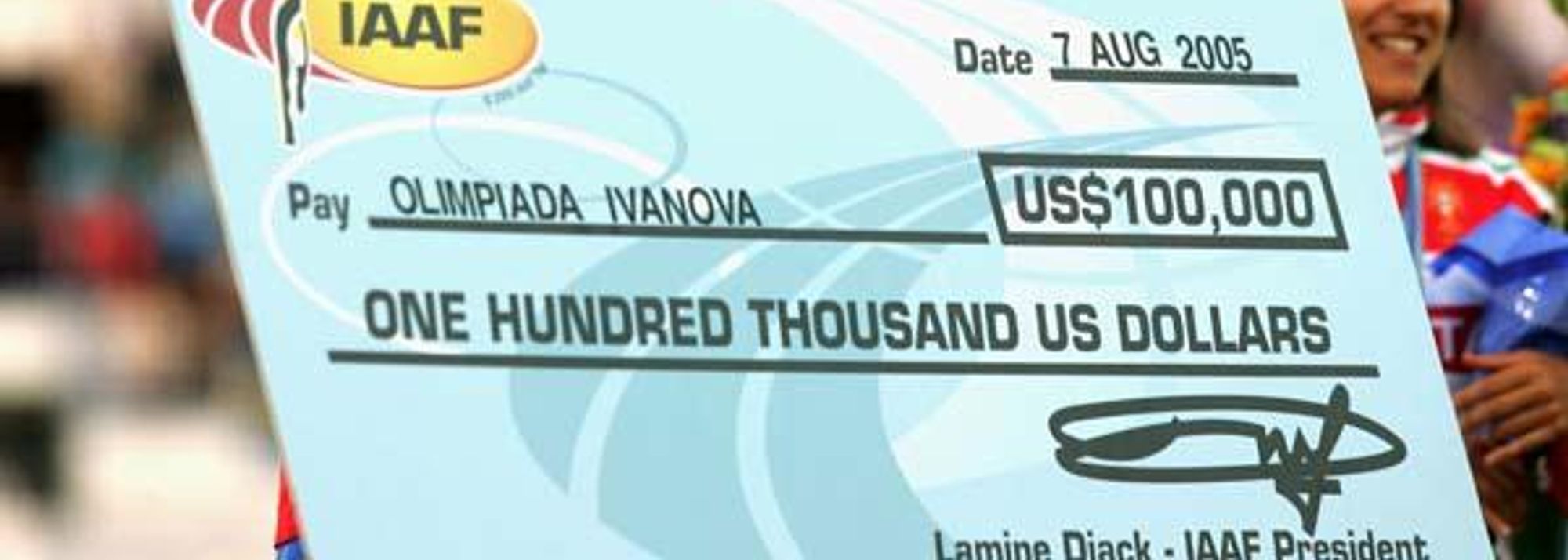


Olimpiada Ivanova receives a 100,000 dollars World record bonus cheque (© Getty Images)
The respected track and field statisticians, A. Lennart Julin and Mirko Jalava continue their end of season review, with the 2005 competitive highlights of the road events, the Marathon and Race Walks – Part Five of eight.
MEN - Road Running and Race Walking
Road Running
Men’s road running in 2005 witnessed four athletes enter the top six in the half marathon all-time list. In September, 18-year-old Japan based Kenyan Samuel Wanjiru set the World record of 59:16 in Rotterdam bettering Paul Tergat’s official record of 59:17 set in Milan in 1998. Then Zersenay Tadesse (ERI) ran the fastest ever Half Marathon clocking 59:05 in the Great North Run from Newcastle to South Shields, slicing one second off Tergat’s actual fastest of 59:06 (2000), but both of these results had been achieved in slightly downhill courses and so will never be accepted for record purposes . The Great North Run is about 30 metres downhill, just a little over the allowed 1m/km which would be 21m for the Half Marathon.
In the World Half Marathon Championships in Edmonton in October it was a very close race with the first four athletes separated by just six seconds. Mubarak Hassan Shami (QAT) was already celebrating the win just before the finish line as he was passed by Fabiano Joseph Naasi (TAN). The 19-year-old registered his first major title in 61:08 ahead of Shami’s 61:09 for the silver.
19 athletes went under 61 minutes during the 2005 season, there were 22 in 2004 and 18 in 2003. Kenya has an absolute dominance in this event with amazing 62 athletes in the world top 100, Ethiopia has 11.
For the marathon distance it was a silent year. Haile Gebrselassie (ETH) set the standard for the distance with his 2:06:20 National record in Amsterdam. Very few athletes even tried to run two major marathons and none were able to win two. In the World Championships in Helsinki the surprise winner from Paris 2003, Jaouad Gharib (MAR), was able to retain his crown. Gharib had finished second in the London Marathon with a season’s best of 2:07:49 and was decisive in Helsinki winning in great style. The Moroccan completed his sixth career marathon in Helsinki and he has only won two of them, both being in World Championships.
29 athletes went under 2:09 during this season, in 2004 we had 30 and a huge 51 in 2003. Kenya is easily the best country here as well with 51 athletes in the world top 100; Japan is second with 10.
Men's Road Running - Marathon - IAAF WORLD RANKINGS - as of 12 Dec 2005 - Position - Name - DOB - Country - Points
1. Jaouad GHARIB 72 MAR 1330
2. Martin LEL 78 KEN 1305
3. Haile GEBRSELASSIE 73 ETH 1301
4. Fabiano Joseph NAASI 85 TAN 1288
5. Felix LIMO 80 KEN 1285
6. Paul TERGAT 69 KEN 1280
7. Julio REY 72 ESP 1278
8. Mubarak Hassan SHAMI 80 QAT 1275
Race Walking
The men’s Race Walking scene was again dominated by Russia and China prior to the World Championships. There were several fast races during the season, including the deepest-ever quality IAAF Race Walking Challenge in Cixi, China, in April. Nathan Deakes (AUS) set the Oceania record of 1:17:33 to win there, only eight seconds ahead of Zhu Hongjun (CHN), who broke the Asian record when finishing in 1:17:41. In the 50km Race Walk the two fastest races of the season were in China, but the Chinese recorded fast times in Europe as well.
The 20km Race Walk in the World Championships produced a big shock considering what had transpired during the season. The World record holder and reigning champion from Paris 2003, Jefferson Pérez (ECU), had only finished a very distant 64th in the Cixi competition in 1:28:57, but was still able to surprise in Helsinki and take his second successive World Championships title with a season’s best 1:18:35. Pérez won with a big margin of more than a minute ahead of two Spaniards, Francisco Javier Fernández and Juan Manuel Molina. Later in the season Pérez suffered an unprecedented loss in the Bolivarian Games to fellow countryman Rolando Saquipay, who had been disqualified in Helsinki.
15-year-old Chinese Li Gaobo recorded a very fast time for a junior in Cixi, 1:18:07, just missing Viktor Burayev’s (RUS) World junior best of 1:18:06 from 2001. Later in the year Li became the youngest men's winner in the Chinese National Games, grabbing the title in 1:18:22 while he was only 16 years of age at the time.
Overall depth took a huge leap forward with 28 athletes under 1:20; there were just 12 in 2004 and 13 in 2003. China is the best country with 35 athletes in the world top 100 with Russia second with 17.
With Robert Korzeniowski (POL), the World record holder and winner of multiple World and Olympic titles retired from active competition, the 50Km walk season started with Han Yucheng threatening the World record (3:36:03 by Korzeniowski in 2003) with his win at February's Chinese National Championships with an Asian record of 3:36:20. Han continued his good form with another victory the next month in Dudince winning in 3:40:30, but the could not finish the Helsinki 50Km walk after being part of the leading group in the early stages.
Sergey Kirdyapkin (RUS) made his 50km debut in the European Cup in Miskolc with a runner-up finish in 3:41:11, but his strong winning performance in Helsinki suggested he had done this many times. Kirdyapkin broke away early in the race and won with a fast time of 3:38:08, which naturally was a personal best in what was only his second 50Km race of his career. Countryman Aleksey Voyevodin, who had beaten Kirdyapkin in Miskolc, took silver in Helsinki 14 seconds behind the winner.
The season ended with another fast race in China, with Yu Chaohong winning the National Games. He was fourth in the Athens 50Km in 2004, but raced in the 20Km in Helsinki. Yu was the second Chinese to threaten a World record during the season. Fighting off a hard challenge by Zhao Chengliang, who was fifth in Helsinki, Yu missed the record by just three seconds with his winning time of 3:36:06, naturally an Asian record. Zhao finished only seven seconds behind in 3:36:13 and Ni Liang broke the World Junior best in 3:41:30 in the same race in Nanjing in October.
The Overall victory in the IAAF Race Walking Challenge 2005 went to Francisco Javier Fernández of Spain.
16 athletes went under 3:45 this season with only 11 in 2004 and 10 in 2003. China is the best country in this event with 41 athletes in the world top 100. Spain has eight.
Men's Race Walking - IAAF WORLD RANKINGS - as of 12 Dec 2005 - Position - Name - DOB - Country - Points
1. Francisco Javier FERNÁNDEZ 77 ESP 1345
2. Trond NYMARK 76 NOR 1297
2. Chengliang ZHAO 84 CHN 1297
4. Jefferson PÉREZ 74 ECU 1293
5. Nathan DEAKES 77 AUS 1282
6. Juan Manuel MOLINA 79 ESP 1280
7. Alex SCHWAZER 84 ITA 1275
8. Hongjun ZHU 83 CHN 1272
WOMEN - Road Running and Race Walking
Road Running
When Paula Radcliffe in convincing fashion won the Marathon in Helsinki, the general feeling was "Finally!" because she had for such a long time been viewed as the foremost female Marathon runner. However, it was actually only her second attempt – Athens 2004 being the first – at a championship gold medal in the Marathon.
The reason everyone had felt for so long Radcliffe deserved that championship triumph was that she had dominated the other face of marathon running – the big city races – since her debut in London 2002 in the process having lowered the World best (now World record) by altogether over three minutes.
Coming into Helsinki which would be her seventh marathon, Radcliffe had the three fastest marks of all-time and had won London three times (2:18, 2:15, 2:17), Chicago once (2:17) and New York (2:23) also once. The only failure was of course the 2004 Olympics.
But her confidence in Helsinki was obviously not shaken by her Athens experience, and she won the race using the most fundamental of all tactics: Using superior conditioning to sustain a pace from start to finish that the others were unable to match. The winning time of 2:20:57 was by over two minutes the fastest ever run in a global championship.
Radcliffe has by her 2:15-example also inspired many other runners to view sub-2:20 as a realistic target. However, changing the mental outlook is obviously not like shouting "Open Sesame!" and the 2:20-barrier has still proven to be very hard to crack. Naoko Takahashi and Catherine Ndereba succeeded in 2001 before Radcliffe, but from then on the "pace" has been just one more new sub-2:20 runner per year: In 2002 Radcliffe, in 2003 Sun Yingjie, in 2004 Yoko Shibui, and now in 2005 Mizuki Noguchi.
This kind of statistical stability is even more obvious if one looks a little bit further down in the year lists. Since 2000 the 25th mark has varied between 2:25:15 and 2:26:33 (in 2005: 2:26:02) and the 50th between 2:27:37 and 2:28:32 (in 2005: 2:27:40). Thus the extraordinary example of Radcliffe has actually not resulted in a general rise in standards.
Women's Road Running - Marathon - IAAF WORLD RANKINGS - as of 12 Dec 2005 - Position - Name - DOB - Country - Points
1. Paula RADCLIFFE 73 GBR 1380
2. Constantina DITA-TOMESCU 70 ROM 1361
3. Chunxiu ZHOU 78 CHN 1331
4. Catherine NDEREBA 72 KEN 1321
5. Derartu TULU 72 ETH 1301
6. Jelena ČELNOVA-PROKOPČUKA 76 LAT 1287
7. Yumiko HARA 82 JPN 1274
8. Susan CHEPKEMEI 75 KEN 1272
8. Lornah KIPLAGAT 74 NED 1272
Race Walking
Just like in marathon running the correlation between the World lists and the outcome of the major championship races is quite weak. Looking at the statistical version of 2005 this event appears to be an almost exclusive China and Russia property as they occupy 14 out of the top-15 positions on the World list.
But if you use the World Championships 20Km race in Helsinki as the norm the picture is very different indeed. There the top-10 places were spread among nine different nations with Russia (1st and 10th) the only – but minor – exception. The top Chinese finished 9th, and also represented in the top-10 are also Belarus, Portugal, Spain, Czech Republic, Greece, Italy and Romania.
Those athletes finishing in positions 3 to 8 in Helsinki occupy positions in the year of 16 to 35 statistically! But the two perspectives upon the 2005 season do still have one common denominator: Both have Russia's Olimpiada Ivanova as their undisputed No 1. In Helsinki she won in 1:25:41 by almost 1½ minutes and her winning time there constituted a new World record for the event. However, with not enough competitions to her name in 2005, she is not ranked, and the World Rankings tell a different story with Belarus’ Ryta Turava, the World championship silver medallist leading the world. The Overall victory in the IAAF Race Walking Challenge 2005 also went to the Belarus athlete.
Looking at the general statistical standards 2005 was basically on par with 2004 and 2003 at all levels, so it appears that this fairly young (Seville 1999 was the first World Championships staging the 20 kilometre walk) event already has found its identity.
Women's Race Walking - 20km - IAAF WORLD RANKINGS - as of 12 Dec 2005 - Position - Name - DOB - Country - Points
1. Margarita TURAVA 80 BLR 1330
2. Susana FEITOR 75 POR 1296
3. Elisa RIGAUDO 80 ITA 1254
4. María VASCO 75 ESP 1252
4. Claudia IOVAN-ŞTEF 78 ROM 1252
6. Jing JIANG 85 CHN 1250
7. Hongjuan SONG 84 CHN 1244
8. Barbora DIBELKOVÁ 83 CZE 1237

