

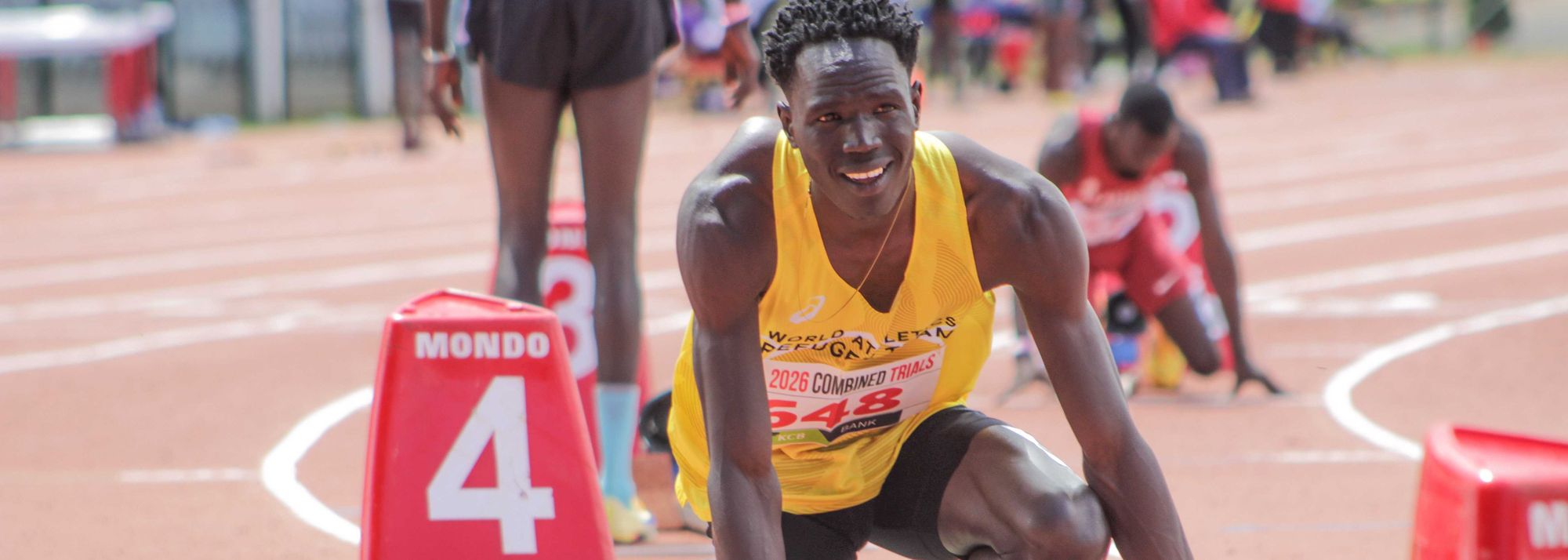


Solomon Ayela Okeny of the Athlete Refugee Team (© Martin Moses)
When war broke out in South Sudan in 2011, seven-year-old Kun Waar Liem fled to the Dadaab Refugee Camp in northeastern Kenya while his parents escaped to Ethiopia. He has not seen them since.
"We were in different places then, and survival came first. So we split. My parents and siblings went to Ethiopia. My elder sister and I came to Kenya."
He didn't know it yet, but years later, the refugee camp that once offered safety also became the starting block to his athletics career.
Kun, a 200m runner, is among the five athletes who will represent the Athlete Refugee Team (ART), an initiative of World Athletics, at the African Championships in Accra, Ghana, from 12-17 May.
His teammate, Solomon Okeny, crossed over to Kenya in 2010 with his mother and five siblings to Kakuma Refugee Camp. He initially started with football, playing for Kakuma United, but he got into running by chance.
"I saw a race where winners got water and glucose,” he said. “In Kakuma’s heat, that was enough. I joined and that’s how I discovered I could run."
The duo trains in Kenya's capital, Nairobi, under Duncan Ayiemba, who also coaches Africa's fastest man, Ferdinand Omanyala.
"He (Omanyala) mentors us a lot on how to progress in sprinting," says Kun. "When we are in training, we just try to catch up with him, and that's how we gain."
Okeny, who is a staunch fan of 400m world record-holder Wayde Van Niekerk, supports his sisters in Kakuma, by paying their school fees through his allowances and by teaching yoga, a skill he has learned over time.
"I left school to take care of my sisters,” says Okeny. “When free education ended in Kakuma and fees were introduced, I worried they might be pushed into early marriage. So I chose to lift them up through education. I'll go back to school this year."
While the sprinters train in Nairobi, the middle and long-distance teams are based in Kaptagat, approximately 300 kilometres northwest of Kenya's capital. The team is trained by 2007 world 800m champion Janeth Jepkosgei.
Like Kun and Okeny, Abdifatah Aden Hassan is preparing for his first major race outside Kenya, but the 1500m specialist is still unsure of the whereabouts of his parents. Hassan fled his home country, Ethiopia, in 2009, and he thinks his parents are still there.
"When the war started, people scattered. I went with the nearest relatives I could find, and we ended up in Dadaab Refugee Camp. I’ve been searching for my parents ever since, but I haven’t been successful yet."
He found his sister in Dadaab and grew up in the refugee camp. Hassan’s talent was spotted through the IOC Refugee Athlete Scholarship programme and the Tegla Loroupe Peace Foundation.
"We are refugees by name, not by choice,” says Hassan. “Let's live like others and work towards our goals; my dream for Accra is to be the best version of myself."
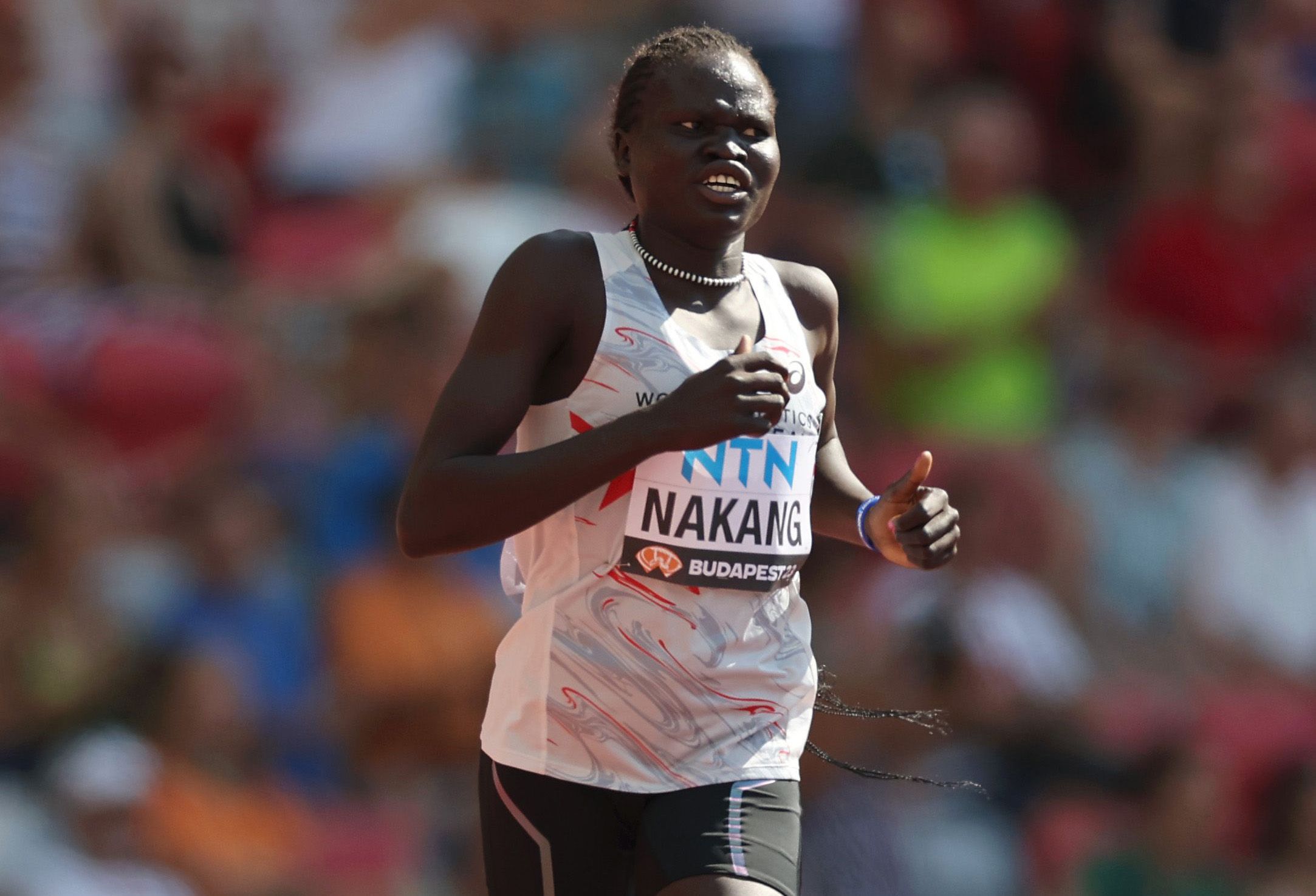
Perina Lokure Nakang at the World Athletics Championships Budapest 23 (© Getty Images)
For Lokoro Dario (men's 5000m) and Perina Nakang (women's 800m), the African Championships won't be their first major international outing. South Sudan's Dario competed at the World Athletics U20 Championships Lima 24 and is hoping for a better outing in Ghana.
"I ran the 3000m in Peru, but I will be competing in the 5000m in Ghana,” he said. “I ran 16:13 in the Athletics Kenya trials, and my target now is to lower it."
Nakang, also a native of South Sudan, remembers how her aunt grabbed her in the middle of one night in 2010 after the war broke out. They fled to Kakuma and were only reunited with her mother six years later.
She is the most experienced in the group, having competed in two World Athletics Championships and the Paris 2024 Olympic Games and is now ready to make her continental debut.
"The training has been going well,” she said. “I am just fine-tuning a few things. It helps to have a world champion as a coach, and I am hoping to lower my personal best in Accra."
Susan Nakiro is also part of the team in Kaptagat, but an injury ruled her out of the African Championships, which has only deepened her resolve to fight through another challenge in life.
In 2017, her parents left Nakiro, who is the eldest, and her five siblings at their home in Lauru, South Sudan, to work at a nearby mining site when war broke out.
"When the gunshots went off, it was scary, and I didn't know what was going on. I gathered my siblings, and I followed the fleeing villagers. The first few nights, we slept in the forest until we reached what I came to know as Kakuma Refugee Camp."
She found her aunt in Kakuma, but the harsh living conditions there meant that she had to fend for her siblings, which practically made her the head of the family at 14 years old.
In 2025, she was picked to join the group after she emerged second in the 200m, before she was later advised to switch to 1500m.
Her siblings are still in Kakuma, but she can now pay for their rent and food with the allowances she gets while in camp.
As they prepare to line up in Accra, the members of the Athlete Refugee Team do so with different stories, different targets and different distances to cover. But each arrives with the same purpose: to make the most of an opportunity earned through talent, resilience and the belief that their circumstances do not define the limits of their ambitions.
Martin Moses for World Athletics