










Stade Pierre-Paul Bernard in Talence, venue of Decastar
The Décastar, a World Athletics Heritage Competition site and World Athletics Combined Events Tour Gold meeting, celebrated its 50th anniversary last weekend at the Stade Pierre-Paul Bernard in Talence, beside the Bois de Thouars.
The 2026 edition again brought many of the world’s leading combined-events athletes to the venue.
To mark the anniversary, World Athletics Heritage contributed to the creation of bilingual historical timeline panels in French and English, offering visitors a concise journey through some of the performances and personalities that have left a lasting mark on the stadium.
Here are five dates that tell the story of Décastar.
1976 – A meeting is born
Talence opened a new stadium at Thouars in 1976, at the heart of a district then undergoing rapid development and close to the Bois de Thouars. That same year, a combined-events meeting was created there, the event that would become Décastar.
The star attraction was Guy Drut, newly crowned Olympic champion in the 110m hurdles, returning to combined events, where his athletics career had begun.
As night fell, the stadium’s football floodlights failed to illuminate the track sufficiently, and cars were positioned around the circuit to provide light for the 1500m. Drut, struck by cramp, did not finish the race, but still amassed 7525 points from nine events.
Out of that unlikely setting emerged a future legend. Britain’s junior Daley Thompson scored 7905 points, a world junior best at the time. He would go on to become a two-time Olympic decathlon champion and four-time world record-setter.
1992 – Dan O’Brien’s world record
Décastar produced its first senior world record in 1992.
After missing the Barcelona Olympic Games following a no-height in the pole vault at the US Trials, Dan O’Brien arrived in Talence determined to respond. In front of some 20,000 spectators over two days, he scored 8891, surpassing Daley Thompson’s world record.

Dan O'Brien in the decathlon in Talence in 1992 (© AFP / Getty Images)
World Athletics identifies O’Brien’s 1992 mark as one of the defining performances in Décastar history.
1994 – Heike Drechsler steps outside her speciality
Throughout its history, Décastar has also attracted champions from outside the combined events, athletes drawn to Talence for what might almost be called a competitive ‘recreation’.
Guy Drut had set the tone in 1976. Olympic pole vault champions Jean Galfione and Renaud Lavillenie would later follow in 1996 and 2013.
In 1994, it was long jump great Heike Drechsler who went further than a cameo appearance. She completed the heptathlon with 6741, the highest score in the world that year.
2004 – A women’s decathlon
In 2004, Décastar staged a third combined event alongside the traditional men’s decathlon and women’s heptathlon: the women’s decathlon.
Three years earlier, the international federation had approved the event and established an 8000-point threshold for recognition of the first official world record.

Marie Collonvillé in the decathlon at the 2004 Decastar (© AFP / Getty Images)
At Talence, France’s Marie Collonvillé exceeded that mark by 150 points, becoming the first official women’s decathlon world record-holder. World Athletics recognises her 2004 performance as another landmark in Décastar history.
2018 – Kevin Mayer’s masterpiece
Like O’Brien in 1992, Kevin Mayer arrived in Talence seeking redemption after a major championship disappointment, having recorded no valid mark in the long jump at the European Championships in Berlin.
His world-record attempt was prepared in near-secrecy. Over two days, Mayer assembled 9126 points, setting a world record that remains the benchmark to this day.
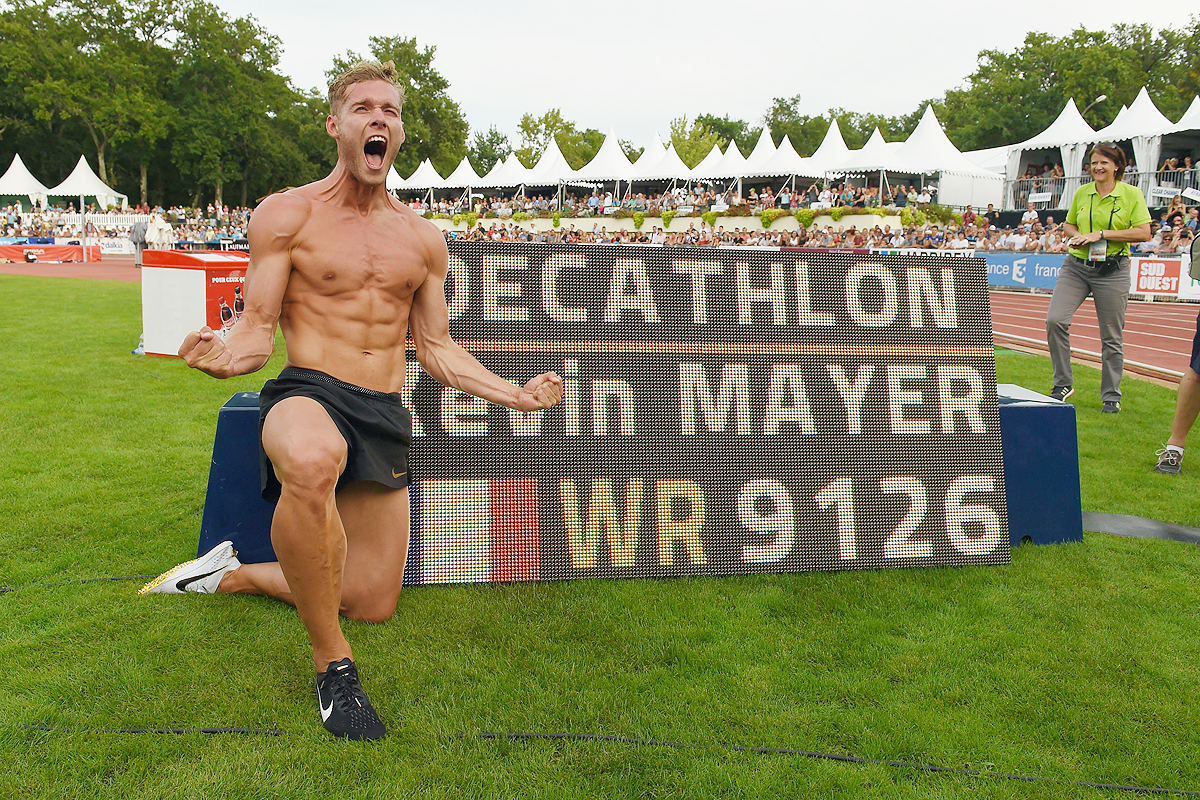
Kevin Mayer celebrates his decathlon world record at the Decastar meeting in Talence (© AFP / Getty Images)
The performance also became part of the Museum of World Athletics collection: Mayer later donated his complete competition outfit from the record – bodysuit, bib and shoes.
A stadium, a legacy
The stadium bears the name of Pierre-Paul Bernard, a major figure in the sporting and civic life of Talence. Founder of the local neighbourhood committee and later the Club Sportif de Thouars, he also served as a municipal councillor responsible for sport.
In 2019, Décastar was awarded a World Athletics Heritage Plaque in the Competition category, recognising its place in the global history of athletics. The plaque was formally presented in Talence the following year.
The guest of honour for the 50th anniversary celebrations was Christian Plaziat, a five-time Décastar winner between 1986 and 1991, and a contributor to the MOWA collection through the donation of the bodysuit he wore when winning the 1995 world indoor heptathlon title.

