

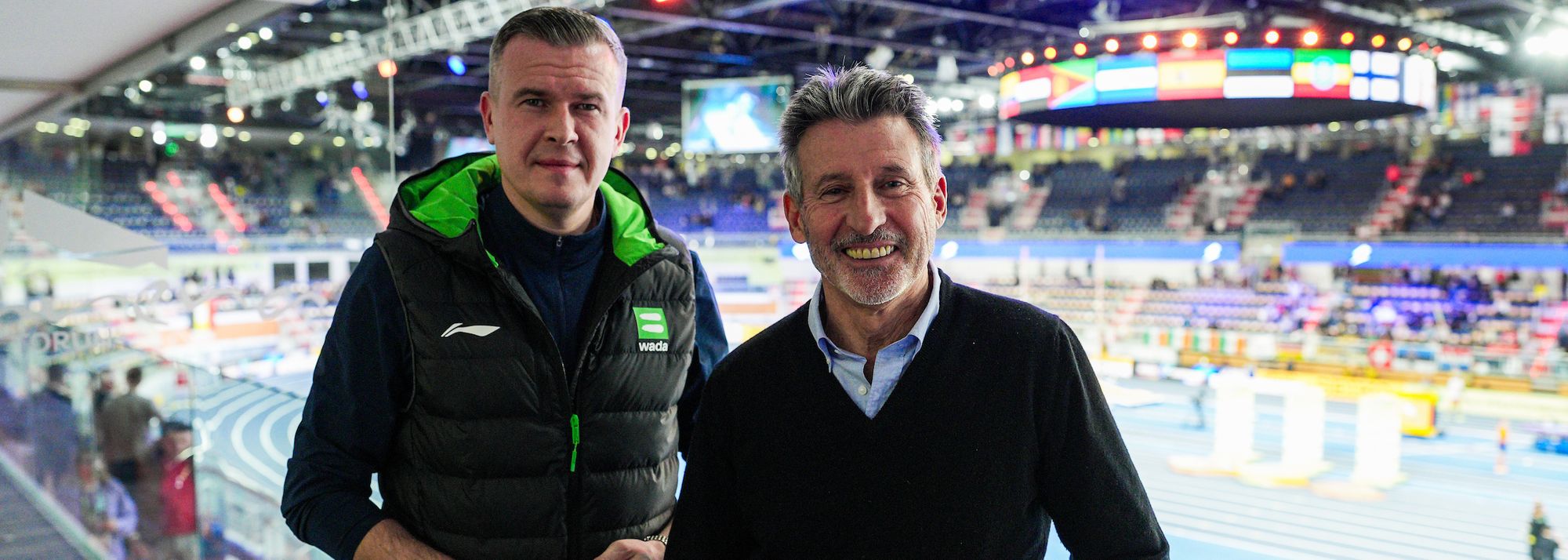


WADA President Witold Bańka with World Athletics President Sebastian Coe in Kujawy Pomorze (© World Athletics  Dan Vernon)
Call for unity and further collaboration among global anti-doping stakeholders
Emphasis on the importance of moving beyond compliance and investment in new research
World Athletics President Sebastian Coe and World Anti-Doping Agency (WADA) President Witold Bańka met at the World Athletics Indoor Championships Kujawy Pomorze 26 in Torun, Poland, on Saturday (21) to discuss the importance of unity and further collaboration within the global anti-doping system, the work of the Athletics Integrity Unit (AIU), and the need to move beyond compliance and invest more money into new research and further investigations.
Anti-doping was a key part of sweeping reforms introduced by Coe upon assuming his presidency of World Athletics in 2015, and it remains a priority for the organisation today.
The AIU was established in 2017 to oversee all matters related to anti-doping and integrity. It operates as a fully independent entity from the federation to ensure rules and regulations are applied objectively for the benefit of the sport as a whole across areas such as anti-doping, age manipulation and match fixing.
Since its establishment, the AIU has worked closely with WADA and they continue to collaborate on a number of cases. Just this week, a new milestone in sport’s integrity was reached with the announcement of the conclusion of a nearly decade-long pursuit of LIMS/McLaren cases in athletics.
This ends a process that began in 2017 and resulted in a total of 66 cases – stemming from the elaborate state-sponsored Russia doping scandal – being successfully prosecuted. As a result of exhaustive investigations, which began with the work of WADA, and subsequent prosecutions by the AIU, several world and Olympic champions were stripped of their titles.
Reflecting on the importance of the milestone, Coe said: “The global anti-doping system depends on effective collaboration between all stakeholders. The protection of clean athletes is not something we can achieve in silos. It is imperative that we work together.
“World Athletics and the AIU would like to acknowledge and thank WADA for their highly effective forensic work both in the context of the McLaren Investigation and Operation LIMS, which ultimately laid the foundation for bringing these cases in our sport.
“The outcomes in our sport show what can be achieved through genuine collaboration in the anti-doping movement, so it is important that all factions are united in the global anti-doping movement for the good of sport worldwide.”
Bańka said: “It was a pleasure to spend time with President Sebastian Coe during such a marquee event as the 2026 World Athletics Indoor Championships. Of course, as a Pole and a former sprinter, it is particularly thrilling for me to be here to watch the exciting action unfold. Attending big sporting events like this one is a reminder of why we dedicate ourselves to the promotion of clean sport and to the protection of the athletes, who work so hard to qualify and compete at this level.
“World Athletics and the AIU are strong partners for WADA. The anti-doping work being done by the AIU is commendable – it deals with a high volume of cases and is certainly one of the best anti-doping organisations in terms of quality of work. Looking ahead, WADA will continue to rely on their expertise and experience to play a leading role in the implementation of the updated World Anti-Doping Code and International Standards. President Coe has been a staunch advocate for the protection of clean sport throughout his presidency, and we look forward to continued collaboration with World Athletics and the AIU for many years to come.”
Presidents Coe and Bańka also acknowledged and discussed the need to move beyond compliance with the World Anti-Doping Code and towards more intelligence-based investigations as well as to further the investment into scientific research around anti-doping.
Coe said: “As I said at the Olympic Summit in December, while the global anti-doping system has made leaps and bounds in the last decades, collectively we can do more to ensure we are catching intentional cheats. We have great programmes in place, but we must continue building and expanding our efforts in investigations, scientific research and education.
“We must all do better to support our clean athletes by catching the dirty ones, especially those at the pinnacle of sport. So, let's resolve to strengthen our collective anti-doping system as we strive for cleaner, fairer and more credible sport.
“This means a collective pursuit of excellence. In the same way World Athletics created a state-of-the-art anti-doping unit in 2015, and when I was on the ASOIF Council we launched the Review of IF Governance, which will release its sixth Review this summer. What we saw with this initiative was a collective raising of both ambition and compliance to best practice. It significantly moved all international federations, including World Athletics, towards excellence.
“When it comes to anti-doping – federation or NADOs – we need the same collective pursuit of excellence. WADA would be perfectly positioned to set those standards.”
World Athletics