

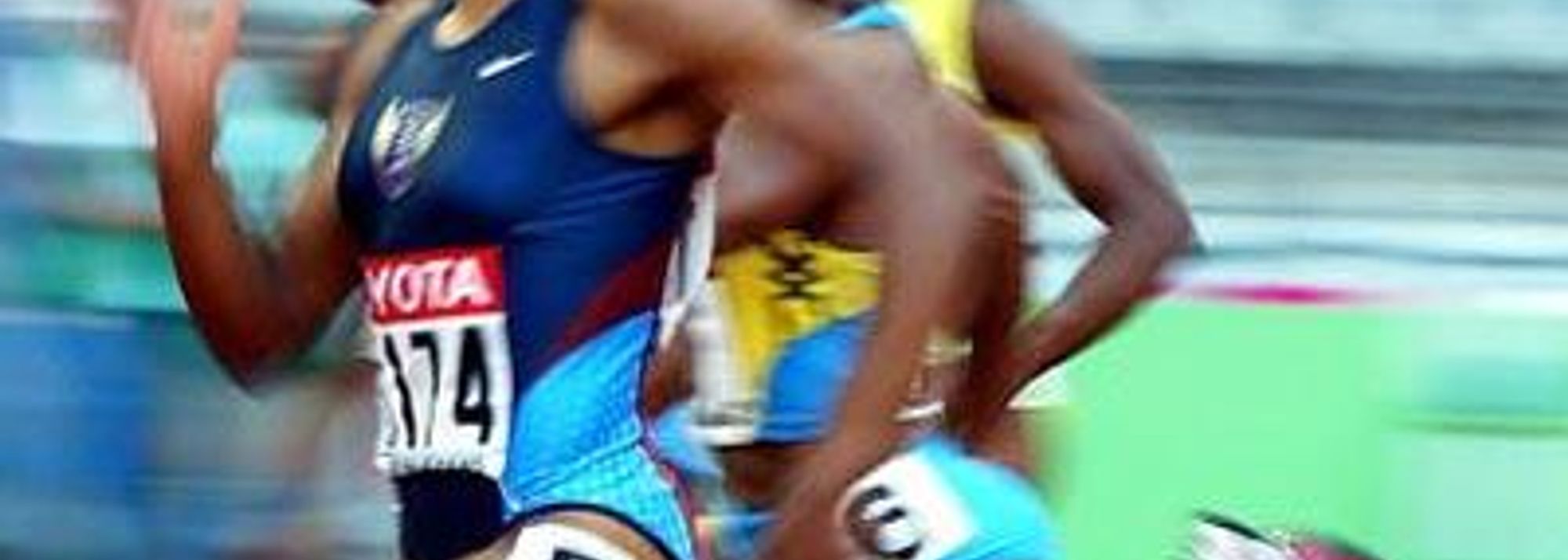


Kelli White on her way to winning her first individual world title (© Getty Images)
Even though she was born on April Fool’s Day, Kelli White made no joke about her claim as the world’s fastest woman with a powerful 100 metres win on Sunday night.
The 26-year-old American overcame a sluggish start and within twenty metres was clawing her way past the rest of the field and onto the top step of the victory platform with a personal-best of 10.85.
“I was surprised by that time,” White said, “especially after that many rounds. But I know that this is a great stadium with a fast track, so I felt the final would be quick.”
In dissecting the race itself, her self-depricating analysis was simple: “My start was just as awful as always, and my finish was great.”
Although tipped as a favourite in the days leading up to
the Paris clash, White was also witness to fine performances by as many as four other sprinters in the elimination rounds leading to the final, and she dared not take the pundits too seriously. It was flattering to wear the “favourite” label, perhaps, but also a little distracting.
Ironically, it was a loss by one hundredth of a second in the early European season which may have provided White with the means by which to secure the gold medal. In Oslo, at the first Golden League meeting of the season and only four days after the close of the US Championships, White finished second in a close race with Bahamas' Chandra Sturrup, who was fourth in tonight’s title race.
With the Golden League’s requirement of a clean slate of wins in order to collect the big cash Jackpot, the Oslo loss freed White of any further obligation in that elite series. She now could pick and choose her races, or simply rest and train.
She honoured commitments for the Paris and Rome competitions in early July, and then she went into seclusion until the Paris championships, surfacing only for a check of her condition during a compact three-day period in London and Berlin, which produced a pair of significant wins over her training partner Chryste Gaines and started the tipsters talking of gold.
White’s mid-summer base was in Germany, conveniently close to her current romantic interest, javelinist Boris Henry, who watched the title race tonight on television at home, while awaiting his own departure for Paris as part of the German team.
And the schedule makers have been kind to White in this regard, keeping her off the track next Sunday in order to devote full attention the Men’s Javelin final.
Given White’s family background, success at the top level should not be a total surprise. Willie, her father, was one of the top sprinters in California during his high school days in the 1950s, and her mother, Debbie Byfield, was a Jamaican Olympian at the Munich Games.
But beyond that genetic makeup, White credits much of her success to the long tenure with her coach, Remi Korchemny. The 71-year-old Ukraine native, an engineer by training, was instrumental in the double Olympic win of Soviet sprinter Valeriy Borzov in those same Summer Games which included White’s mother. Now, thirty-one years later, and with computers available to pick apart sprinting minutiae, the super-analytical Korchemny has helped another of his pupils achieve victory in the world’s sporting arena.
White’s association with Korchemny goes back ten years, beginning with her high school days near Oakland, California, and continuing via intermittent long-distance contact while she competed for the University of Tennessee. Finally, coach and athlete were permanently reunited in 2000.
It was almost by accident earlier this season that White, a 200 metres bronze medallist in the Edmonton championships, discovered her world-class potential in the shorter sprint.
After she clocked a wind-aided 11.04 in late March in an open competition in California, Korchemny frankly told her that there was more money to be made in the 100, and together they drew up plans to add that event to White’s active repertoire. With Austrian manager Robert Wagner’s influence, she was able to secure Golden League starts even before she won the US 100 metres title in late June.
But with all of the seemingly fairytale appearance of the 2003 season, the earlier road to White’s crowning achievement had some significant bumps, the most significant being an attack nine years ago by a knife-wielding stranger at a suburban train station in a case of mistaken identity, a mishap which nearly cost her the sight in her left eye. In addition, she had to deal with a severe plantar fascia tear last year which cut short her outdoor season.
Tonight, in the press conference accorded all medal winners, White was a model of grace and modesty. And she did not gloat over her achievement.
“Anyone can have one successful season, but to do it over and over makes you a true champion and a winner,” a humble credo for a most deserving athlete.


