

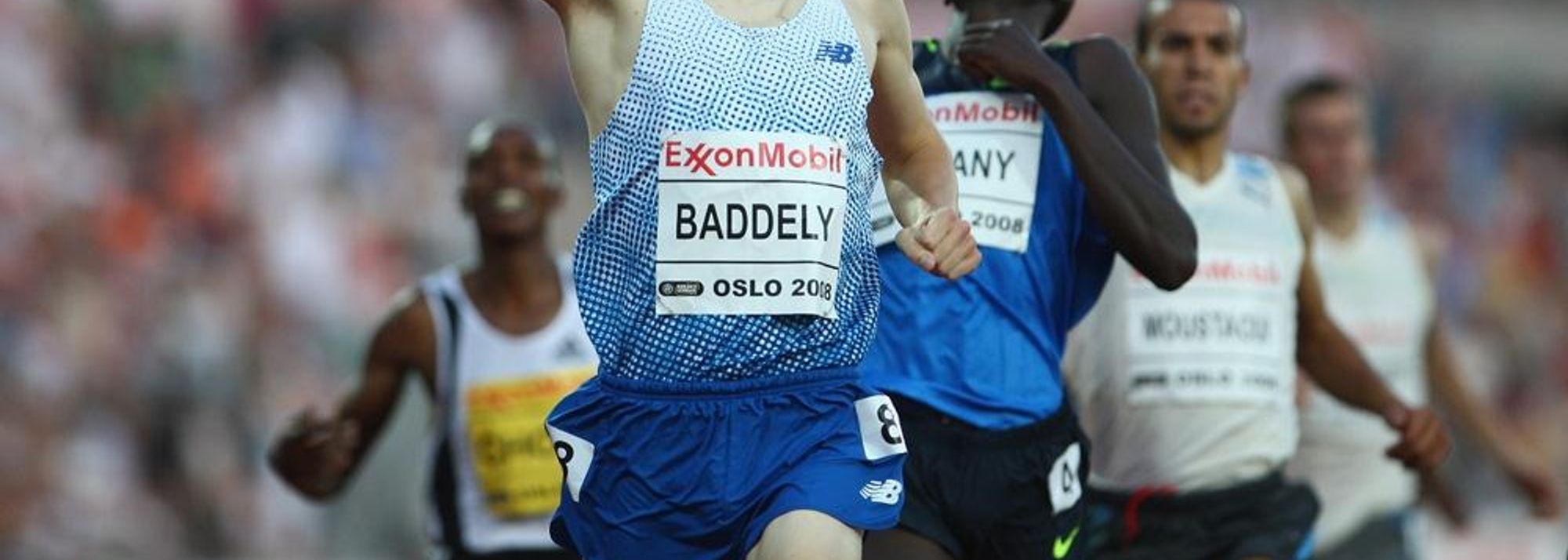


Andy Baddeley taking Oslo's Dream Mile in 2008 (© Getty Images)
As he heads towards the climax of what he describes as his “breakthrough season”, Andy Baddeley refuses to think beyond the first day of the Olympic athletics programme in Beijing. “My expectations are to go there with only one race in mind – that’s my heat on the 15th,” he says. “You can’t do anything in the final unless you make it through the two rounds before that.”
Barely a year as a full-time athlete
It may seem a statement of the obvious but don’t include Baddeley in the category of cliché-forming sportsman. Intelligent and amusing, the British athlete with the first class degree in aeronautical engineering from Cambridge University has defied a heart condition to move within striking range of an Olympic 1500m medal.
This month marks one year since Baddeley, a former part-time lecturer in sports science at St Mary’s College, Twickenham, became a full-time athlete at the age of 25. What took him so long? “My studies probably held me back but I think I’m more mature because of it,” he said. After winning the Dream Mile in Oslo and the European Cup 3000m this season, it is a maturity that is growing.
A succession of British middle distance runners labelled as the ‘Next Coe’, ‘Next Ovett’ or ‘Next Cram’ have come and gone while the nearest to greatness was achieved by Michael East. His 2002 Commonwealth Games 1500m triumph at least gave him partial claim, for a while, as the ‘Next Peter Elliott’.
Elliott was the 1990 Commonwealth champion but also Britain’s last Olympic 1500m medallist (1988 silver) and a world indoor record holder besides. Futhermore, he was the last Briton to win the Dream Mile in Oslo (1991) until Baddeley’s triumph on 6 June. Now, as the sixth Briton to break 3:50 (3:49.38 in Oslo), after Cram, Coe, Ovett, Elliott and David Moorcroft, all in the 1980s, he heads the IAAF 2008 Top List for the distance.
However, asked his realistic expectations going into Beijing, Baddeley, now 26, gave a measured response. “I feel confident but, at the same time, this is a breakthrough season for me and I am not going to get too excited,” he said. “I have got to get through the rounds first and that is foremost in my mind. I’ve always dared to dream of a medal, since I was little, but it is not realistic until you are in the final.”
Baddeley’s final Olympic warm-up race, in the Emsley Carr Mile, at the Aviva London Grand Prix, on 25 July, underlined his credentials as a potential Olympic medallist. He finished runner-up to Kenya’s Shedrack Korir, leaving World champion Bernard Lagat suffering his first defeat of the year in third place.
“I probably wasn’t quite close enough with 200m to go,” Baddeley reflected. “I expected Bernard to chase him a bit harder and I was sitting on Bernard but I was pleased with how it went - strong pace and a strong finish. I made the right moves at the right time and that’s what you’ve got to do to get through the rounds. Two or three more metres and I would have had him. I’ll just make sure I go two or three metres earlier in Beijing.”
Baddeley had announced his international potential in the 2007 Dream Mile when finishing third (3:51.95). His coach Andy Hobdell, a lawyer based at St Albans Crown Court, responded as any self-respecting coach would – by asking for more. “I’ve told Andy that I consider world-class running to be anything below 3:50,” adding that he believed he was capable of it.
And so it proved this summer as Baddeley triumphed in a field of 15 athletes in Oslo, of whom 12 were African. If there is a tendency to think that Africans dominate the distance, the statistics are mixed.
On the one hand, the last three Olympic champions have been from Africa (Noureddine Morceli, Algeria, 1996; Noah Ngeny, Kenya, 2000; Hicham El Guerrouj, Morocco, 2004). Seven of the nine medals from the last three Olympics have gone to Africa. At the 2007 World Championships, in Osaka, the top six were African-born, albeit the gold and silver medals went to Lagat, in the colours of the United States, and to Rashid Ramzi, representing Bahrain.
On the other hand, at the last Olympics, in Athens 2004, five of the top eight finishers were European, with Portugal’s Rui Silva taking the bronze behind El Guerrouj and Lagat. At the 2005 World Championships, in Helsinki, four of top six were born outside Africa, although the gold and silver went respectively to Moroccan-born Ramzi and Adil Kaouch, representing Morocco.
On Coe, Cram and Ovett: 'If they can do it, why can’t I?'
The last non African men’s Olympic 1500m champion was Spain’s Fermin Cacho in Barcelona in 1992. “I know who he was but I can’t remember watching him,” Baddeley said. “It’s the same with Coe, Ovett, Cram – I know what they achieved but I’ve watched the videos and I know what they used to run like.
“I don’t have to race Coe, Cram and Ovett. I have to race the guys I am racing now. They are up there on a pedestal but it shouldn’t be intimidating. It should be more a case of: ‘If they can do it, why can’t I?’”
Baddeley met Coe and Ovett for the first time this summer. “They were both very encouraging, very positive,” he said. “They gave me a few little titbits about the Olympics.” Such as? Baddeley smiles as he gives his answer: “Steve Ovett said ‘Don’t worry about it, it’s just another race’, Seb Coe said ‘It’s really special, it’s the Olympics’. So that was two contrasting points of view!”
Moving past a heart scare
In 2003, Baddeley gave up running “for eight to 12 weeks” to concentrate on his studies and, in 2004, he graduated. But it was in that year that he began to suffer heart palpitations in training. “My heart was beating very fast and irregularly,” he recalled. “I was finding it difficult to breathe and my left arm felt numb. It was all a bit scary.”
A chip was implanted beneath the surface of his skin to monitor the condition. Used to collect data, doctors concluded it was not life threatening.
Baddeley’s interest in the sport extends to shoe technology. “I was always keen to have the new shoes and I was always looking at what the new models were, what was different, and how they changed.” He said. “Then, this year, I met the New Balance innovation team in Boston and I was chatting to them about their new designs. Part of my degree was material science and I would love to be able to combine that with my running and the fact that I am interested in shoes.
“It all started when I used to sit at home – I was arty but I wasn’t very good - and I used to try to draw shoes and sports people. I had a whole book of faceless footballers because I could draw them but I couldn’t draw their faces!”
David Powell for the IAAF

