




Ja'Kobe Tharp celebrates at the NCAA Championships (© TrackTown USA  Julia Massa)
A week after breaking the world 110m hurdles record*, Ja’Kobe Tharp posted a video on social media of himself at age 15 jumping five hurdles.
His adolescent form, it must be noted, leaves a lot to be desired.
“That video was to show where I came from and where I am today,” the 20-year-old Auburn student said. The clip clocks in at just under 12.75 seconds, the eye-popping time he ran on 10 June at the NCAA Championships in Eugene.
While Tharp said “everybody laughed” at his early efforts, he never lacked confidence.
“Back then I was telling people: ‘Oh, I’m the best hurdler in the world’ and I’m still losing random races in Tennessee,” said Tharp, referencing his home state. “I was like: ‘Bro, they beat me this time, but I’m going to get them next time. And if I don’t get them next time, I’ll get them after that.’
“I always believed that I was the best and whatever I put my mind to, I can do to the utmost.”
Tharp was as good as his word, winning the world U20 title in 2024, becoming NCAA and US champion in 2025 and finishing sixth at that year’s World Championships in Tokyo.
Heading into the 2026 NCAA event, Tharp and Ken Harnden, the Auburn sprints and hurdles coach, knew he was ready to run fast after two 13.05 performances in May – one into a headwind. But no one expected a world record in the heats.
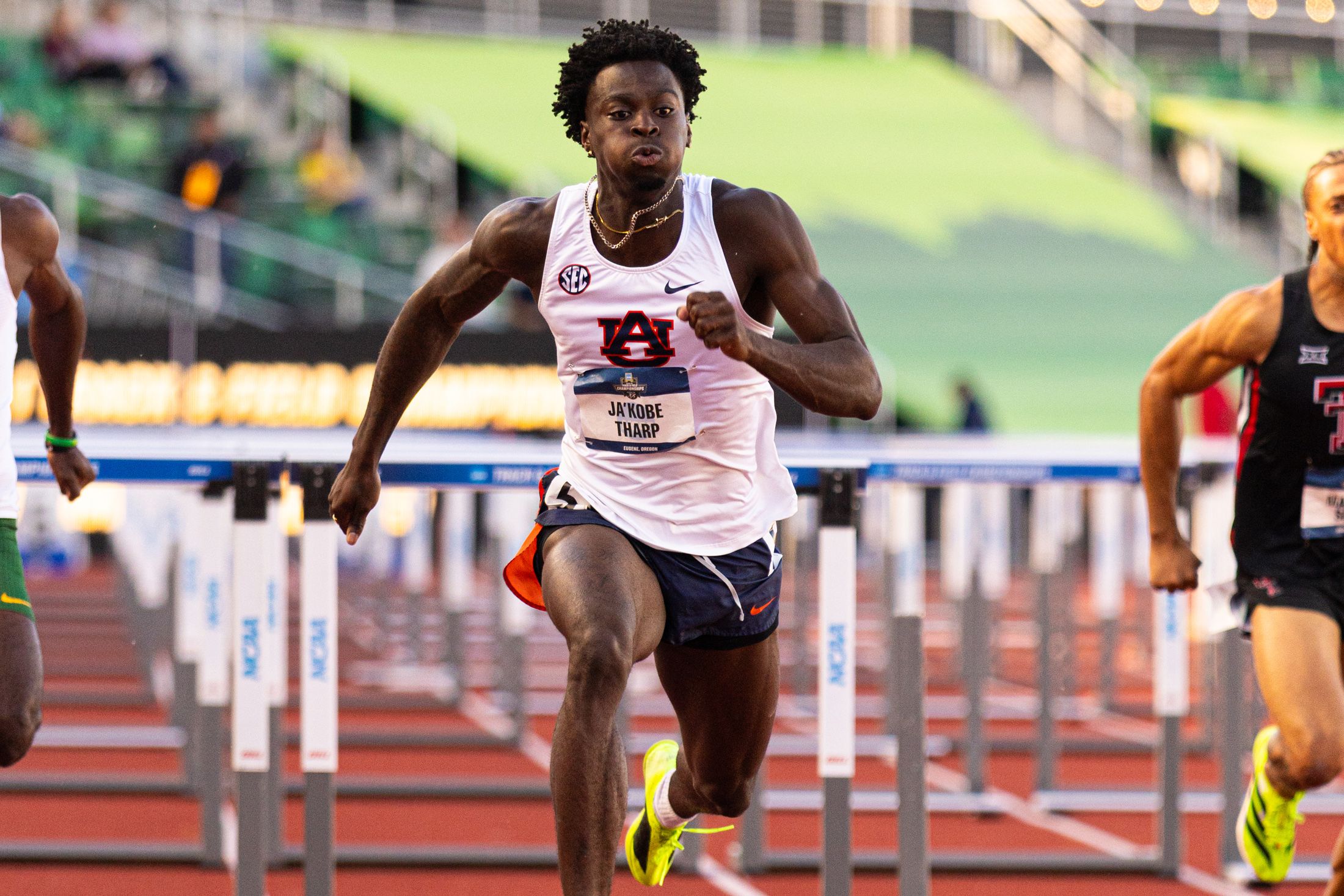
Ja'Kobe Tharp in action at the NCAA Championships (© TrackTown USA  Julia Massa)
“It wasn’t part of the plan,” Tharp said. “I swear I didn’t mean to.”
And certainly no one expected a time that had some people – including Tharp – wondering if the clock malfunctioned or if the run was wind-aided.
“It’s a crazy, insane time, so I was like: ‘Yo, did I just run that?’” said Tharp, whose PB was 13.01 from 2025. “And it corrected to something even faster than what flashed. It was 12.76 and they corrected it to 12.75.”
Tharp chopped 0.05 off the record Aries Merritt set in 2012 one month after winning the Olympic gold medal. Merritt was in Eugene as an assistant coach for Texas State. “He gave me congratulations,” Tharp said, “and said: ‘The sky’s the limit.’”
Former Auburn head coach Leroy Burrell, who recently announced a move to Texas A&M, knows what it means to be a world record-holder, having set the 100m mark twice in the 1990s. He told Tharp: “Hey, everything’s changed. You’re the big dog now.”
Tharp will put his undefeated season on the line on Saturday (4) when he competes at the Prefontaine Classic on the same Hayward Field track where he broke the record. Jamal Britt, who ran 12.89 in Paris, is also in the field for the Diamond League event along with world champion Cordell Tinch and world silver medallist Orlando Bennett.
Tharp has also been announced for the Diamond League meeting in Silesia on 23 August but has not confirmed any other summer one-day meetings. He just announced that he will turn pro before his senior collegiate season and plans to race in the inaugural World Athletics Ultimate Championship in Budapest this September.
“Ja’Kobe definitely thrives on pressure,” said Harnden, a two-time Olympian for Zimbabwe in the 400m hurdles. “He’s the best final five hurdles athlete I’ve seen since Allen Johnson (1996 Olympic champion).”
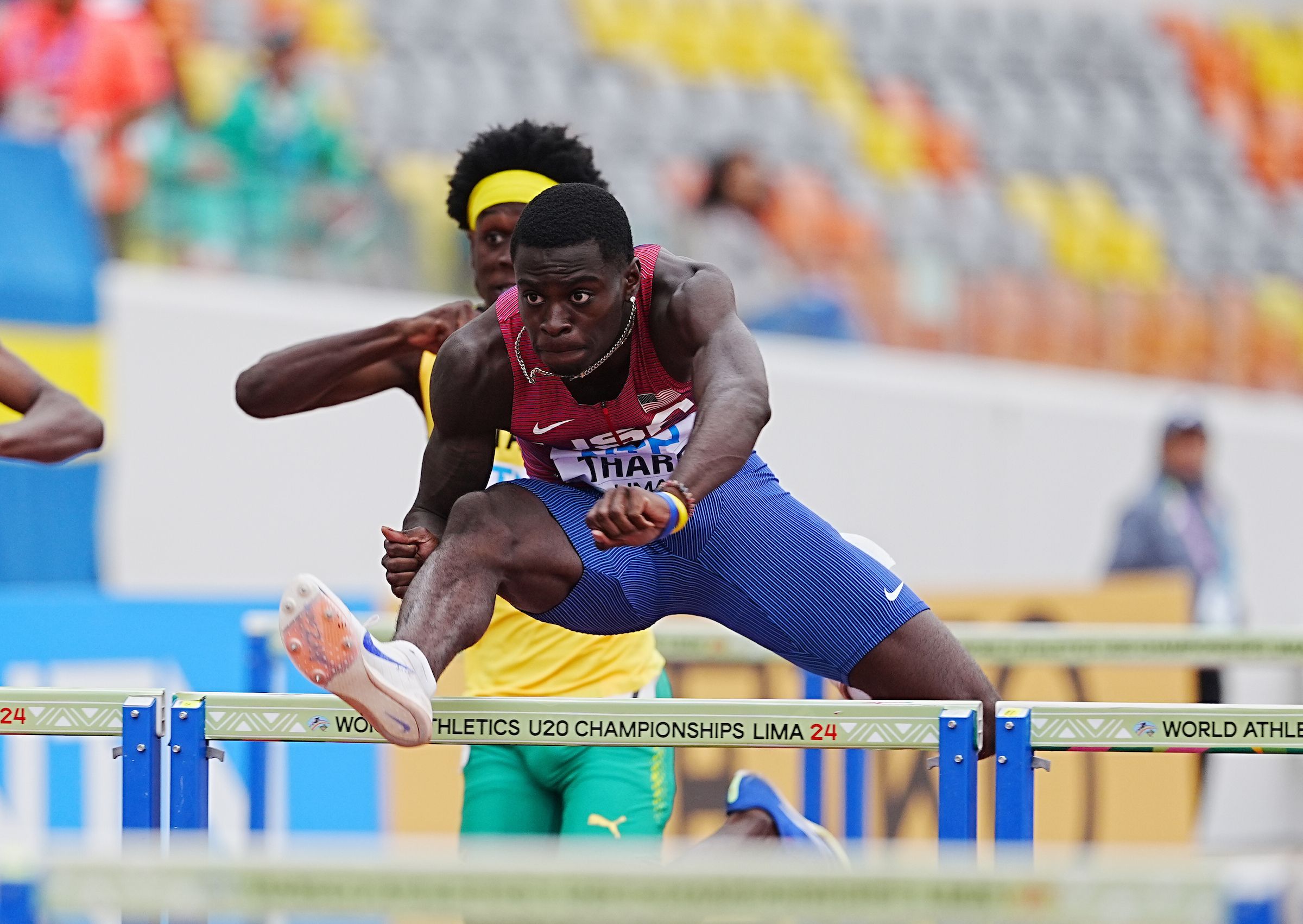
Ja’Kobe Tharp at the 2024 World U20 Championships in Lima (© World Athletics Christel Saneh)
On the nights before he competes, Tharp watches videos of fast races, such as Merritt’s world record or Olympic and world champion Grant Holloway’s collegiate record of 12.98 from 2019, which he also broke.
“Now I’m going to be watching my races at the end of the night,” Tharp said.
Burrell said there was “certainly an energy in the stadium” the day of the world record. “Kendrick Smallwood drops a 13.02 and clearly that set the tone.”
The Texas hurdler posted the fastest collegiate time of the year and Tharp, who was stepping into the blocks for the next heat, knew it would give Smallwood a boost of confidence.
“I wanted to send a message in round one the same way I did at indoor nationals with a 7.36 in the 60m hurdles,” Tharp said. “That I’m still here and I’m the best hurdler in the world.”
Tharp had what he called an “efficient start,” accelerated to separate from the field and powered all the way through the finish line with a legal wind (1.0m/s).
His closest competitor finished 0.40 back.
When Tharp realised what he had done, he thrust his arms into the air and bounced around the finish area.
Like all hurdlers, Tharp practices with the barriers placed closer together, but this was the first time he experienced the same feeling in a race.
“The last three hurdles, they were coming up fast,” Tharp said. “The closer they are, the more your body wants to reject and push away from it. So, you have to fight the urge to push back and kind of dive into the danger.”
The danger got out of his way. Harnden didn’t see the race because he was at the practice track, but when he finally saw Tharp, he told him: “You have one hour to celebrate and then we’re back to work.”
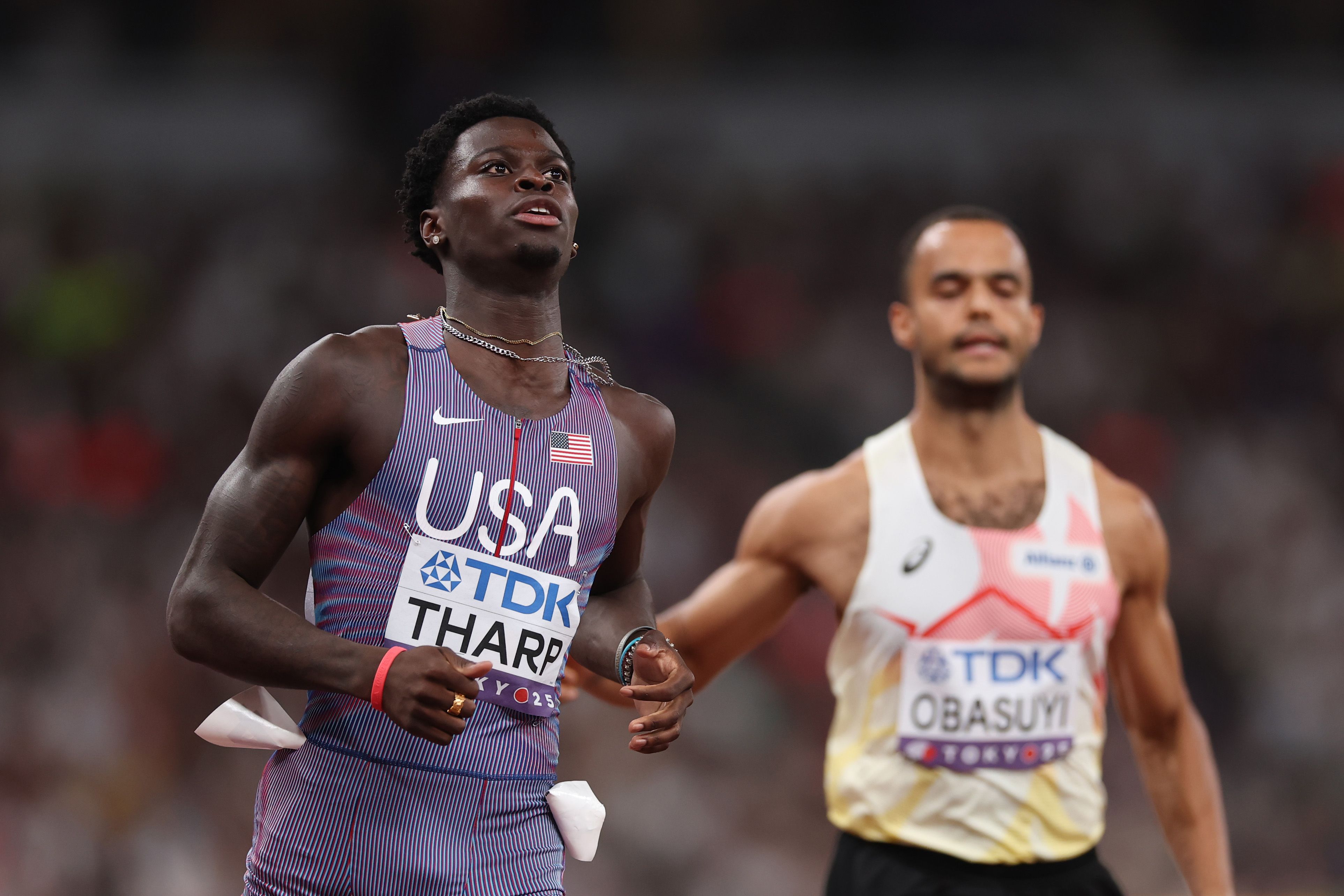
Ja’Kobe Tharp at the World Athletics Championships Tokyo 25 (© Getty Images)
The veteran coach said the “true measure” of Tharp’s talent is “the ability to bury the world record for 48 hours and come back and still be on your game. There were other athletes that had great performances in the prelims and couldn’t back them up in the finals.”
In that final, Tharp ran 12.90, which is still tied for 12th fastest all time. He defeated Smallwood, who was thrilled with his PB of 12.95.
Tharp said that compared to the NCAA indoor meeting in March, when he improved to a world-leading 7.32 in the 60m hurdles final, this time he took the wrong approach. He focused on speed instead of execution.
“If I try to run fast, it won’t happen,” he said. “But if I’m truly locked in on, ‘All right, I need to do this and this,’ amazing things happen.”
Growing up in Murfreesboro, Tennessee, Tharp’s first love was basketball, the sport played by his parents. When he didn’t make his middle school team, he pivoted to track and field. His coach saw he was all legs and assigned him to the hurdles.
Tharp eventually returned to basketball with dunking, naturally, his specialty.
At Auburn, he quickly adjusted to the higher collegiate hurdles and placed second at the NCAA Championships. The next year he made the transition from eight steps to seven in the run-up to the first hurdle and suffered some losses while adopting the new technique.
After placing second to Smallwood at the 2025 SEC Championships, Tharp recalled: “Coach Ken told me: ‘Remember how this feels.’ Coming into this year, I was like, ‘I don’t want to lose a single race at all.’’’
Tharp has added strength to his 1.93-metre frame by working out in the weight room, where he and Auburn’s NCAA 100m champion Kayinsola Ajayi of Nigeria engage in friendly competition.
“His confidence abounds and that’s part of what makes him really good,” Harnden said of Tharp. “You combine that with the physical tools, the work ethic, the level-headedness, the competitiveness – it’s a match made in heaven. You go back to some of the greats in our sport – Usain Bolt was able to combine all those things.
“His ability to step up to the level that is necessary is like Bolt. The lights come on and he’s your guy.”
Tharp has done research showing most hurdlers peak between ages 24 and 27, so he envisions a long career ahead of him. He talks frequently with Holloway, who helps him navigate his new status in the sport.
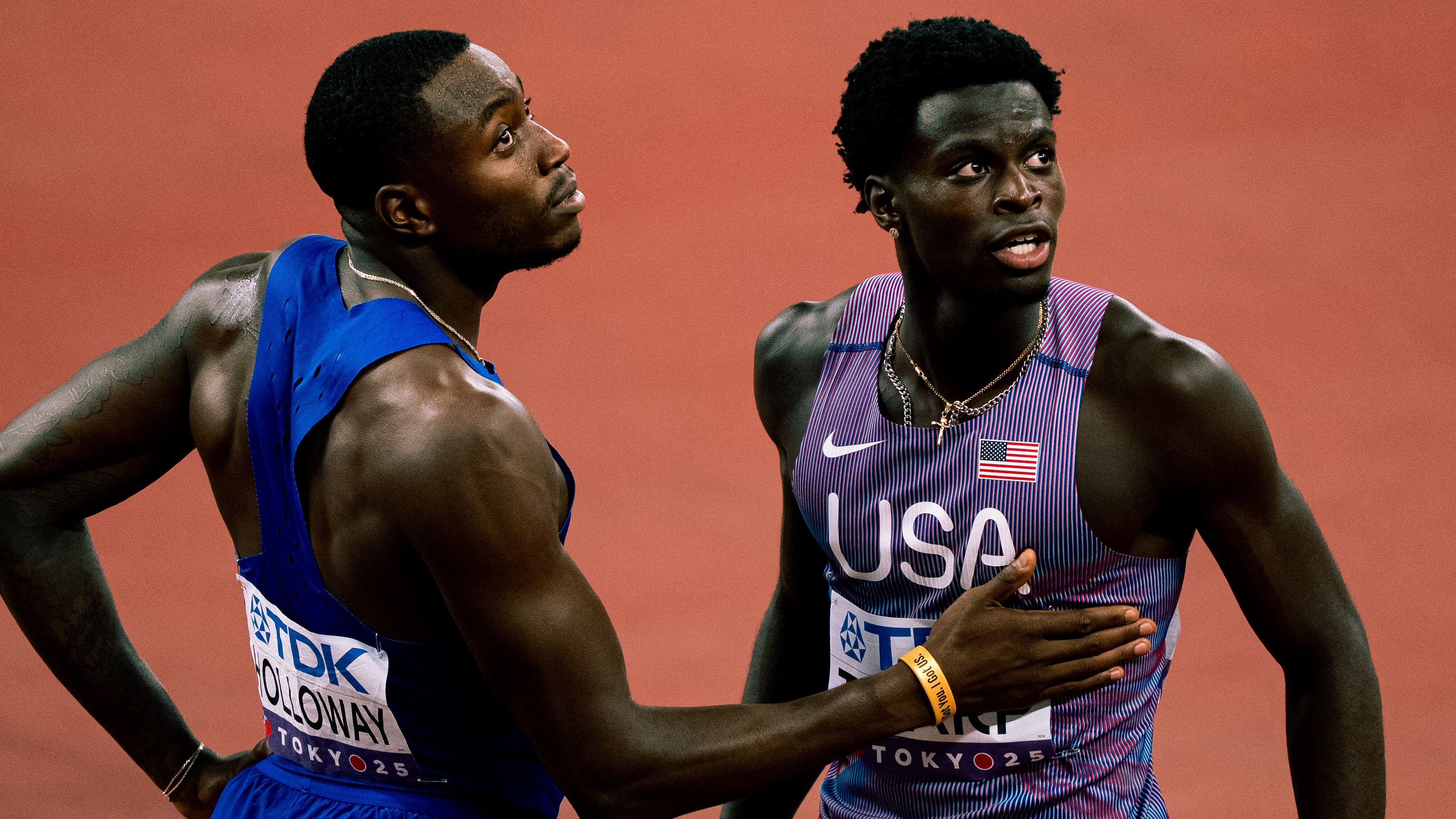
Grant Holloway and Ja’Kobe Tharp at the World Championships in Tokyo (© World Athletics Tyler DeWaard)
“I’m pretty sure I have more in my legs,” Tharp said.
How much more?
“I don’t want to throw a number out there,” he said, “but I think I can fix a lot of things about that (12.75) race. I could have put my trail leg down a little better on the earlier half, so I could have set up the ending better. But it’s just small, tiny technical things that will take me to the next level.”
Harnden considers Holloway the GOAT – the greatest of all time – not Tharp, even though he has the world record. “That’s where we’re trying to go,” the coach said, “but we haven’t won a world title or an Olympic title, and you can’t be the GOAT until you do that.”
While Tharp went into the Tokyo World Championships as the US champion, the long season caught up to him. After running 13.19 in the semifinals, he was disappointed with his 13.31 in the final. But he gained valuable insights.
“I was kind of shocked to see how big track was,” Tharp said. “It was really a humbling experience going there and seeing how many fans were there, and it made me want to work harder to go and show people who I am.”
He now admits that athletics has finally overtaken basketball as the No.1 sport in his heart, with one caveat. “It’s only fun,” Tharp said, “if you’re winning.”
Karen Rosen for World Athletics
*Subject to the usual ratification procedure


