
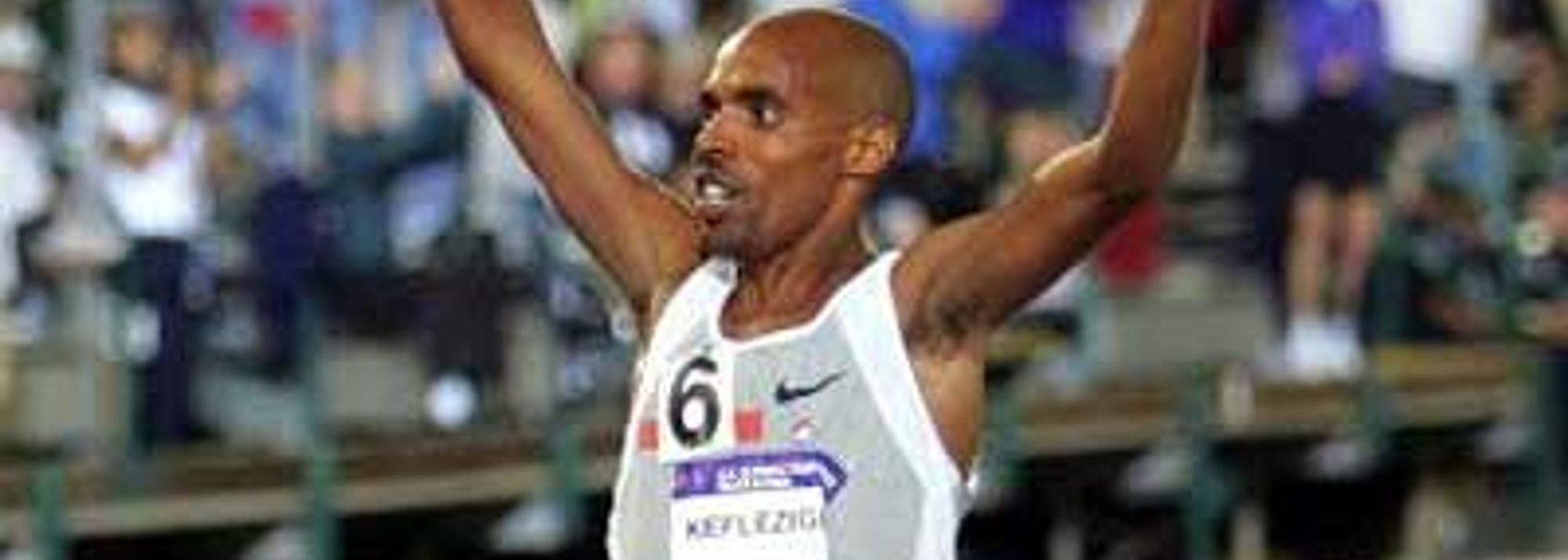


Mebrahtom Keflezighi wins the 10,000m - US Trials (© Getty Images)
The opening day of the US Olympic Trials (9 July) was devoted mainly to elimination rounds in most events, with Olympic team positions assigned only in the Men’s 10,000 metres, the first day’s final event.
Men's 10,000m - Keflezighi solo run
Already named to the US Olympic team in the Marathon, Mebrahtom Keflezighi ran solo for more than the final three kilometres to add an additional team spot in the 10,000m with a 27:36.50 victory, an Olympic Trials record.
Finishing behind Meb were Abdi Abdirahman in 27:55.0 and Dan Browne, another member of the American marathoning trio, in 28:07.34.
The pack of twenty-six runners began to unravel just after the 2K mark, and by 2400, four were pulling away. Meb, Abdirahman, Bob Kennedy, and Browne ran together for another kilometer before Kennedy suddenly dropped out at 3600.
Browne then fell back from the remaining two just before the halfway point, which Meb passed in 13:43.33. Meb and Abdirahman continued to run together for another two kilometres before Meb made his move to victory.
Meb and Abdirahman both have the Olympic “A” standard, as has Browne. Although Meb has previously indicated he would double in Athens, Browne’s Athens plans have not yet been confirmed. Should Browne give up his place in the 10K, then the next runner with the A-standard in the 10K placings tonight would be 21-year-old university student Dathan Ritzenhein, who has been suffering from a foot stress fracture and was the last finisher in 31:13.91. The non-finishing Kennedy is the only additional US runner who has achieved the A-standard.
Jones begins Olympic quest
Marion Jones’ quest for the same three individual Olympic team spots she secured four years ago began yesterday as well, with the 100 metres first on her Sacramento schedule.
Media interest centered primarily on the lead-off section which featured Jones. She and Angela Williams came away from the start virtually even, but halfway through the course, LaTasha Colander surged impressively to steal the race in 11.35, as Jones held second in 11.38 ahead of Williams’ 11.47, as a 1.6 headwind hampered the times.
Lauryn Williams showed one of the reasons she is second on the current world season list with an incredible start in the final heat. The NCAA champion blazed away to a 11.13 while battling a headwind of 0.8. Left to salvage the other places, Muna Lee (11.37) and Tremedia Brice (11.50) finished second and third.
“I was super nervous before the race,” said Williams. “Things weren’t coming together at the practice track. Maybe my nervousness turned out to be a good thing.”
Inger Miller was the victor in the second heat with a wire-to-wire 11.28, ahead of Chryste Gaines (11.39), as the headwind dipped slightly for them to 1.4.
In heat three, Gail Devers held the early lead, but with thirty meters remaining, Torri Edwards pulled even and just nipped the two-time Olympic 100 champion, as both were timed in 11.36 against a 1.0 headwind.
Shot qualification – Godina’s 21.55 heads list
Another eagerly awaited event was the Men’s Shot Put qualifying, as the world’s top four throwers went into battle together for the first time this season.
With a 20.50 automatic qualifier having been established, the top three on the US list met that criterion with ease. After opening with a meek 20.00, three-time world champion John Godina added a 21.55 to emerge with the day’s top throw.
“It was easy,” said Godina, not trying to be smug. “I’m in very good shape right now. I’m just waiting for tomorrow. Tonight was more like practice than qualifying for the big guys.”
Sydney silver medallist Adam Nelson was not far behind with 21.44, while the world leader for this season, Christian Cantwell, moved to the final with 20.91 after a leadoff foul.
Nelson agreed with Godina’s assessment of the true meaning of today’s qualifying round. “Tomorrow, that’s when the real destruction happens.”
“I can count up a couple of areas where I missed a half metre here, a metre there, so no worries,” said World Indoor champion Cantwell confidently. “Tomorrow will be good.”
Reese Hoffa, the fourth man on the stellar US list, completed the quartet of throwers surpassing twenty metres with 20.30.
Wind plays with the pole vaulters
Moderate temperatures topping out at 28C in the afternoon provided pleasant conditions for both athletes and spectators in the Alex G. Spanos Sports Complex, but the unseasonably cool weather also brought mischievous winds to the men’s Pole Vault.
For a twenty-four-man competition sporting no less than seven jumpers with season bests of 5.80 or more, it was unexpected that the final twelve jumpers should be determined in less than fifty-five minutes of jumping on two runways. Such were the swirling winds in the north end of the stadium.
No fewer than nine no-heights were recorded, among them Sydney silver medallist Lawrence Johnson and four-time US champion Jeff Hartwig.
The competition started at 5.40 but only one additional height (5.50) was needed to extract the finalists for Sunday’s competition.
World leader Toby Stevenson, and Sydney champion Nick Hysong were among that privileged dozen, as was former world indoor silver medallist Tye Harvey and Paris finalist Derek Miles.
Stevenson knows that fortunes can crumble quickly in the vertical jumps, and afterwards he spent more time commiserating with his friend Hartwig than discussing his own potential. A moment of candor finally emerged, however. “My heart goes out to him. He’s a great competitor. Am I relieved he’s out? Yeah!” said the helmeted Stevenson.
Long after the jumping appeared to have concluded, several isolated extra attempts were extended to Hartwig and Kurt Hanna, both of whom had successfully protested that time-keeping information had not been clear.
Hanna made use of the reprieve with a successful leap at the protested 5.40 but failed at 5.50, where he finished below the top twelve on a countback. Hartwig simply failed on his second chance as his luck had run its course, ironically in the same stadium in which he failed to earn a spot on the Sydney Olympic team.
When asked if he would still be around to compete for an Olympic spot in four years, Hartwig left no doubt with his answer: “Absolutely not - no chance!”
Long Jump - Lean but of the best quality – 8.37!
The ranks in the US men’s Long Jump may be thin at the moment, but the top layer today was of prime quality.
Paris World champion Dwight Phillips made a single attempt suffice with a 8.37 leap, a qualifying mark exceeded in Olympic Trials history only by Carl Lewis’ 8.39 in 1984.
Walter Davis, who was third in the 2000 Trials in both the long and triple jumps but competed only in the Triple Jump in Sydney, recorded a PB 8.25 to set up a potent duel in Sunday’s final.
NCAA champion John Moffitt had the next best jump with 8.08, as he rounded out the three competitors who exceeded long jumping’s benchmark eight-meter level.
A veteran of three world championships, 32-year-old Erick Walder, also advanced to the final with a 7.84 jump, the same distance recorded by Tony Allmond.
400m Hurdles qualifiers get underway
Both of the 400 Hurdles races began elimination rounds yesterday.
The first heat of the men’s 400 Hurdles produced a pair of notable casualties as Atlanta gold medallist Derrick Adkins and Sydney Olympian Eric Thomas pulled up after two and four hurdles, respectively. LaBronze Garrett won with 49.44, as Sydney fourth-placer James Carter moved through with 49.74.
The session’s fastest times came from the closest finish of the day, as LaRon Bennett (49.09) held off reigning World Junior champion Bershawn Jackson (49.14) in heat two, as defending Olympic champion Angelo Taylor scored a season-best 49.78 in third, despite crashing the first hurdle significantly.
The silver medallist in the Paris championships last year, Joey Woody, was well in control off the final curve as his 49.43 prevailed ahead of NCAA runner-up Bennie Brazell (49.53).
Regan Nichols was the remaining heat winner in 49.65, as La’Boris Bean scrambled for second with 49.89.
Glover on top
Sandra Glover posted the fastest qualifying time in the Women’s 400 Hurdles with a strong 54.52 heat win. Also winning heats were Brenda Taylor (54.98), Lashida Demus (55.14) and Sheena Johnson (55.64).
Johnson, the NCAA champion and one-time world leader in the event this year, would have run considerably faster had she not had significant step problems on the final barrier.
Kim Batten, the 1995 World Champion and former World record holder, advanced to the semifinals with a third-place 57.53.
Registering quality second-place times were Raasin McIntosh (55.25) and Shauna Smith (55.23).
Family affair – women’s 800m
The Clark family figured significantly among those advancing to the women’s 800 metres semifinals. Hazel posted a wire-to-wire win in 2:02.65, followed in the next heat by her sister-in-law Jearl Miles Clark, who came back in the final meters to nip Jen Toomey at the tape, 2:03.24 to 2:03.25.
Nicole Teter put on a surge in the final straight to outleg a cluster of runners and post a 2:03.30 win in the final heat, followed by Nakiya Johnson (2:03.55) and Sasha Spencer (2:03.58).
In the men’s 800 metres, Khadevis Robinson benefited from a fast pace by Jebreh Harris through the first 600m of heat one before kicking over the final 200 and into the tape for the fastest time of the day, 1:46.42 to the 1:46.67 for Harris.
A frantic scramble off an outside move brought Jesse O’Connell to a win in heat two with 1:47.95, ahead of Christian Smith (1:48.06) and former World Indoor 800 champion David Krummenacker (1:48.09). Last year’s NCAA champion Sam Burley moved to the semifinals with his fourth-place 1:48.18.
As he has done so many times, Derrick Peterson used a strong late kick to win the third heat with 1:47.83, as current NCAA champion Jonathan Johnson got a rare late surprise in the final sixty meters, finishing in a still-qualifying fourth with 1:48.87. Ahead of Johnson were James Hatch (1:48.40) and Elliott Blount (1:48.67). Sydney Olympian Bryan Woodward finished eighth in 1:50.96.
Runyan’s 5000m qualifier
After running near the back until the 2K mark of the Women’s 5000 Metres, Marla Runyan, the eighth-placer in the Sydney 1500 and last year’s US champion, broke away with a group of six runners in the first heat and slowly made her way to the front at 3800m. At that point, Runyan surged away as part of a four-runner group, as she held the lead for the remainder of the race enroute to a 15:36.75 victory, with Shalane Flanagan (15:37.42), Carrie Tollefson (15:38.64) and Melissa Butry (15:39.32) following closely.
The second heat began at a leaden pace but eventually picked up speed. After Amy Rudolph noticeably forced the tempo at 1500m, she and Jen Rhines moved out to make it a two-person race at 2300m. The pair cruised easily into the finish, with Rhines - a Sydney Olympian in the 10K and already named as an Athens marathoner - winning in 15:50.08 to Rudolph’s 15:50.63. A cluster of four followed, with Shayne Culpepper (15:54.74) and Melissa Gulli (15:55.60) taking the next two places.
Heptathlon – Day One
The first day of the Women’s Heptathlon was contested yesterday. Although running only the fifth-fastest time of the field in the 200, Tiffany Lott-Hogan still widened her heptathlon lead with a 24.53 clocking in the 200 to finish the first day at 3686. DeDee Nathan, who had stood second after three events, slipped to fourth overall after running only 25.27 in the half-lap race for an aggregate 3598.
The fastest time of the evening was registered by Michelle Perry with 23.08, despite a 1.6 headwind. Perhaps this was not totally unexpected after Perry’s scintillating 13.02 hurdles race against a 1.6 wind in the day’s first event.
That lifted her from eighth to third overall at 3634, behind Hyleas Fountain’s first-day total of 3659 which came as a result of her 24.05 sprint.
The top two women on the US season list in the Women’s Triple Jump came away with the top two marks, although in reverse order. Vanitta Kinard bounded to a wind-aided 14.07 to meet the automatic qualifying standard of 13.75, with Tiombé Hurd’s 13.99 resulting from a stout 2.9 breeze to also move ahead to the final on Sunday.
Last year’s US champion, Yuliana Perez, followed with 13.64, just ahead of the 13.62 of Shani Marks.
The US leader in the Women’s Javelin, Kim Kreiner, who finished second in the 2000 Trials, narrowly took the top qualifying spot with a 54.02 throw. Staying close to Kreiner was the 2002 national champion Serene Ross at 53.95. The defending US champion, Erica Wheeler, had the fourth-best throw at 52.64, being just nudged out by Dana Pounds at 52.68.
Ed Gordon for the IAAF


