

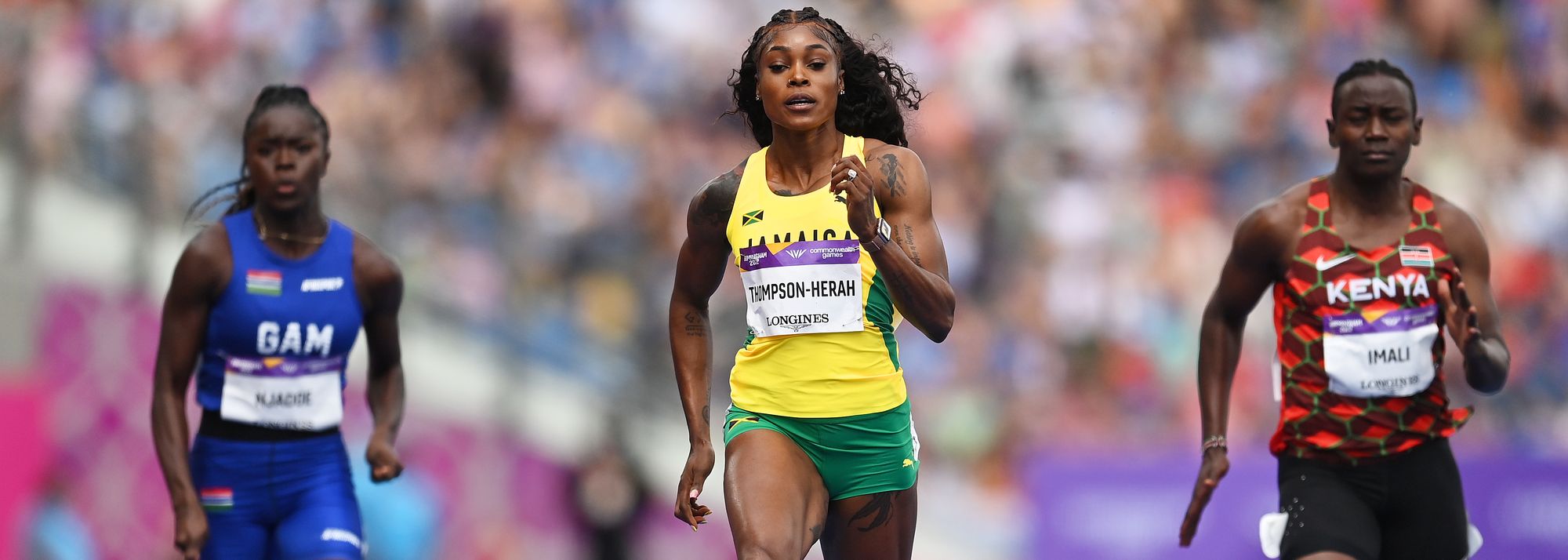


Elaine Thompson-Herah in Birmingham (© Getty Images)
As the fourth of the eight contenders in the women’s 100m final at the 2022 Commonwealth Games bounded out on to the bright blue Birmingham track, Katharine Merry, on commentary duty for the world television feed, gave a brief summation of the Jamaican sprinter’s CV: “Elaine Thompson-Herah…the fastest woman alive, five-times Olympic gold medallist.”
At the Prefontaine Classic in Eugene the year before, Thompson-Herah ran the 100m in a scorching 10.54, just 0.05 shy of the supposedly untouchable world record held by the late Florence Griffith Joyner.
Thompson-Herah also had a place in track and field posterity as the only woman to have achieved back-to-back Olympic doubles at 100m and 200m – alongside the only man to have accomplished the feat, Usain Bolt.
At the age of 30, however, Thompson-Herah had yet to win an individual medal of any colour at the Commonwealth Games. She had 4x100m gold from Glasgow in 2014, having run in the heats before making way for Schillonie Calvert in the final, plus a silver from the same event on the Gold Coast in 2018.
In individual events, she had made just one appearance, missing a medal by 0.01 as the fourth-placed finisher in the 200m in 2018, clocking 22.30 behind the victorious Bahamian Shaunae Miller-Uibo (22.09), her Jamaican teammate Shericka Jackson (22.18) and England’s Dina Asher-Smith (22.29).
In Birmingham in 2022, however, Thompson-Herah finally ended her drought.
At the renovated Alexander Stadium where she was a Diamond League winner over 100m in 2017, and in the central English city where she placed fourth in the world indoor 60m final in 2018, the Jamaican added her name to the select list of female athletes who have achieved 100m and 200m victories at a single Commonwealth Games.
Proudly sporting the yellow national singlet she has generously donated to the Museum of World Athletics, in the space of three days the fastest woman on the planet completed a sprint double last accomplished by Debbie Ferguson of The Bahamas in Manchester in 2002 and historically achieved by the Australian trio of Decima Norman (1938), Marjorie Jackson-Nelson (1950 and 1954) and Marlene Willard (1958).
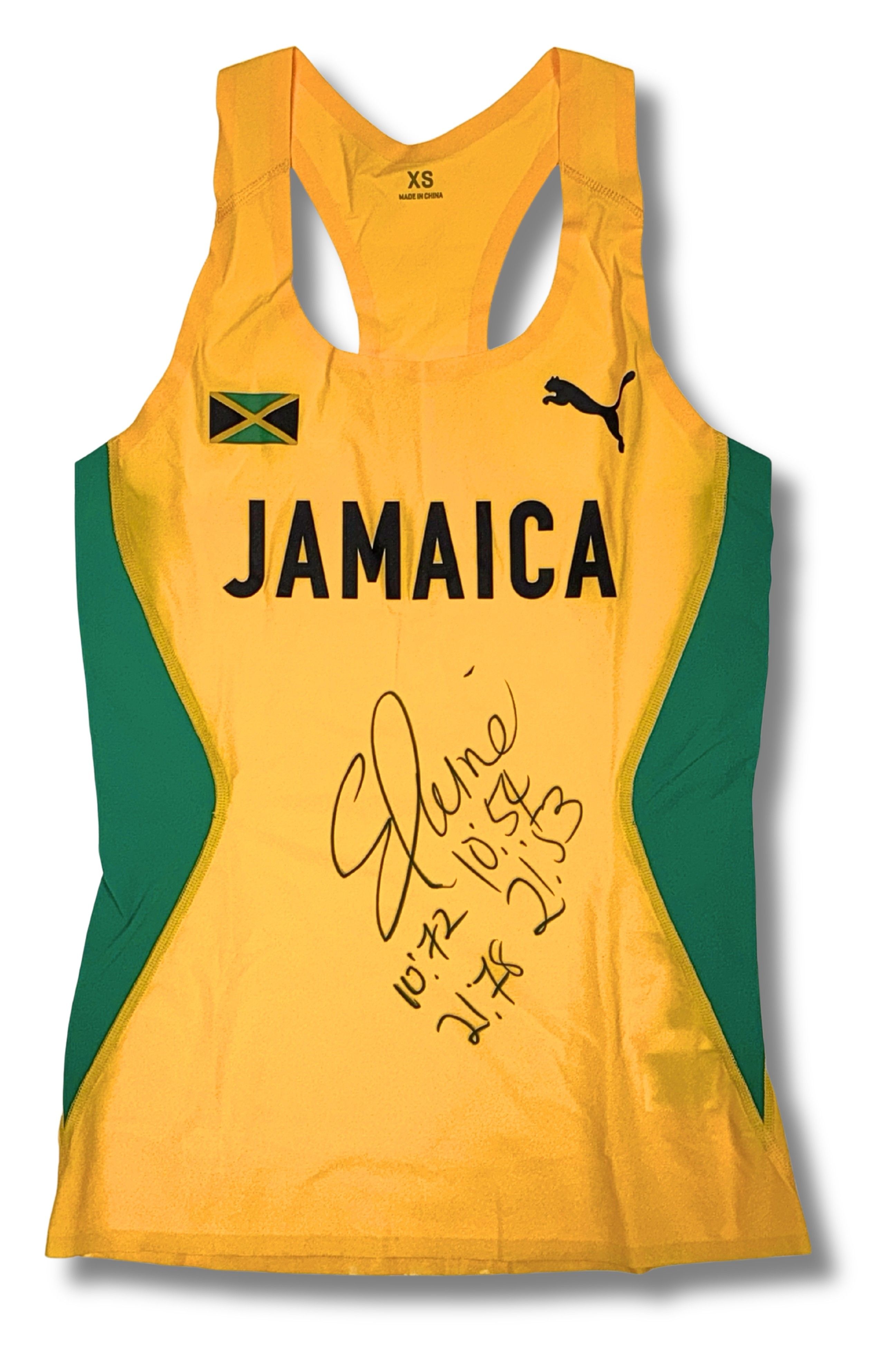
Elaine Thompson-Herah's 2022 Commonwealth Games vest (© MOWA)
First up, in the climax to the second day of track action, Wednesday 3 August, Thompson-Herah stamped her class on the 100m final, surging clear at 40 metres and crossing the line a clear winner in 10.95, with her future successor as Olympic 100m champion, the emerging Saint Lucian Julien Alfred, second in 11.01 and England’s Daryll Neita third in 11.07.
“I am grateful to win my first Commonwealth title,” Thompson-Herah reflected. “I started out as a rookie in the relay in 2014, then I was fourth in 2018 in the 200m. Now I have moved up to a gold.”
Three nights later, on Jamaican Independence Day, Saturday 6 August, the double-double Olympic champion stormed clear around the curve in the 200m final and finished five metres clear of the field in 22.02, slicing 0.07 off the Games record set by Miller-Uibo in 2018.
“It’s a big achievement for me to add to my resume,” said Thompson-Herah, who was followed home by Favour Ofili of Nigeria (22.51) and Christine Mboma (22.80), the 19-year-old Namibian who had taken Olympic 200m silver behind Thompson-Herah in Tokyo the previous year.
“It didn’t work out for me at the World Championships in Oregon last month, but I couldn’t dwell on that,” said the Jamaican. “I came here and got the double. I’m super happy with that.”
Thompson-Herah, who added 4x100m bronze to her medal collection the following day, had fallen short of global gold on the Oregon trail, finishing third in the 100m behind her compatriots Shelly-Ann Fraser-Pryce and Jackson and seventh in the 200m before contributing towards a second-placed Jamaican finish behind the US in the 4x100m.
As a youngster, Elaine Sandra-Lee Thompson was never one of the golden girls of Jamaica’s Boys and Girls Championships. Her highest placing at the annual sprint extravaganza more commonly known as Champs was fourth in the class two girls 100m final in 2009, finishing half a second behind the winner in 12.01.
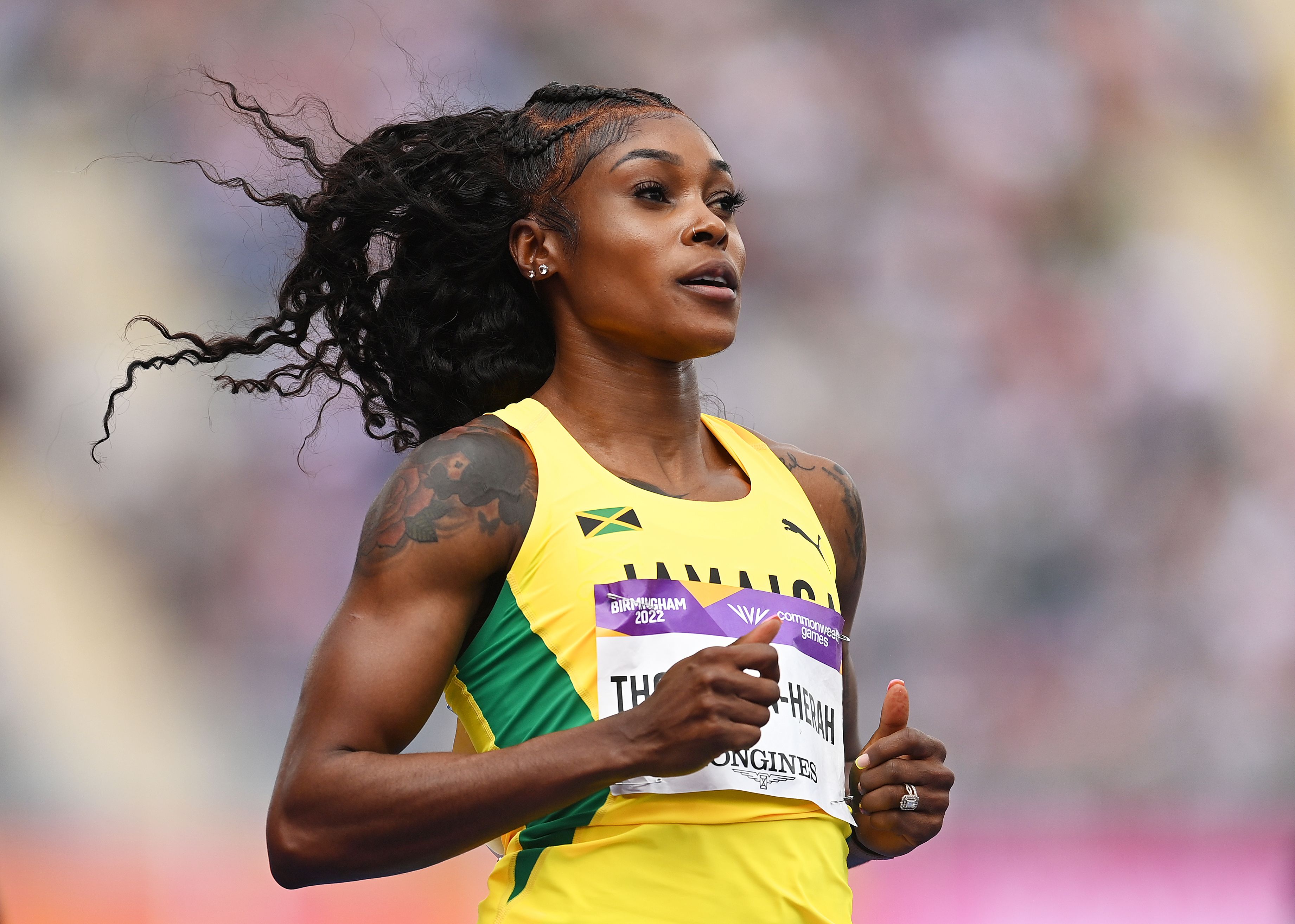
Elaine Thompson-Herah (© Getty Images)
Under the guidance of Stephen Francis, training alongside Fraser-Pryce in the MVP sprint stable at the University of Technology in Kingston, the girl from Banana Ground made her breakthrough at the 2015 World Championships in Beijing, claiming 200m silver behind Dafne Schippers of the Netherlands in 21.66 to go fifth on the all-time list.
In Rio a year later Thompson-Herah became the first woman since Griffith Joyner in 1988 to win the Olympic 100m and 200m. Hampered by achilles tendon problems over the next four years, she returned to form with a vengeance in 2021.
Following her 10.54 clocking in Eugene, she broke Griffith Joyner’s Olympic 100m record with 10.61 in Tokyo, then won the 200m in 21.53, which at the time was second only to the late US sprinter’s 21.34 world record. Gold in the 4x100m earned her membership of the Olympic women’s sprint treble club – alongside the original Flying Dutchwoman Fanny Blankers-Koen (1948), Australia’s Betty Cuthbert (1956) Wilma Rudolph of the USA (1960) and Griffith Joyner (1988).
At the World Championships, Thompson-Herah has only collected the one gold, from the 4x100m in 2015. Thus far, that is.
At the age of 33, after two years of achilles injury problems, she is on the comeback trail – under the guidance of Reynaldo Walcott at the Elite Performance Track Club.
After a couple of low-key outdoor 60m races in Kingston in February, she won the 200m in the Velocity Fest meeting at the National Stadium on 21 March, clocking 22.61 – her fastest time since clinching her Commonwealth double in Birmingham four years ago.
So there is time yet to savour a sprinter lauded by Patrick Robinson, the prominent international judge and author of Jamaican Athletics – A Model for 2012 and the World, as a phenomenon to behold.
“In Thompson-Herah, we see not just power raw and crude, but power refined and transformed into a thing of beauty,” he wrote last year. “The majesty of her running is without equal.”
Simon Turnbull for World Athletics Heritage


