

What is the Athletics for a Better World Standard?

Last updated: 2 October 2026
Contents:
Introduction to the Athletics for a Better World Standard
Requirements of the ABW standard
2026 Workshop Series for event organisers
Best practice guidance and examples
A key component of the World Athletics Sustainability Strategy, which was unveiled in April 2020, is to embed principles of sustainability into the delivery of all the events World Athletics owns or controls, like our World Championship events, and those we license or influence, like the events that make up our one-day athletics meeting series and tours and label road races.
To do that, actions around each of the six pillars of the strategy were built into two tools we developed to drive the strategy across all of our events: a Sustainable Events Management System, or SEMS, which offers best practice guidance in 15 key areas of event planning and delivery, and the Athletics for a Better World Standard, a system that evaluates, measures and scores an event’s achievement in sustainable delivery and in delivering the event in alignment with the six pillars that frame our strategy.
The ABW Standard consists of 55 action areas that address all levels of event delivery - including procurement, waste management, energy, food and water management, travel and accommodation planning. Diversity, accessibility and inclusion of staff and volunteers is also addressed. So is ensuring the health, safety and wellbeing of all participants and stakeholders. Another key aspect is partner, host city and athlete engagement in sustainability initiatives and concludes with guidance on monitoring, reporting and finally communicating about organisers' efforts and ambitions.
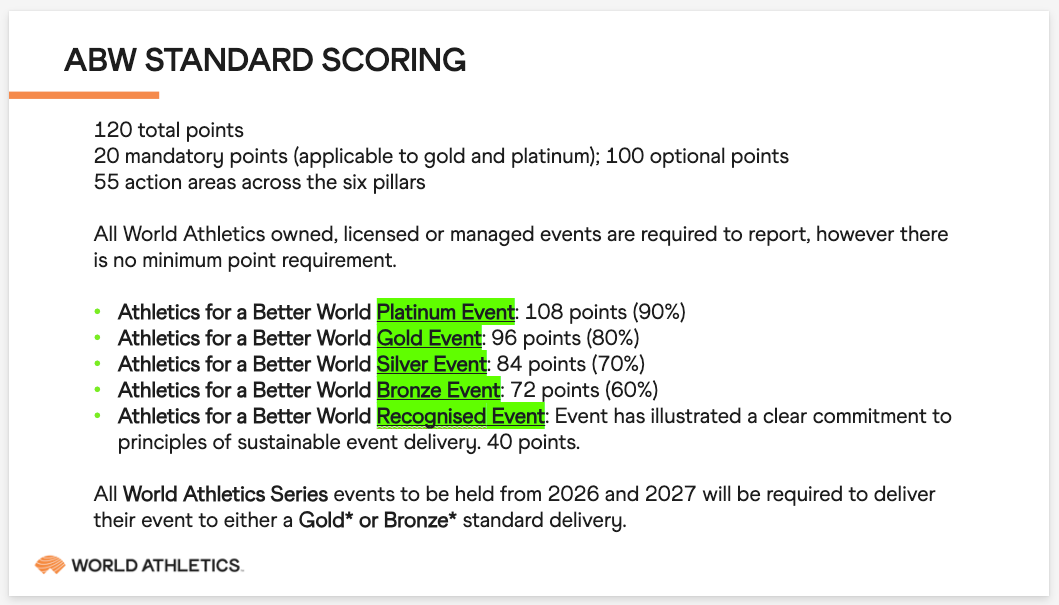
The standard is tiered, with platinum, gold, silver, bronze and recognised event achievement levels that will eventually have to be met as part of the evaluation process of all World Athletics-licensed events from 2024. All World Athletics Series events from 2026 or 2027 will be required to commit to a gold or bronze level achievement, depending on the event, making sustainability a core feature of all future World Athletics championships events.
See the list of ABW Certified events
The standard is also scalable so that any event at any level, from a local parkrun or club track and field meeting to a national or world championship, should be able to achieve the highest standard of sustainable event achievement.
The World Athletics Sustainability Strategy was the foundation of the management system we put together to ensure that sustainability is firmly embedded in our events. That system achieved ISO 20121 Sustainable Event certification in April 2023, an important milestone that lent credibility to World Athletics efforts and illustrated that the path we’re creating is the right one. That certified system also includes our Athletics for a Better World Standard.
Since it was unveiled in December 2021, organisers of more than 500 one-day competition series events and label road races have been introduced to the system. Several dozen events piloted the standard in 2022 and more than 100 piloted portions of it in 2023, providing valuable input prior to its implementation from 1 January 2024.
The system is also being incorporated into the delivery of all World Athletics Championships and increasingly into all World Athletics Series events.
World Athletics has a number of resources available to organisers to assist with the sustainability planning. They include 13 planning and reporting templates that will help you jump start your efforts. To gain access to the resource centre, please get in touch via sustainability@worldathletics.org.
Organisers of the World Athletics Championships Budapest 23 were the first local organising committee to fully embrace the Athletics for a Better World standard, giving it a full throttle test run at the event in the Hungarian capital. Organisers of the World Athletics Indoor Championships Glasgow 24, announced and delivered upon their strong ambitions by achieving the Standard's platinum level. With thoughtful and diligent planning and equally strong ambitions, the Local Organising Committee of the World Athletics Championships Tokyo 25 also acheived platinum.
The Oslo Bislett Games, part of the Wanda Diamond League series of the world's finest athletics competitions, was the first one-day event to reach the Platinum Achievement Level.
Requirements of the ABW Standard
Implementation of the Athletics for a Better World Standard has different objectives, depending on the event category.
Annually held events, such as those that are part of the Wanda Diamond League, the Continental Tour or Label Road Race series, are able to set longer term targets and objectives and chart their progress year-on-year through annual or biennial reporting. World Athletics Series events focus on both strong delivery and the sustainability legacy they create for their host venues and cities.
World Athletics Series (WAS) events will be required to meet the following achievement levels:
- World Athletics Championships - Gold (from 2027)
- World Athletics Indoor Championships - Gold (from 2028)
- World Athletics Road Running Championships - Bronze (from 2027)
- World Athletics Ultimate Championships - Gold (from 2026)
- World Athletics Relays - Bronze (from 2026)
- World Athletics Cross Country Championships - Bronze (from 2028)
- World Athletics Race Walking Team Championships - Bronze (from 2026)
- World Athletics U20 Championships - Bronze (from 2028)
One-day events are not required to meet a certain achievement level but are obligated, from 2024, to begin utilising the ABW Standard as a guidance tool and embedding it into the delivery of their events, and encouraged to target at least 40 points, the Recognised Event level. Event organisers who participate in the system's webinar series, requested one-to-one guidance from World Athletics and follow the planning templates should have the know-how and advice necessary to meet that threshold.
Reporting and evaluations
The ABW Standard is self-reporting via a web-based reporting platform. Organisers have three months to complete their reports. Submitted reports are reviewed and evaluated by the World Athletics sustainability team, which includes international recognised experts in the sport and sustainability space. Before issuing a final score, World Athletics will provide preliminary feedback to show where additional points may be scored. Select audits may also include on-site visits and follow-up virtual meetings. Organisers should allow 4-6 weeks for a completed evaluation.
If your event has not yet gained access to the reporting platform, please get in touch via email to sustainability@worldathletics.org and we'll get you set up. A tutorial on setting up an account and using the platform will also be provided.
An Excel version of the Athletics for a Better World Standard reporting form, which like the online platform includes the scoring methodology, performance requirements and guidance notes, is also available. Event organisers can request the latest version via email to sustainability@worldathletics.org.
The platform asks organisers to chart two point tallies, Points targeted and Points Requested.
The Points Targeted total serves two purposes: the first, to help organisers map their ambitions; and the second, to inform World Athletics of an event's ambitions. World Athletics will try its best to organise on-site third party verification for all events targeting gold or platinum achievement levels. At least three months advance notice is required to schedule a visit by a third party verification auditor.
The Points Requested total indicates the points organisers feel should ultimately be awarded based on the evidence provided. It is that total that will be evaluated by World Athletics.
2026 Workshop Series for Event Organisers
The World Athletics ABW Standard Workshop series was introduced in 2023 to help acquaint event organisers with the Standard and to help get their sustainability initiatives up and running. The 2026 workshop series has been specifically designed based on organisers' feedback. The schedule:
-
- Thursday 29 January - Communicating & Promoting What You Do - 10:00-10:45 CET
- Thursday 5 February - Open Format / ABW Intro. 10:00-10:45 CET
- Wednesday 11 February - Open Format / ABW Intro. 16:00-16:45 CET
- Wednesday 18 February - Finding Time and Resources for Sustainability Initiatives - 16:00-16:45 CET
- Thursday 26 March - Organisers Spotlight - a Panel discussion - 10:00-10:45 CET
- Tuesday 21 April - Partnerships for Community Impact - 16:00-16:45 CET
- Wednesday 20 May - Sustainability Reporting - Tell us & Show us - 10:00-10:45 CET
- Thursday 25 June - Communicating & Promoting What You Do - 16:00-16:45 CET
- Tuesday 21 July - Finding Time and Resources for Sustainability Initiatives - 10:00-10:45 CET
- Wednesday 16 September - ABW Standard Reporting workshop for Indoor Athletics Events- 14:00-15:00 CET [Registration link]
- Thursday 30 September - Open Format / ABW Intro - 10:00-10:45 CET [Registration link]
-
- Thursday 29 October - Organisers Spotlight: Best Practice at Sustainable Athletics Events. - 16:00-16:45 CET - [Registration link]
-
- Thursday 24 November - Impacts on Air Quality, Nature and Local Environment - 11:00-11:45 CET [Registration link]
- Wednesday 16 December - Partnerships for Community Impact - 11:00-11:45 CET [Registration link]
Workshop participation is free but registration via the links provided is required. If you have trouble registering please contact us at sustainability@worldathletics.org.
Check back here regularly for calendar updates.

World Athletics Sustainable Event Best Practice Guidance and Examples
[Sustainability Leadership] [Developing Your Sustainability Plan] [Sustainable Procurement] [Waste Management] [Energy Management] [Food Management] [Water Management] [Travel Planning] [Accommodation] [Carbon Neutrality] [Air Quality] [Diversity, Accessibility and Inclusion] [Health Safety Wellbeing] [Monitoring and Reporting] [Communications]