

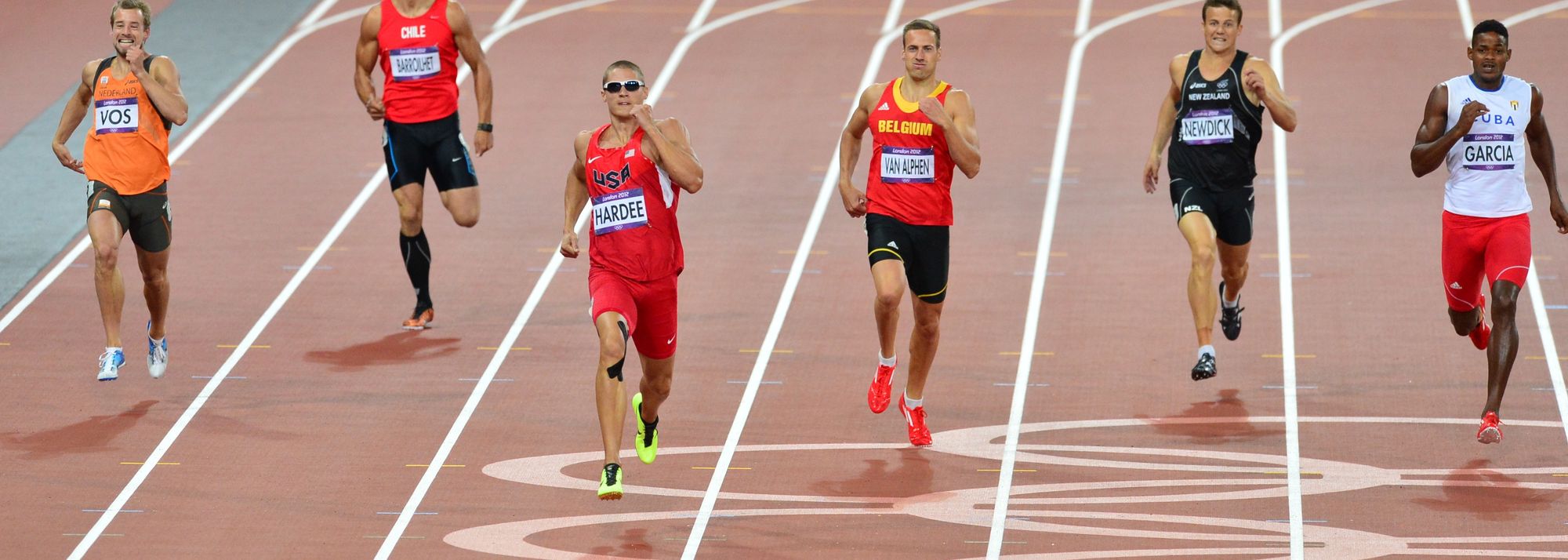


Trey Hardee at the London 2012 Olympics (© AFP / Getty Images)
Behind the shades shielding his eyes from the glare of the late evening floodlights, it was not difficult to imagine the thoughts of James Edward Hardee III as he crossed the line to win heat three of the decathlon 400m at the London 2012 Olympics.
His time, 48.11, was bettered by the winner of the final heat, his US teammate Ashton Eaton clocking 46.90, yet the well-paced effort completed a soundly measured opening day by the native of Birmingham, Alabama (also the birthplace of Carl Lewis), better known to the world as ‘Trey’ Hardee.
It left the 28-year-old a clear second in the standings with 4441 points, a huge 220 points down on Eaton, the newly established world record-holder, but steadily on course for a place on the podium.
As he packed away the bright yellow sprint spikes – which he has generously donated to the Museum of World Athletics – Trey Hardee had reason to be more than satisfied with that state of affairs.
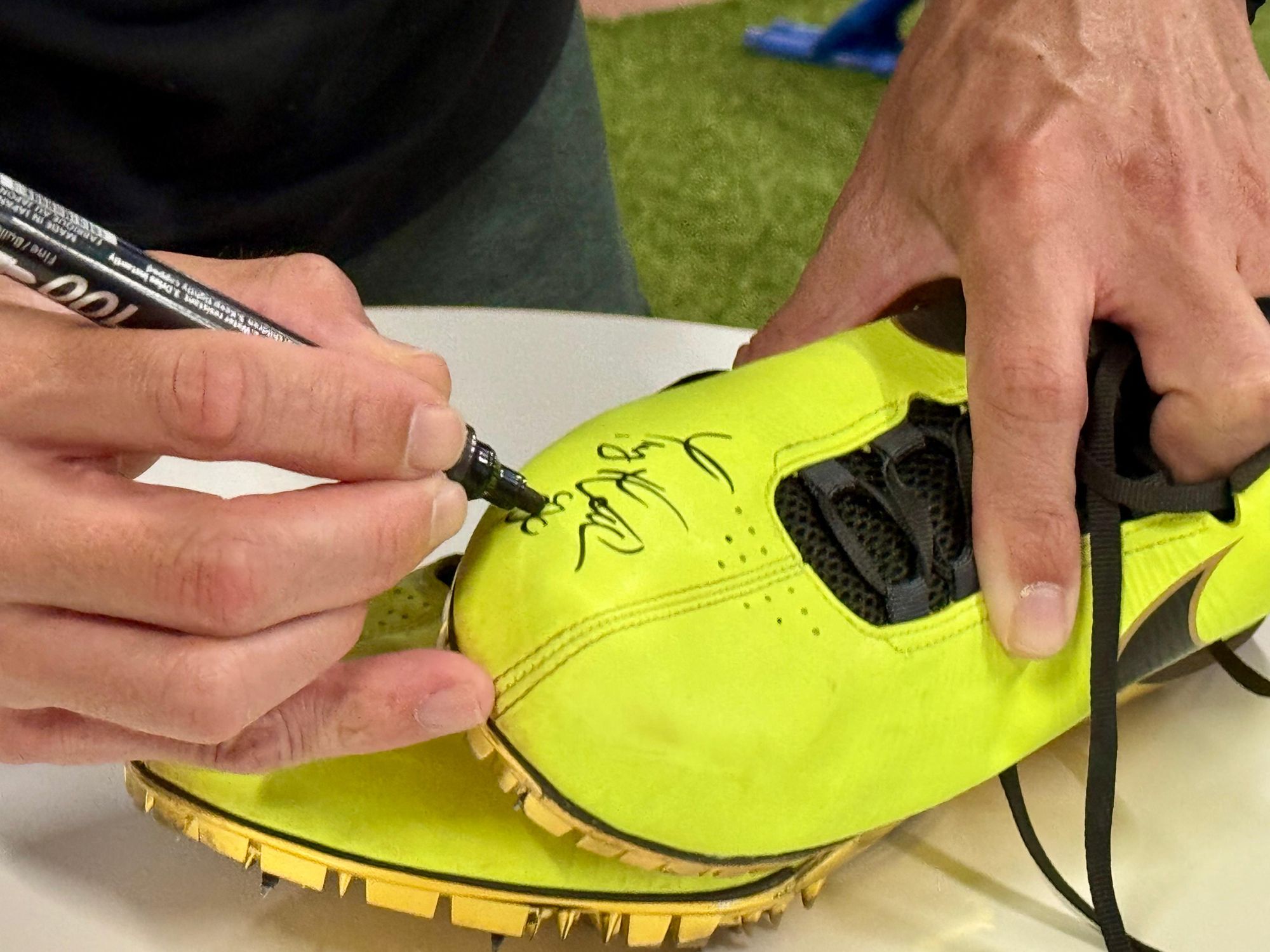
Trey Hardee signing his shoes
He might have been the reigning world champion, having backed up his 2009 victory in Berlin by successfully defending the title ahead of the rapidly improving Eaton in Daegu in 2011, but his Olympic ambitions had been left in serious doubt by the painful legacy of his victory in South Korea.
In the penultimate event in Daegu, the javelin, having opened with a lifetime best of 68.99m, on his third attempt Hardee ripped the ligaments in his right elbow.
“I only had an hour and fifteen minutes to get ready for the 1500m and at that stage there was not a lot I could do,” the Alabaman recalled in an interview for the World Athletics series My greatest challenge. “I took a painkiller and taped up the elbow to 90 degrees, so I ran like a robot.
“In the end, running this way was not bad because the pain acted as a distraction from the process of the race. I crossed the line in 4:45.68, which was some way short of what I could have run, but I had won the gold by 102 points from Ashton.”
Hardee turned to a celebrated surgeon in his home town in a bid to rebuild his golden arm for the London 2012 Olympics. A former pole vaulter, Dr James Anderson had forged a reputation for healing sports stars stricken with shoulder and elbow injuries, the basketball icon Michael Jordan and legendary golfer Jack Nicklaus among them.
Hardee underwent ulnar collateral ligament reconstruction, more popularly referred to as Tommy John Surgery after the Major League baseball pitcher whose stellar career was saved by the procedure – in which the ulnar collateral ligament in the medial elbow is replaced with a tendon from elsewhere in the patient’s body.
It was still touch and go whether Hardee would be ready for the US Trials, or make the top three. While Eaton reeled off a series of stunning marks en route to a world record of 9039 in Eugene, Hardee took it one event at a time, concentrating on keeping his body together and making the team.
Having picked up a javelin for the first time since Daegu just two weeks earlier, he managed to throw it out to 57.00m at Hayward Field. “As soon as it landed, I threw off my brace and ran around like I had just won the lottery,” he recalled.
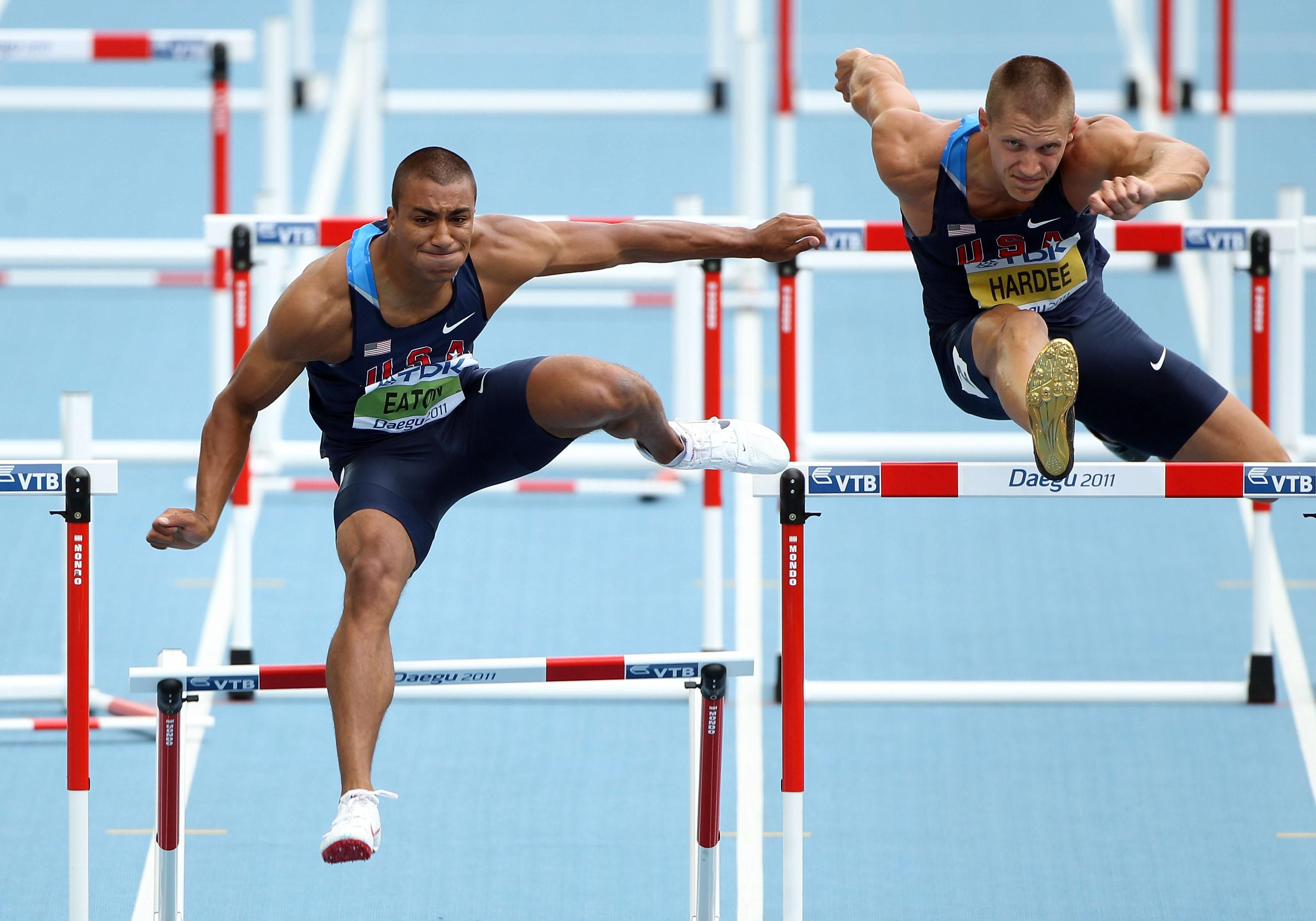
Ashton Eaton and Trey Hardee battle it out in the 110m hurdles in Daegu (© Getty Images)
Hardee’s final points tally, 8383, was a long way down on the 8790 from his 2009 world title win that would remain his career best, but it was good enough for second place behind the new world record-holder and a hard-earned spot on the US Olympic team. “I knew I’d been given a gift and a bunch of chips just by making the team, so I could just enjoy myself in London,” he reasoned.
Hardee didn’t waste his chips in the British capital. Opening with 10.42 in the 100m, then long jumping 7.53m, putting 15.28m in the shot and clearing 1.99m in the high jump, his 48.11 in the 400m cemented a solid first day.
Though a long way down on Eaton’s halfway haul of 4661 points, Hardee’s running tally of 4441 put him 55 clear of Canada’s Damian Warner in third place.
Hardee had been this way before. At the end of day one of the Beijing Olympic decathlon in 2008, he sat in third place in a tight contest with 4428, just five points behind second-placer Andrei Krauchanka of Belarus and 93 down on his US teammate and competition leader Bryan Clay.
Hardee was still in contention for a medal, lying fourth, when he no-heighted in the pole vault. Having joined Mississippi State University on a pole vault scholarship (before graduating to combined events and moving to the University of Texas), the disappointment was a particularly hard one for Hardee to take.
It was with a sense of some relief then that – after opening the second day in London with a 110m hurdles PB of 13.54, beating Eaton by 0.02, and following up with a throw of 48.26m in the discus – he managed to steady his nerves and safely negotiate both the pole vault and the javelin.
Clearing 4.80m in the vault and throwing 66.65m in the javelin, the third-best mark of his career, Hardee finished with the flourish of a lifetime best 1500m time of 4:40.94 to secure the silver medal.
It was the first US one-two since Milt Campbell prevailed ahead of Rafer Johnson in Melbourne in 1956. Eaton took gold with 8869, Hardee the silver with 8671, and Cuba’s Leonel Suarez claimed bronze with 8523.
“Just making the team and being in London, considering the circumstances of my elbow surgery, was my goal for 2012,” Hardee reflected. “To get a silver medal there, I was shocked, honoured and blessed.”
Hardee also gained a world indoor heptathlon silver medal in the course of a career that came to an end in 2017. A father of three and a high performance trainer, the two-time world champion has since become a successful and respected television track and field analyst.
Simon Turnbull for World Athletics Heritage