

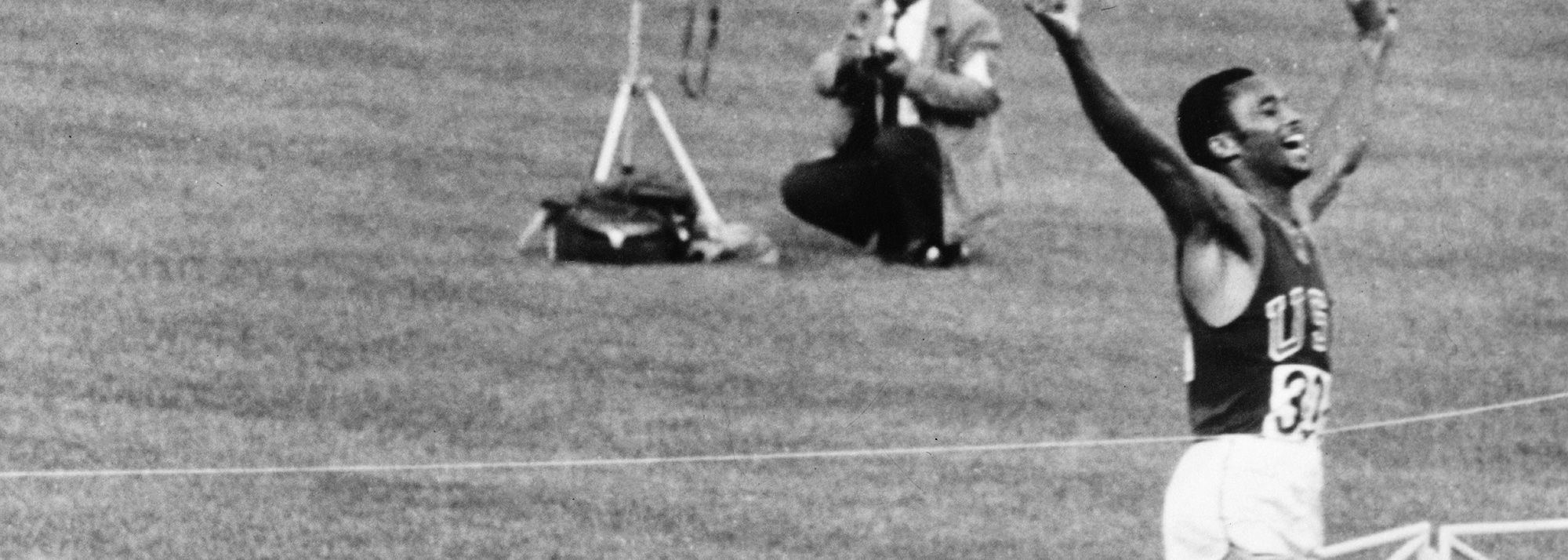


US sprinter Tommie Smith (© Getty Images)
At first, all you can make out is a blur of six figures getting into sprinting motion far down the light brown cinder track. A spectator in a blue baseball cap temporarily obscures the view. Then you get a nine-second glimpse of the sprinter in lane four pulling clear majestically – before another cap obscures any sight of Tommie Smith crossing the finish line into track and field history.
The grainy 60-year-old cine-film clip available on YouTube shows more of the San Jose State star jogging gracefully back up his home college track than it does of him becoming the first man to break 20 seconds for both the 200m and 220 yards.
At least we can still get a glimpse of this long-forgotten, long-buried piece of athletics antiquity – and of the breathtaking grace of the man whose super-smooth sprinting style was once described as “like pouring oil on to glass”.
Tommie Smith is much more than the legend renowned for the iconic black-gloved, head-bowed protest for human rights that he and his US and San Jose State teammate John Carlos so courageously struck on the medal podium after winning gold and bronze respectively in the men’s 200m at the 1968 Olympic Games in Mexico City.
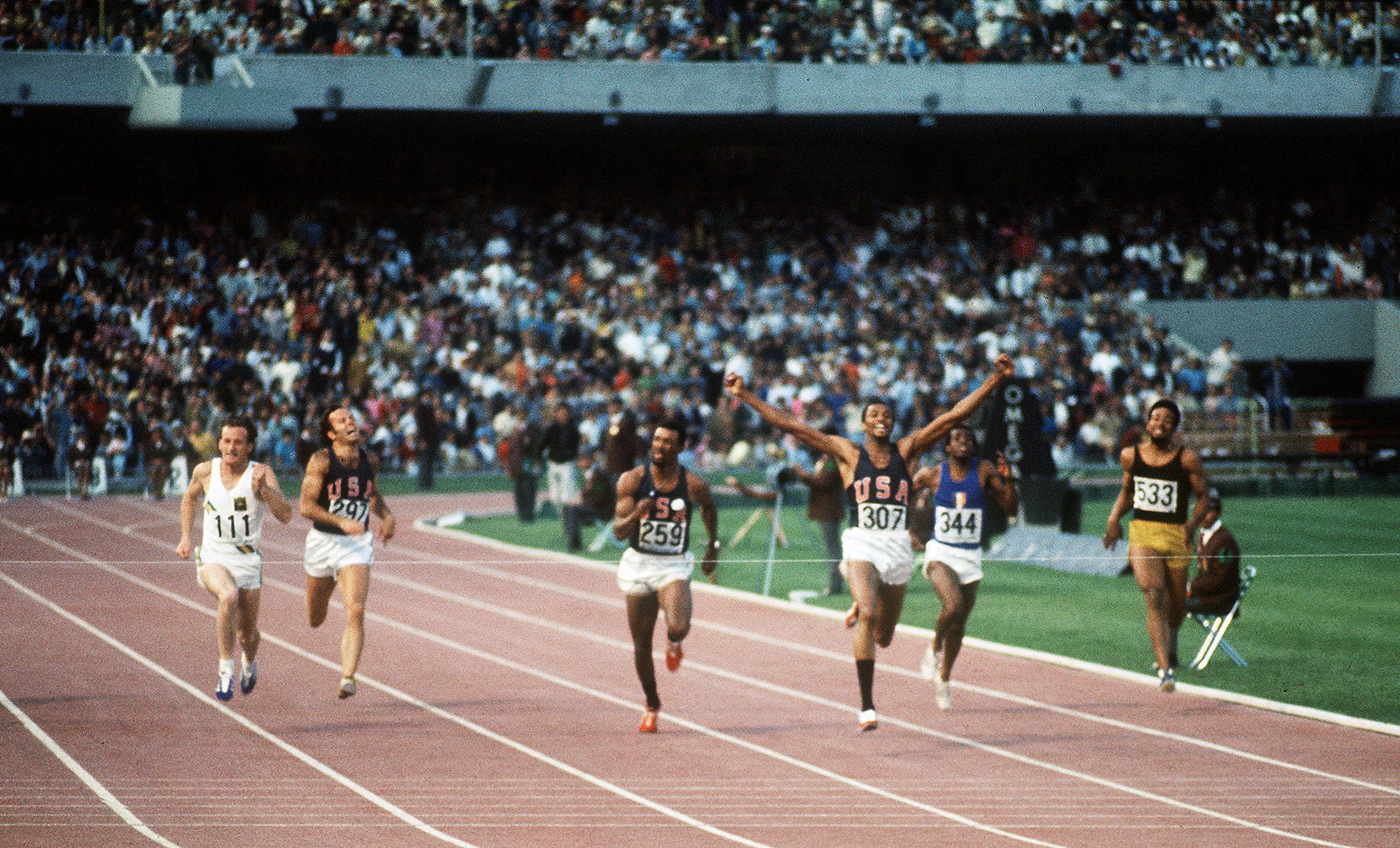
Tommie Smith wins the 1968 Olympic 200m title (© AFP / Getty Images)
At one time, the childhood sharecropper from East Texas held 11 world records simultaneously. That evening at San Jose State, on 7 May 1966, Smith was clocked on a straight track at 19.5 by timekeepers stationed at both 200m and 220 yards – just 1.17m beyond.
In doing so, the 22-year-old sociology student took a half-second chunk off the 20.0 world record set by Dave Sime in 1956 (in a race which included Smith’s older brother, George), and equalled by Frank Budd, another compatriot, in 1962 – and by Smith himself at San Jose in 1966 (after which he set off on a 12-hour civil rights march to San Francisco).
The barrier-breaking feat – two years before Smith’s 19.8 200m curve world record in the Olympic final – was hailed by Track and Field News as “the greatest performance in the history of track and field – greater than Randy Matson’s 21.52m shot put and Ron Clarke’s 27:39.4 10,000m, according to the Portuguese Scoring Tables.”
The timekeepers clocked Smith at 200m in 19.4, 19.5 and 19.6 and at 220 yards in 19.5, 19.5 and 19.6. The rules in place stipulated that if two or more times were identical then that would be the official one, but if all three were different then the middle one would be recorded.
“I thought there was a good chance for a record, but it was my third race of the day and I hadn’t concentrated on it or thought about it a lot,” said Smith, who finished half a second clear of runner-up Wayne Herman in near-perfect conditions, assisted by a following wind of 1.84 metres per second.
Earlier in the all-comers meet, Smith had run a scorching 9.2 4x110 yards relay leg and a wind-assisted 9.3 for 100 yards.
Nordy Jensen, in his meticulous account for Track and Field News, wrote of Smith “slipping into his fluid ‘Tommie-jet’ gear.” “Many coaches and observers feel that he has a special gear that no other athletes have,” he added.
“I don’t consciously feel a change of gear,” Smith mused: “It’s just that I have extra speed at the end. My stride at the end of the race is longer than at the start, and this makes a difference.”
At 1.90m (6ft 3in) and 78kg (173lb), Smith was on the large side for a sprinter. He perfected a smooth, high-stepping, long-striding technique under the expert guidance of San Jose’s celebrated track coach Lloyd C ‘Bud’ Winter, whose ‘Speed City’ stable also included John Carlos and two other protégés who won Olympic gold medals in world record times: Lee Evans (400m) and Ronnie Ray Smith (4x100m).
“Tommie has that uncanny ability to sustain speed longer,” Winter enthused. “We measured his stride from 120 yards out in lane four and at that stage it was 8ft 5in (2.57m) up to about 20 yards from the tape. Then it was 8ft 7in (2.62m) and his last three strides were 8ft 9in (2.67m).
“This tells us something. It indicates that he is accelerating at the end of a 220 when most are decelerating.”
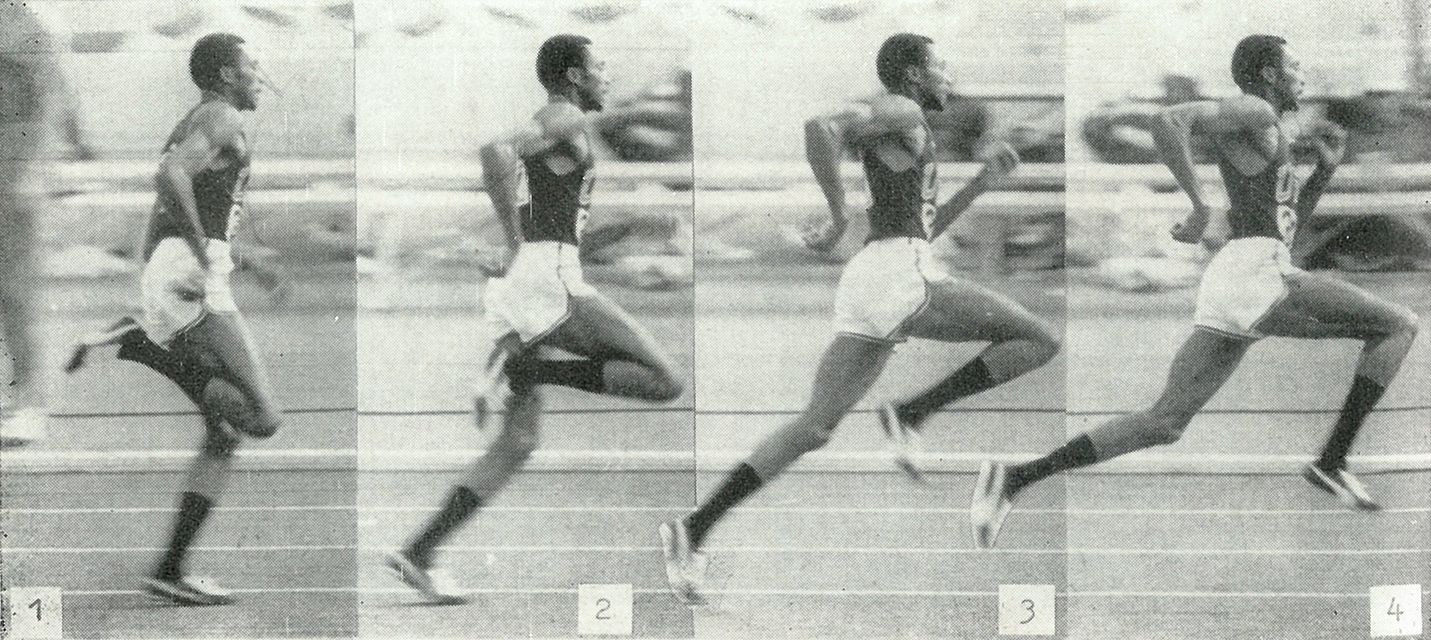
Tommie Smith's stride (© World Athletics  Gundlach)
The range of Smith’s talent was similarly huge. He could run 100m in 10.1 (missing the world record by 0.1 in 1966), clocked a 400m world record of 44.5 and ran a 4x400m leg in 43.8. He also boasted a long jump PB of 7.90m, which was measured at 8.18m from the point of take-off.
The extent of Smith’s mental strength is more difficult to quantify, but it is evident throughout the 260 pages of Silent Gesture, the inspirational autobiography he penned with journalist David Steele.
It has shades of The Grapes of Wrath. One of 12 children in a sharecropping family, the young Smith gained physical strength from 12-hour shifts picking and chopping cotton. He was six when his family journeyed two days by truck from East Texas to a new life, living in communal shacks and working in the fields of California.
His Olympic triumph in Mexico, when he turned on the ‘Tommie-jets’ to fly past Carlos with 60m remaining, was achieved despite being carried away on a stretcher after suffering an adductor pull in his 200m semi-final – and in the face of death threats.
Banned and banished from Mexico by the International Olympic Committee after his podium protest, Smith was ostracised and threatened on his return home. He spent three years as a wide receiver for the Cincinnati Bengals American football team before working as a sociology lecturer and track coach, all the while continuing to champion the cause of human rights.
On the podium in Mexico, while Smith and Carlos performed their silent gesture, the Australian silver medallist Peter Norman wore a pin badge in support of the Olympic Project for Human Rights, the movement set up to campaign against the treatment of Black people in the United States and beyond.
When Norman died in 2006, Smith and Carlos travelled to Melbourne for his funeral, delivering eulogies and acting as pallbearers.
Simon Turnbull for World Athletics Heritage