

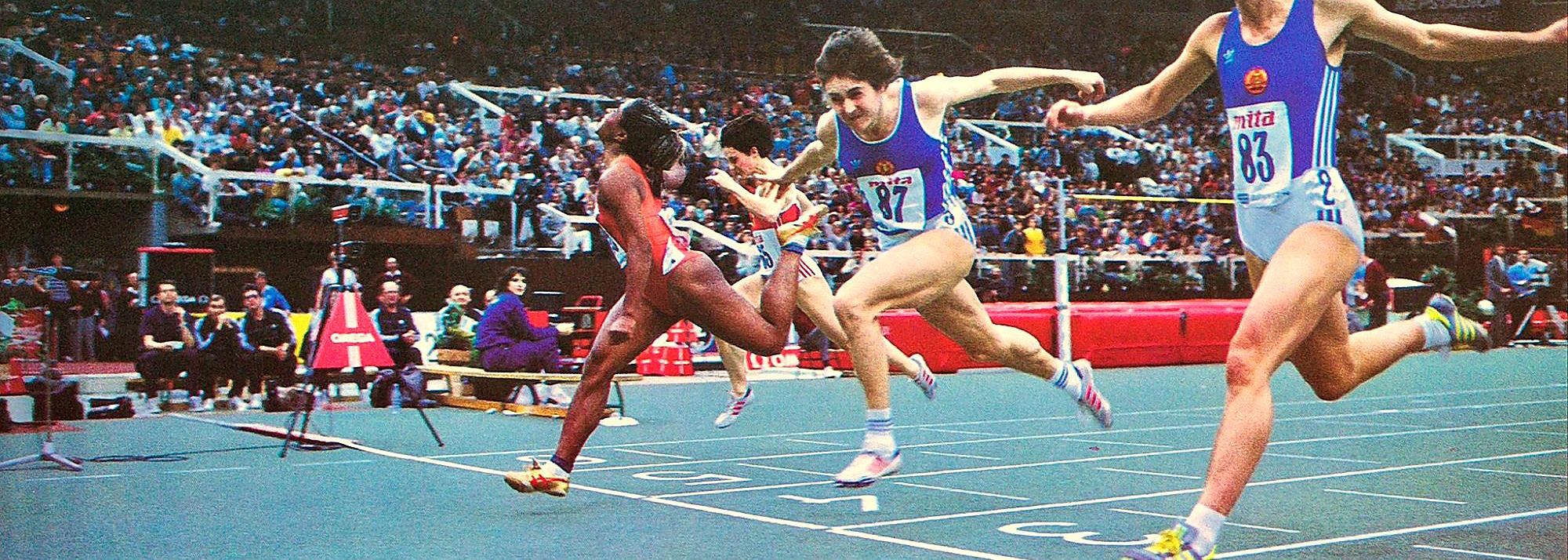


Nelli Cooman wins in her gold spikes (© World Athletics)
There was just the one concern on Nelli Cooman’s mind as she settled into her starting blocks in the Palacio de Deportes in Madrid on the afternoon of 23 February 1986.
“The most important thing was the start,” the diminutive Dutch dynamo said, recalling the European indoor women’s 60m final of 40 years ago for the BBC World Service’s Sporting Witness series. “When my start is ok, you’re gonna see my backside.”
As it happened, Cooman registered the slowest reaction time of the six finalists, 0.178. Yet, such was the explosive sprinting power packed into her 5ft 1in frame, the rest of the field were staring at her from the first step onwards. Cooman proceeded to rocket clear of Marlies Gohr, reducing the five-time champion to a ragged, arms-flailing mess of an also-ran.
As the flying Cooman flashed across the line, the figures on the trackside clock froze at 7.00.
It was the first seven-seconds-flat clocking in the history of the women’s 60m indoors, a landmark achievement that was subsequently recognised as the first official world indoor record at the distance.
The previous world best stood at 7.04, by Gohr’s East German teammate Marita Koch. Gohr took second place in 7.08, to go third on the all-time list, with compatriot Silke Gladisch third in 7.14.
“My reaction time was not the best, but my first step was,” Cooman reflected. “My start was everything. I even beat Carl Lewis and Ben Johnson out of the blocks on a training camp. They both saw my backside. They were not very happy.
“I benefitted from having 80% fast-twitch fibres. I was like a Ferrari when the gun went.”
Four decades on, the human Ferrari has generously donated the gold spikes she wore that day to the Museum of World Athletics (MOWA) – as a reminder of the seven seconds that changed her life.
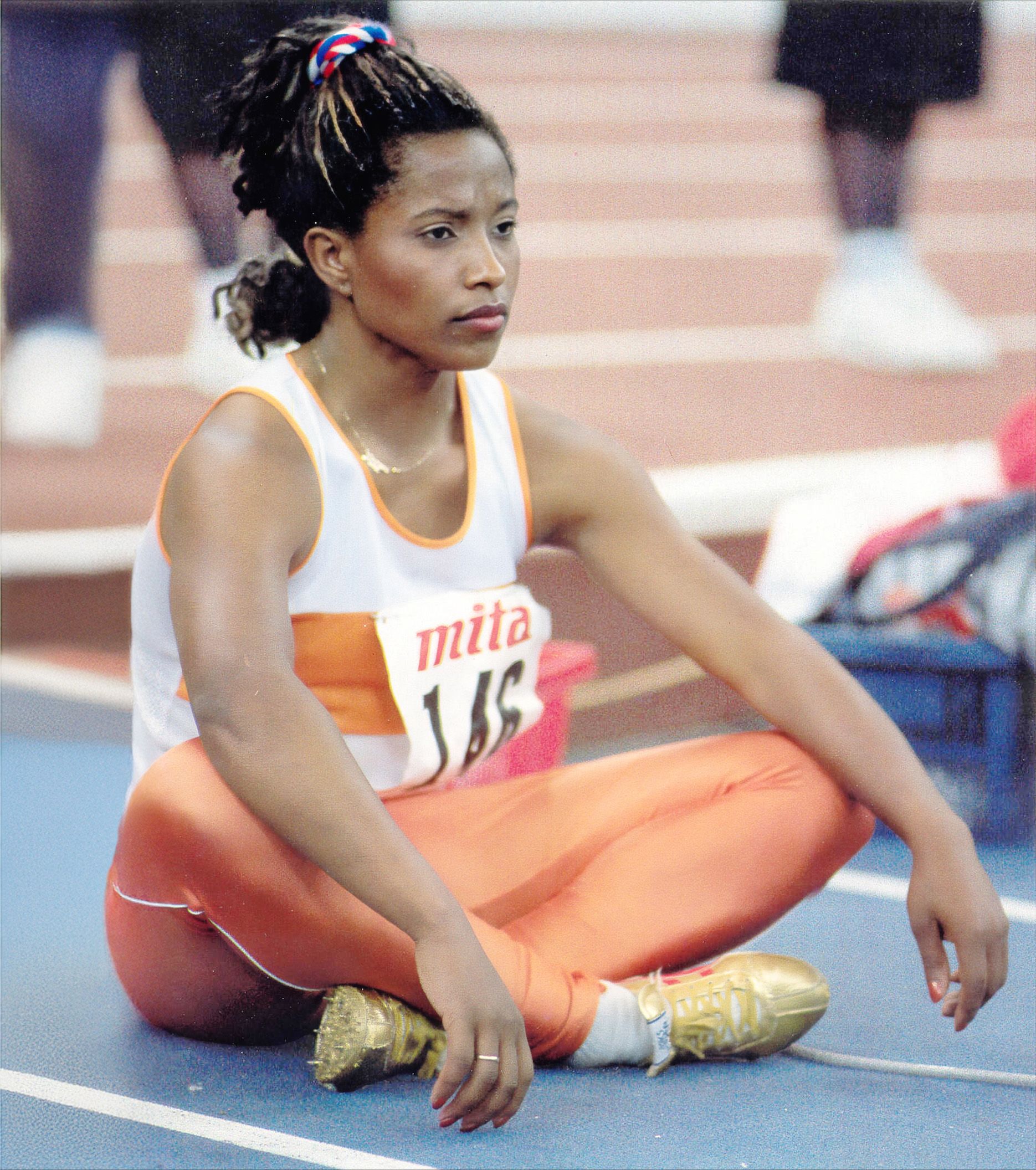
Nelli Cooman (© World Athletics)
Sprint rise
She was 21 at the time and already a European indoor 60m champion. A surprise bronze medallist as a teenager in Gothenburg in 1984, she had been an even more surprising winner in Piraeus in 1985.
Beating Gohr by 0.03 in 7.10, Cooman brought an end to the East German’s unbeaten record of five successes in the event with an upset victory commemorated in the MOWA collection by the Dutch singlet and shorts and the bib number she wore that day.
As a breakthrough world record-setter in Madrid in 1986, however, Cooman became a household name in her homeland – a familiar face on Dutch television shows and insistently recognised on the streets. “Everyone would say, ‘Hey, Nelli Cooman…seven seconds!’” she recalled.
Born Cornelli Antoinette Cooman in Suriname, the former Dutch colony on the Caribbean coast of South America, her family emigrated to the Netherlands when she was eight, her mother holding down three part-time jobs to provide for Nelli and her three sisters as they settled into a new life in Rotterdam.
Cooman’s sporting prowess first became evident on the football field; her schoolmates called her ‘Miss Pele’. She was reluctantly drawn into track and field at the age of 16 when a local coach spotted her natural sprinting talent at a school sports day.
Under the guidance of Henk Kraajenhof, a scientist turned expert speed coach, Miss Pele became the mistress of the boards.
Queen Nelli of the Netherlands came to rule the global indoor sprint game – even though, at times, she had to hone her speed in a pedestrian tunnel under the River Maas, due to a lack of suitable facilities.
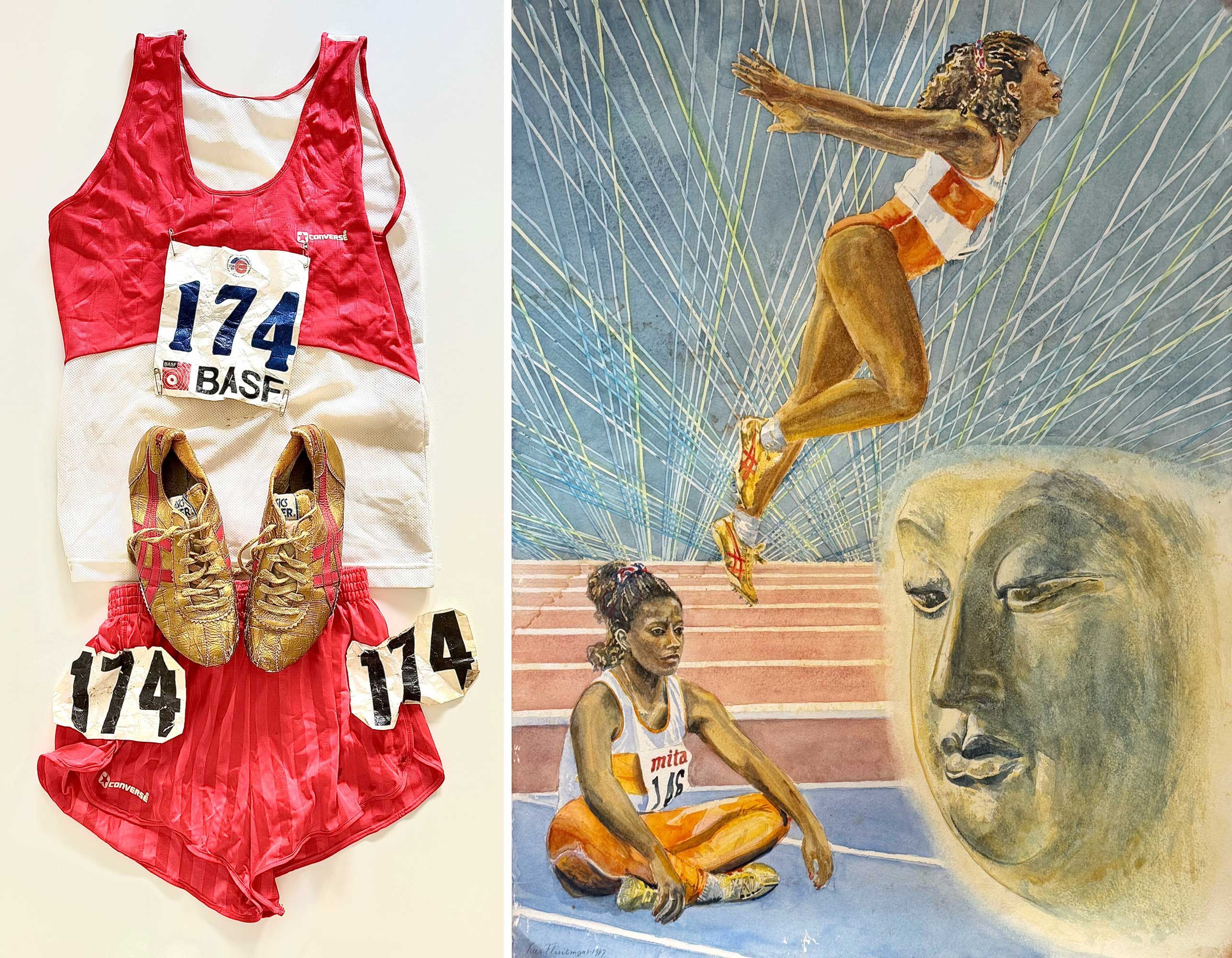
Nelli Cooman's donations to the Museum of World Athletics (© World Athletics)
Multiple medallist
Outdoors, over 100m, she only claimed one major championship medal: European bronze in Stuttgart in the summer of 1986. Indoors, with her power-packed frame ideally suited to 60m, Cooman racked up a record tally of six European crowns, following her wins in Piraeus and Madrid with victories in Liévin in 1987, Budapest in 1988, The Hague in 1989 and Paris in 1994. She also claimd a second bronze, in Glasgow in 1990.
Then there were her two world indoor triumphs.
The first of those came in 1987 in Indianapolis, where Cooman initially won by a whisker (officially 0.003) in 7.08, although Canada’s Angella Issajenko was retrospectively disqualified as runner-up because of doping.
A painting depicting that triumph has also been kindly donated to the Museum of World Athletics by Cooman, who successfully defended her global crown in Budapest in 1989, improving her championship record to 7.05.
Her world indoor record survived until 1992, when Merlene Ottey breached the seven-second barrier.
The Jamaican did so with a time of 6.96 – like Cooman’s historic 7.00 clocking, also achieved 670m above sea level in Madrid, the second-highest capital city in Europe.
Simon Turnbull for World Athletics Heritage