

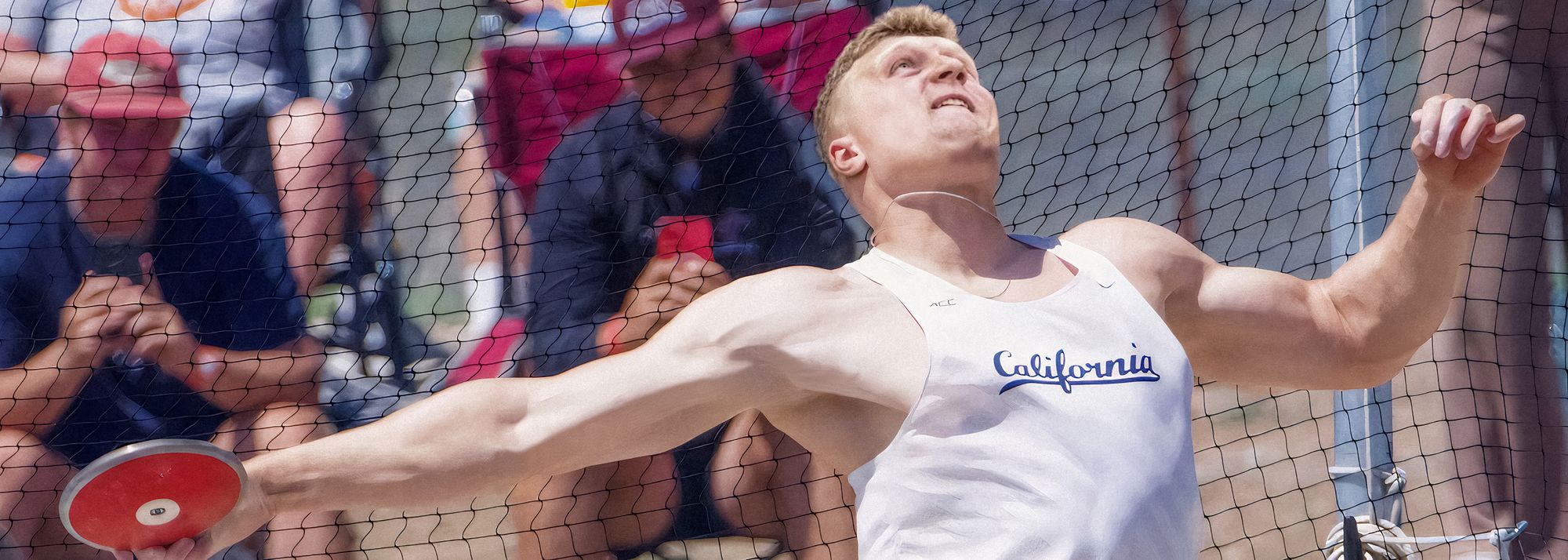


Mykolas Alekna in action in Ramona (© Gerry McEvoy)
By the time Mykolas Alekna came to take his fourth-round effort in the 2025 Oklahoma Throws Series World Invitational, he had already put Ramona on the global athletics map.
It had been there, in the backwater town (population 524) just off US Highway 75, that the Lithuanian discus prodigy consigned the oldest men’s track and field world record to history – during the 2024 edition of the World Athletics Continental Tour Bronze meeting. At the tender age of 21, Alekna hurled his disc 74.35m – surpassing the 74.08m that Jürgen Schult had thrown at the East German European Championships Trials in Neubrandenburg in 1986.
It was the one achievement that his father, the great Virgilijus Alekna, had not quite managed to accomplish in a stellar career in which he bagged two world and two Olympic gold medals. Virgilijus’ best mark, long-time No.2 on the world all-time list, was 73.88m.
Mykolas managed to eclipse his own world record with his opening effort of the 2025 Oklahoma Throws meeting: 74.89m. That made it two global marks in the space of 12 months in the tranquil setting of Millican Field, with just a handful of coaches, athletes and throws aficionados in attendance.
Then, in round four, Alekna Jr. stepped into the circle to put himself and Ramona – Throw Town, or Throwklahoma, as it has been dubbed – into the track and field history books again. Wearing the white University of California Berkeley vest he has generously donated to the Museum of World Athletics, Mykolas orchestrated a potent blend of balletic speed, balanced technique and sheer power, catching the wind with a throw that winged out to 75.56m.
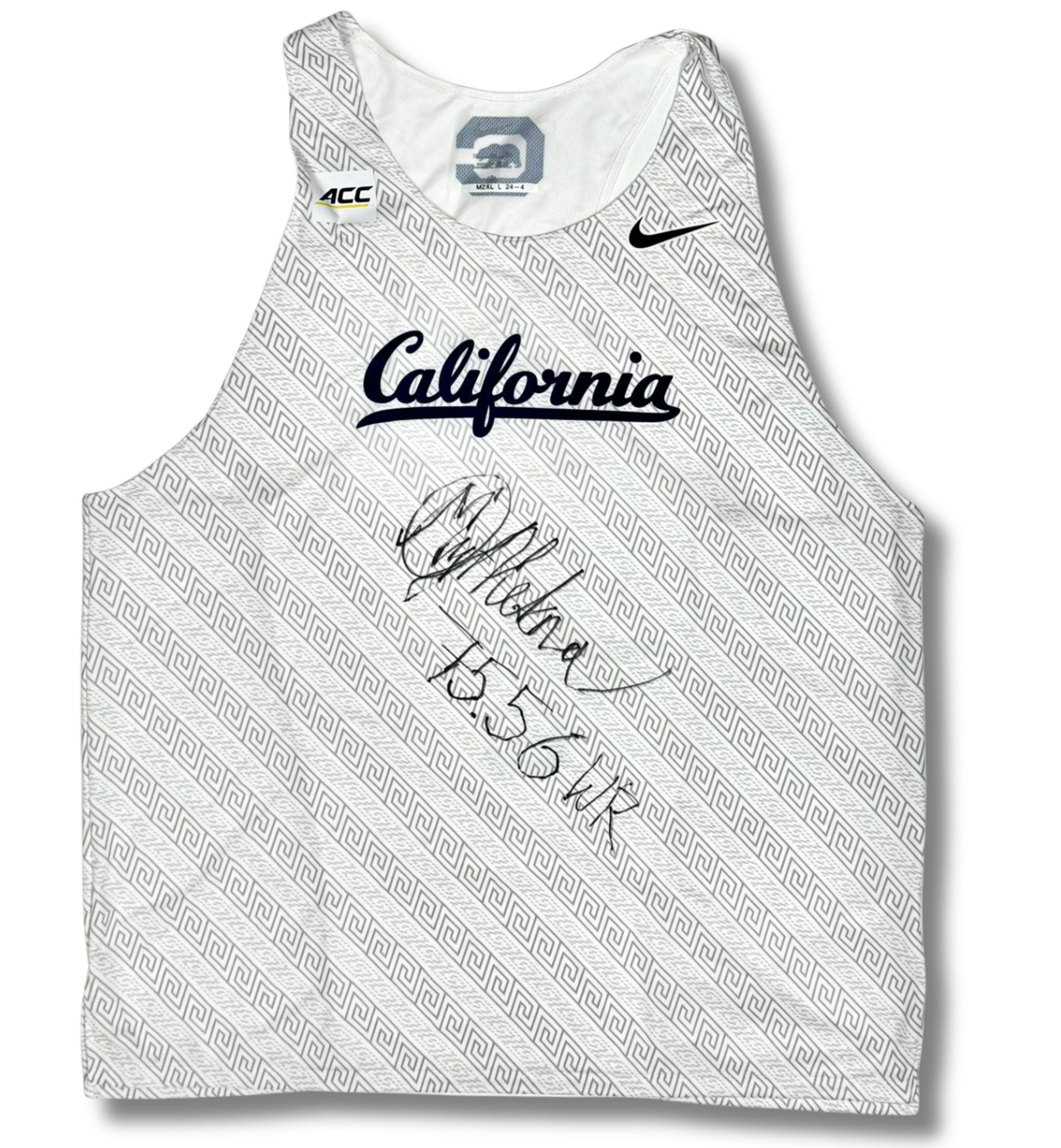
The vest Mykolas Alekna has donated to the Museum of World Athletics (© MOWA)
At the age of 22, he had become the first man to throw beyond 75 metres – 49 years after Mac Wilkins breached the 70-metre barrier.
“Going into that competition, I wasn’t thinking about breaking the world record,” Alekna told the audience at US Throws Clinic, an interview carried on the Throw University YouTube channel. “I was just going there to have a good time. Of course, I knew I was capable of setting a world record, but it was more about executing all the technical elements of the throw. I think the reason I was able to achieve it was that I was just having a good time. I didn’t feel any pressure to set a world record.”
At the time, Alekna was finishing his degree in psychology at the University of California, Berkeley. An erudite, contemplative soul, his chilled approach has also been heavily influenced by his father.
“I think the biggest lesson I learned from my dad was staying calm,” he said. “He’s a really calm guy. I think I learned that mindset from him – not taking everything seriously, just be relaxed, even at the moments when the pressure is high.”
It also helped in Ramona on 13 April last year that Throw Town provided Virgilijus’ youngest son with an ideal platform. Millican Field is an open setting, with throwing circles set in varying directions to maximise prevailing air currents. Another key factor was the strength of the competition.
At the same venue three days previously, Matt Denny had thrown 74.25m, just 10 centimetres short of Alekna’s first world record. In the main competition, the Australian who took Olympic bronze behind Jamaica’s Roje Stona and Alekna in Paris in 2024 improved his Oceania record to 74.78m, consolidating his new-found No.2 spot on the world all-time list.
The list of multiple best winning throws by an individual is dominated by the Aleknas. Mykolas and Virgilijus are responsible for:
5 of the top 12: Mykolas 4, Virgilijus 1
7 of the top 25: Mykolas 5, Virgilijus 2
10 of the top 50: Mykolas 7, Virgilijus 3
24 of the top 100: Mykolas 11, Virgilijus 13.
34 of the 160 winning throws beyond 70 metres: Mykolas 14, Virgilijus 20
Mykolas may dominate the sharp end, with three of the top four throws in history, but his long-term ambition is to match his dad’s depth. “I want to be more consistent, with more throws over 72 metres, 71 metres, 70 metres,” he said. “I’d like 70 metres to become automatic.”
In breaking the world record twice in the same afternoon, Alekna echoed Wilkins’ barrier-breaking heroics of 1976. Just a month after setting a global mark of 69.18m at the Mt. SAC Relays, the Oregonian reeled off three in a row at the San Jose Invitational: 69.80m, 70.24m and 70.86m.
It just so happens that Alekna has chosen to follow in Wilkins’ footsteps by serving his final year of collegiate availability at the University of Oregon. Wilkins was recruited to the mighty Ducks by Bill Bowerman, the legendary distance running guru and co-founder of Nike.
He went on to win the Olympic discus title in Montreal in his golden summer of 1976 but the University of Oregon discus record he set three years earlier, 64.77m, no longer stands intact. Instead, during the 2026 collegiate season, Alekna will need to better the 65.88m thrown in 1983 by one Dean Crouser – uncle of the behemoth of the shot put, Ryan Crouser.
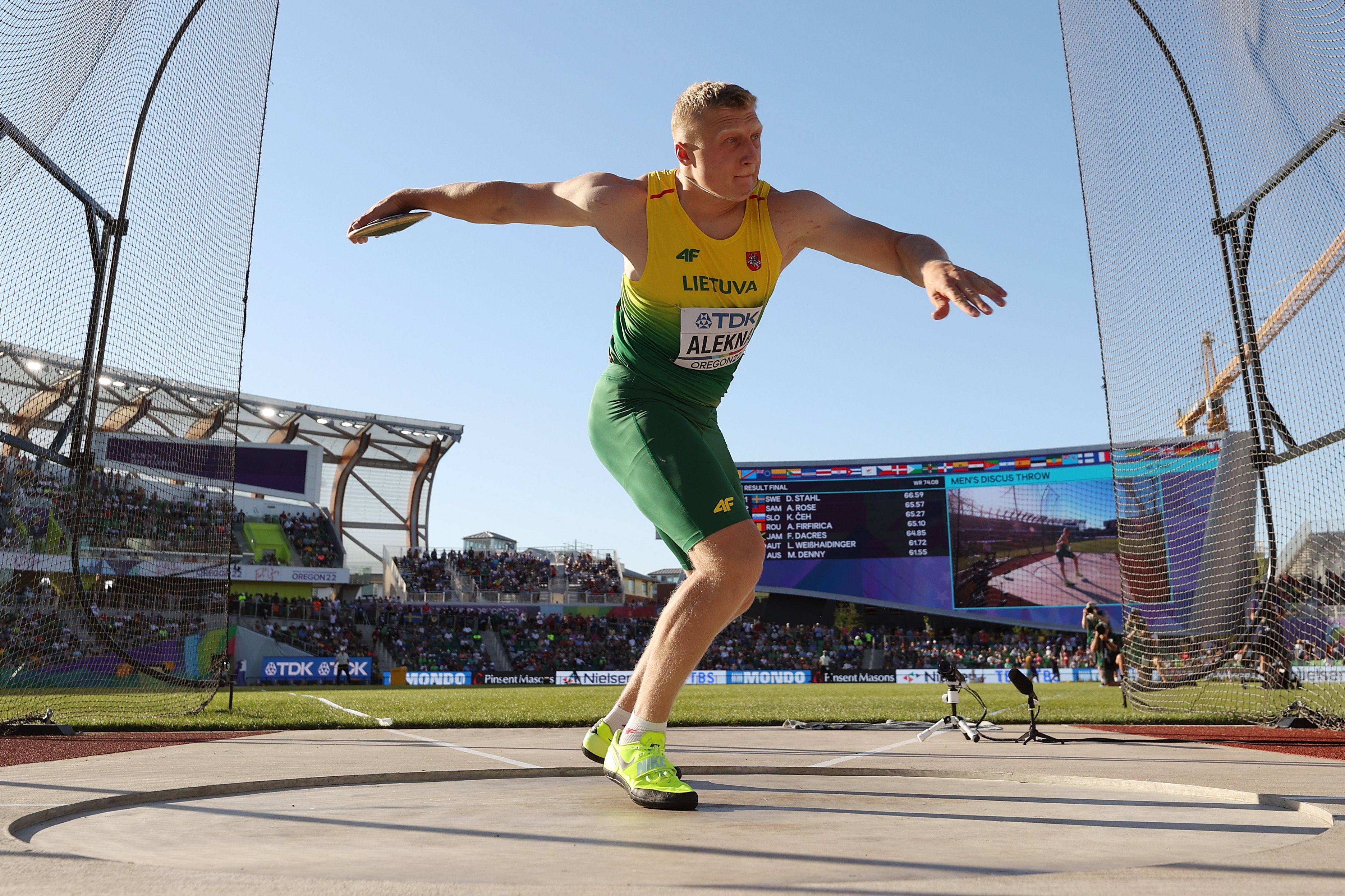
Mykolas Alekna at the World Athletics Championships Oregon22 (© Getty Images)
Alekna’s new college coach at Hayward Field is Brian Blutreich, a US Olympic teammate of Dean’s brother, javelin thrower Brian Crouser, in Barcelona in 1992. Blutreich finished 25th in the discus qualifying round in the Catalan capital. His stable of Ducks throwers includes Jorinde van Klinken, the Dutch athlete who took women’s discus silver behind Valarie Allman at the World Athletics Championships Tokyo 25.
Alekna, who was coached at Berkeley by Mo Saatara, will continue to be guided at home by his long-term coach, Mantas Jusis, who had two throwers in the men’s discus final in the Japanese capital last year. Martynas, Mykolas’ 25-year-old brother, finished seventh with 63.34m. With a PB of 67.23m, he has the potential to become the third Alekna to join the 70 metre club.
Mykolas started his athletics life following in the footsteps of his mother Kristina, as a would-be long jumper. He was only 19 when he emulated his dad with European discus gold in Munich.
Four years on, at 23, he has three World Championships medals (silver from 2022 and 2025 and bronze from 2023) and Olympic silver from Paris in 2024.
His father was 28 when he won the first of his Olympic gold medals, in Sydney in 2000, and 32 when he claimed the second, in Athens four years later. And Virgilijus was 31 when he won his first world title, in Paris in 2003, and 33 when he secured his second, in Helsinki in 2005.
So, as well as a man mountain of natural talent, young Mykolas has time on his side yet to match the mighty discus deeds of his boyhood idol, his Lithuanian legend of a father.
Simon Turnbull for World Athletics Heritage