

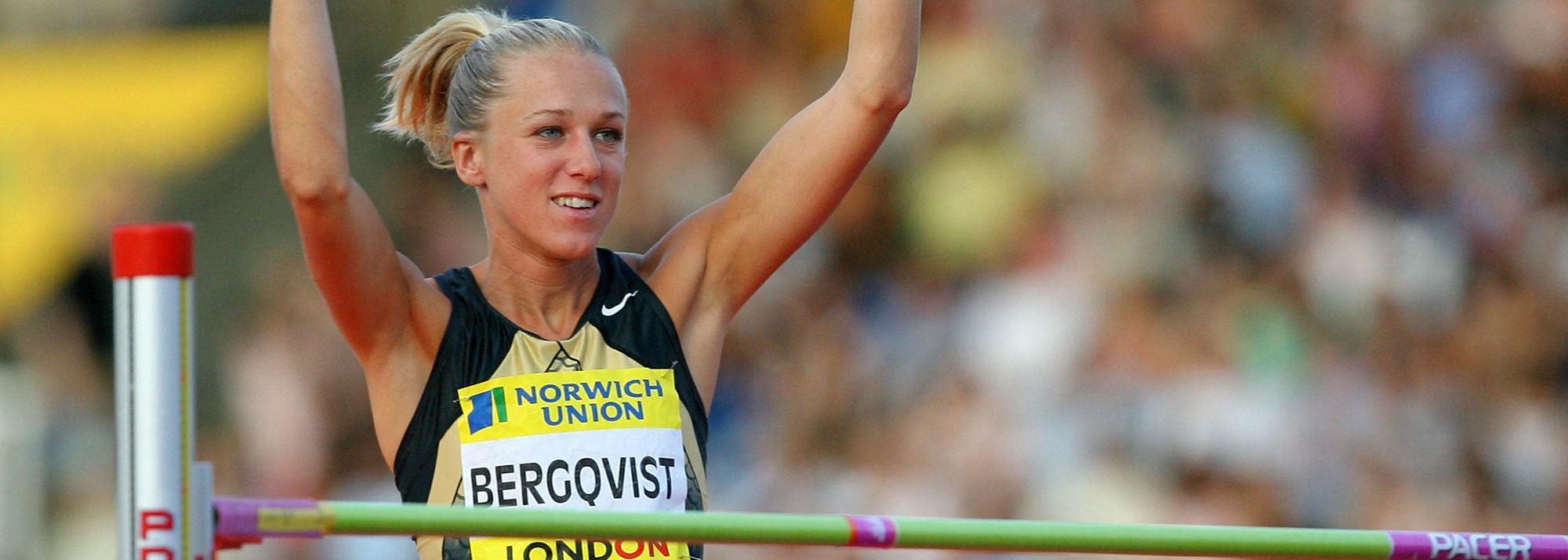


Kajsa Bergqvist in 2006 (© AFP / Getty Images)
It was the afternoon everything came together in a glorious crescendo for Kajsa Bergqvist. The setting was the Friedrich Ludwig Jahn Sporthalle in Arnstadt, the German town where Johann Sebastian Bach spent four years as organist at the Neue Kirche (New Church).
The occasion, on Saturday 4 February 2006, was the 30th edition of Hochsprung mit Musik – the annual indoor international “High Jump With Music” meeting. As Mamma Mia blasted over the public address system and the crowd clapped in the tight confines of the hall, Bergqvist slapped her thighs and urged herself on – “Here I go again,” perhaps.
From achilles agony to an unbeaten high-jump streak
Just 19 months after the agony of an achilles rupture that shattered her Athens Olympic ambitions and threatened to curtail her career, the 28-year-old Stockholmer had found a golden groove in a gilded era for Swedish athletics.
In 17 competitions since the cruel tear in Båstad in July 2004, her only defeats came in two low-key javelin contests: third place, with a personal best of 36.80m, at the Swedish Club Championships in May 2005, and second place, with 34.92m, at a local meeting during a training camp in Stellenbosch in January 2006. In her specialist discipline, however, the Swedish comeback queen was undefeated, a run that included the women’s high jump title at the 2005 World Athletics Championships in Helsinki.
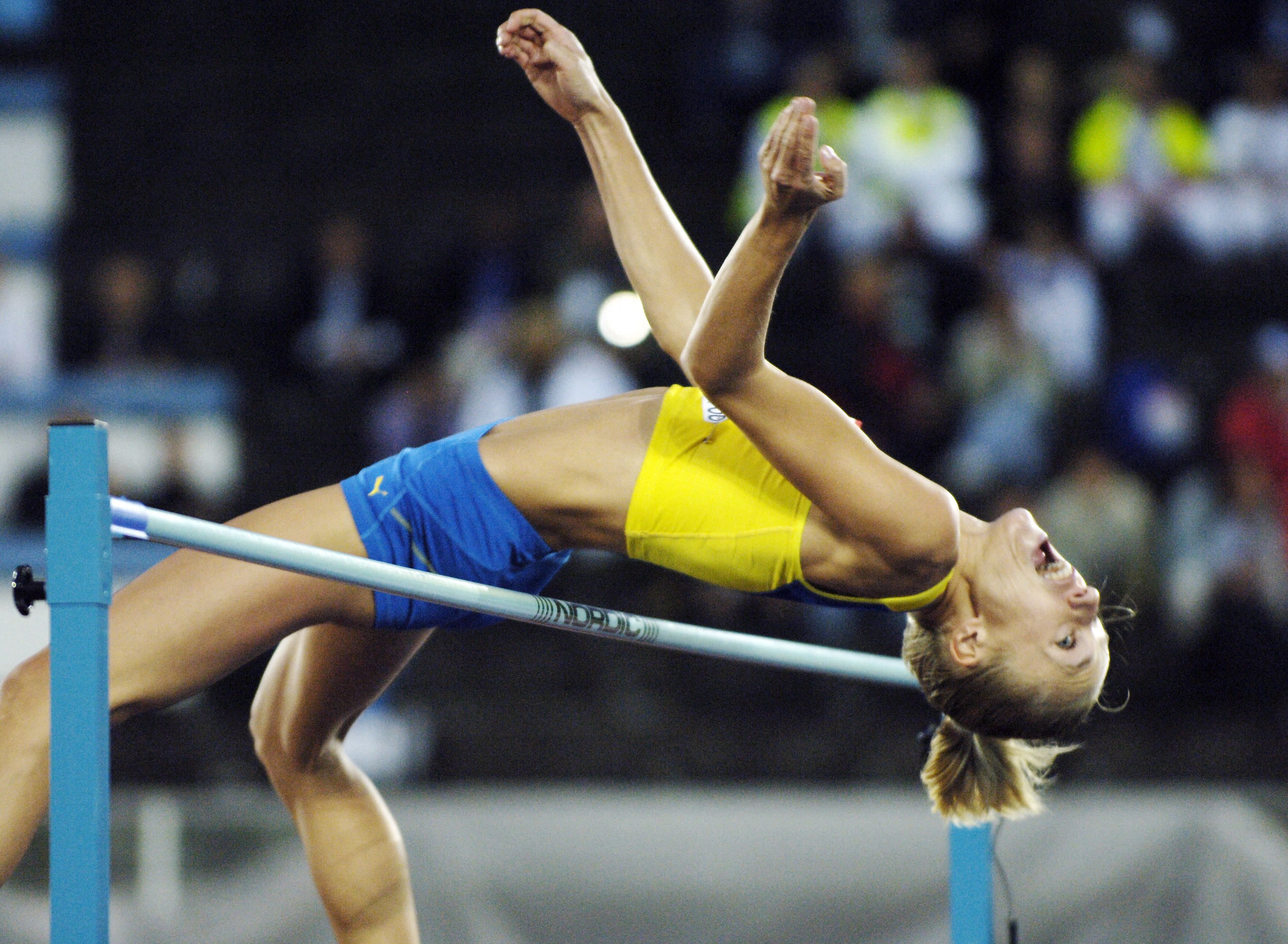
Kajsa Bergqvist in Helsinki (© AFP / Getty Images)
Helsinki confidence, then the world indoor record within reach
In Helsinki she beat USA’s Chaunté Howard with a first-time clearance at 2.02m and, buoyed by confidence, raised the bar to 2.10m, producing a strong second attempt at Bulgarian Stefka Kostadinova’s world record of 2.09m.
In Arnstadt, after securing victory with a first-time success at 2.03m and then clearing 2.05m on her second attempt, her sights shifted to 2.08m, one centimetre above the world indoor record set by the great Heike Henkel at the 1992 German Indoor Championships in Karlsruhe. Fittingly, Henkel was in the crowd as Bergqvist prepared for her first shot at history.
“Something special”: the jump, the embrace, the quotes
You could see in the Swede’s ice-blue eyes and steely expression that she believed she would make it. She brushed the bar with her heels but landed on the mat as a world indoor record-breaker. A wild celebratory circuit of the hall followed, then a warm embrace from Henkel, the retired world indoor and outdoor, Olympic, and European indoor and outdoor champion.
“I had a feeling something special was going to happen,” Bergqvist told Cege Berglund of Göteborgs-Posten, the long-time master chronicler of Swedish track and field, who sadly died in December 2025. “I was really motivated by Heike being here. I’m sure it was worth an extra centimetre or two. She’s my all-time high jump hero.”
Henkel, meanwhile, said: “I’m happy that Kajsa is the one who has broken my record. She deserves it because she’s turned in consistent performances over the years.”
From late starter to serial medallist
Born and raised in the municipality of Sollentuna, 14km north of central Stockholm, Bergqvist did not specialise in the high jump until she was 15 after finishing last in that event, and also in the javelin and long jump, at the Swedish U20 Championships. Two years later she won silver at the 1994 World U20 Championships in Lisbon, losing to Russia’s Olga Kaliturina in a jump-off.
Coached by Bengt Johnsson, she also finished runner-up at the 1995 European U20 Championships and the 1997 European U23 Championships before making her senior breakthrough with gold at the 2000 European Indoor Championships.
A fortnight after clearing 2.00m in Patras, she repeated the feat in Ghent, winning the European indoor title ahead of Czechia’s Zuzana Hlavoňová who cleared 1.98m, with her idol Henkel placing eighth. It was the first of her 10 consecutive medals at major championships indoors and out in the first six years of the new millennium, including five golds: European indoor (Ghent 2000), world indoor (Lisbon 2001, Birmingham 2003), European outdoor (Munich 2002) and world outdoor (Helsinki 2005), alongside Olympic bronze (2000), world outdoor bronzes (2001, 2003), European indoor silver (2001) and European outdoor bronze (2006).
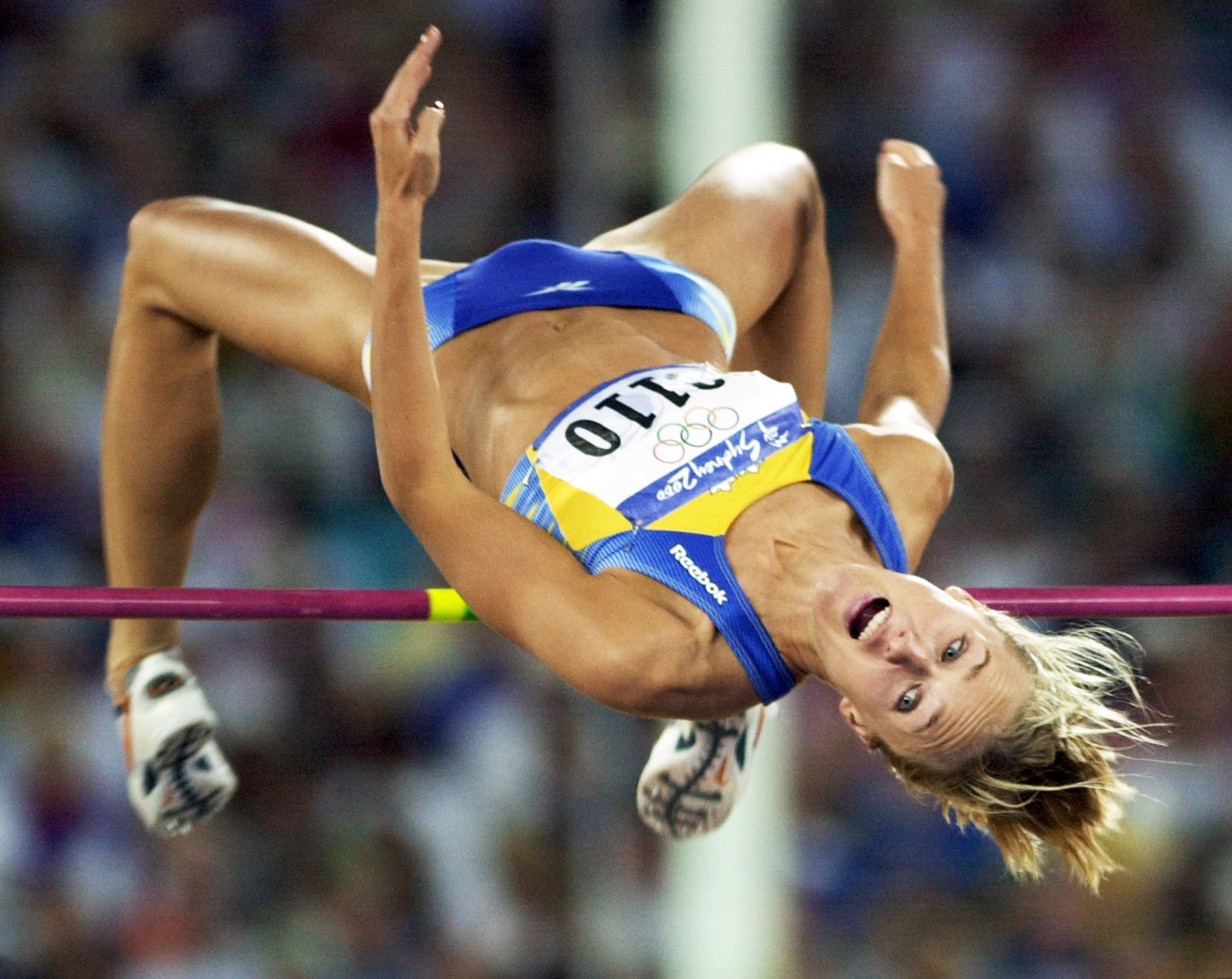
Kajsa Bergqvist in action at the Sydney Olympics (© AFP / Getty Images)
Twin peaks, a home disappointment and a lasting legacy
The 2005 world title and the world indoor record set in February 2006 proved the twin peaks of a 15-year international career. Under Yannick Tregaro – her coach since 2003, the former junior international high jumper who guided Christian Olsson to world and Olympic triple jump glory – Bergqvist found her way back towards form in the build-up to the 2006 European Championships in Gothenburg, coming close to a 2.10m outdoor world record at DN Galan in Stockholm and clearing 2.05m at the London Grand Prix. Yet she could not add to the home gold rush at Ullevi Stadium: while Olsson, Carolina Klüft (heptathlon) and Susanna Kallur (100m hurdles) struck gold, Bergqvist and fellow Swedish high-jump star Stefan Holm had to settle for bronze. In Bergqvist’s case, championship-best clearances of 2.03m by Belgium’s Tia Hellebaut and Bulgaria’s Venelina Veneva left her third on 2.01m.
After placing seventh in the 2007 world final in Osaka, the world indoor record-holder announced her retirement in January 2008. “Physically, I am okay, but after a long career I have simply come to the point where I feel it’s ‘mission completed’,” she said. “I look back on my career with great joy and pride.”
Two decades on, at the age of 49, Bergqvist remains a major force in Swedish track and field as head coach of the national team. Her 2.08m clearance in Arnstadt still stands unbeaten indoors, with only Yaroslava Mahuchikh (2.10m) and Kostadinova (2.09m) having gone higher, both outdoors.
Simon Turnbull for World Athletics Heritage