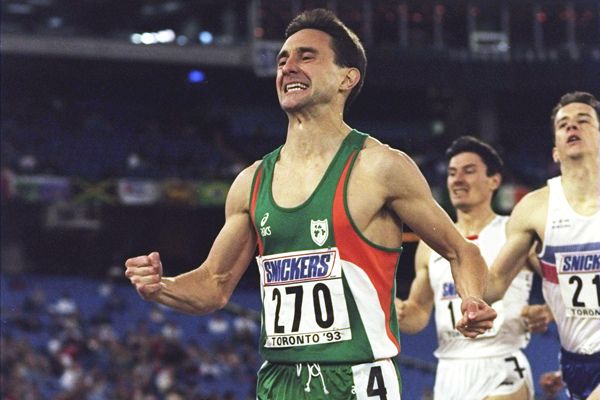

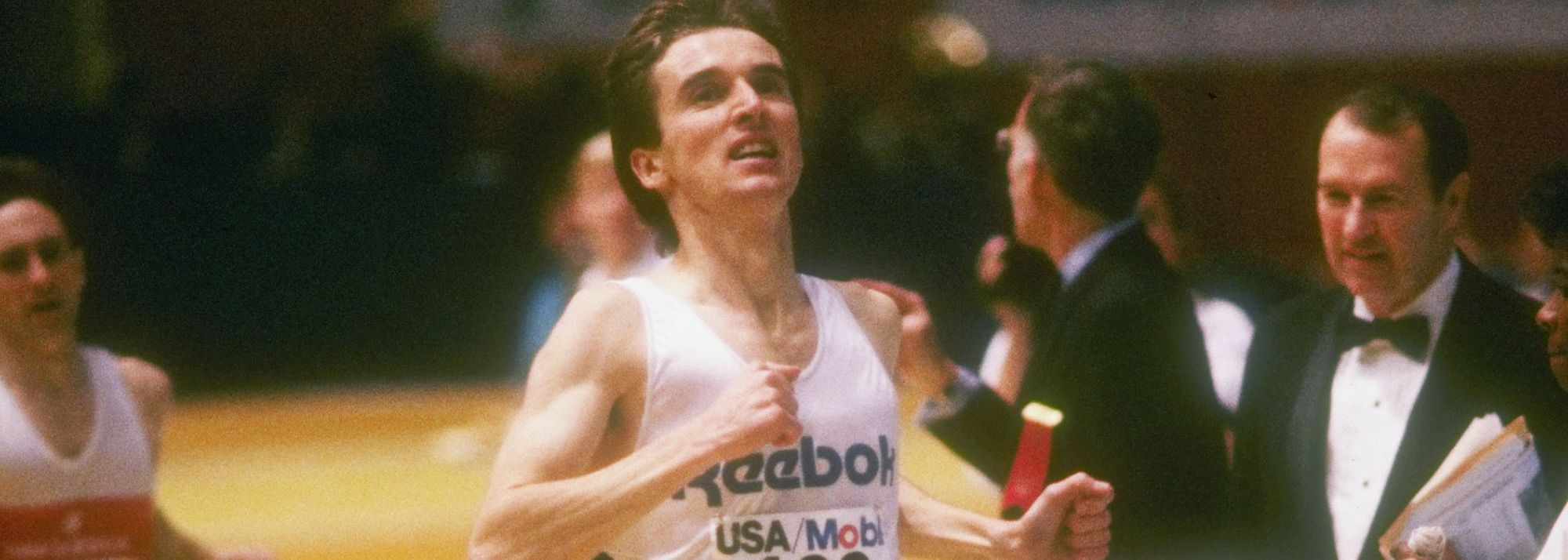


Frank O'Mara racing indoors in 1989 (© Getty Images)
As Frank O’Mara approached the finish line in the 1991 world indoor 3000m final, his closest pursuer was already fading from view.
The Irishman had left Hammou Boutayeb some 15 metres adrift with a devastating kick coming off the penultimate turn in the Palacio de los Deportes in Seville.
In his hugely inspirational autobiography ‘Bend Don’t Break – A Memoir of Endurance’, there’s a photo of a 16-year-old O’Mara winning the 1977 Irish schools 1500m title in a record of 3:58.2 with the next boy just a distant blur way down the home straight.
That Sunday evening in Seville 14 years later proved to be the peak of the redoubtable O’Mara’s career as an athlete.
A man apart even before the off, coolly jogging up and down the track with the rest of the 10-man field already assembled anxiously on the start line, the 30-year-old native of Limerick and long-time star of the University of Arkansas’ Razorbacks track team proceeded to emerge as a class apart.
Boutayeb’s pace proved too much for José Luis González, the Spaniard who took world outdoor 1500m silver in Rome in 1987, but O’Mara stuck to the heels of the Moroccan before taking the lead with two laps remaining and then turning on the afterburners 150 metres from home.
He could afford to wave to the crowd, Steve Ovett-style, coming into the home straight and still cross the line 2.50 seconds ahead of Boutayeb in 7:41.14 – a whopping 6.80 seconds inside the championship record held by his great Moroccan friend and rival Saïd Aouita, and just 1.96 seconds shy of the world indoor record set in 1973 by Belgium’s Emiel Puttemans.
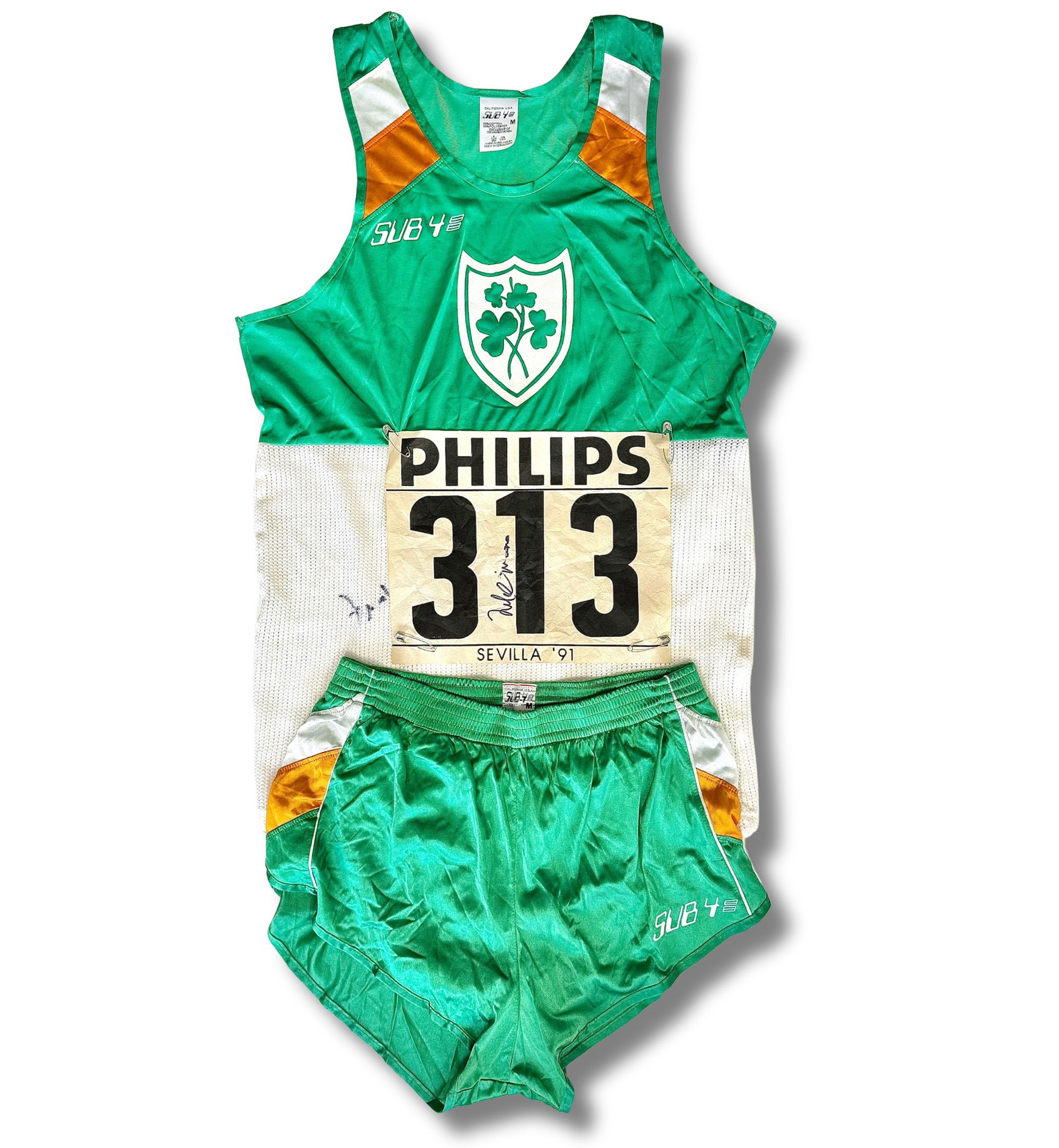
Three decades on, World Athletics Heritage is honoured that O’Mara has chosen to donate the green Ireland singlet and shorts and 313 bib number he wore that memorable day to the Museum of World Athletics.
It was his second world indoor 3000m success, the three-time Olympian having prevailed ahead of his Ireland and Razorbacks team-mate Paul Donovan with a more pedestrian masterclass at the inaugural championships in Indianapolis in 1987, crossing the line in 8:03.82 on that occasion.
“You strive the whole of your life to achieve something like that, and the second one was particularly rewarding,” O’Mara reflected in a recent television interview.
“I won going away from the field and finished close to the world record. Waving to the crowd coming down the home straight probably cost me the world record.”
There was no waving to the gallery when the 16-year-old O’Mara smashed the Irish schools 1500m record by 4.1 seconds at the Plassey track in Limerick – with a time that stood for three decades.
That youthful breakthrough performance, which earned him a track scholarship to the University of Arkansas, came after a year-long slog of rising at 5.30am to perform punishing hill sessions before early morning mass at boarding school.
As he relates movingly in Bend Don’t Break, the young O’Mara was on a mission to honour a pledge he had made to his ailing father after finishing a “comprehensively beaten third or fourth” in the previous year’s race.
“I’m going to win next year – just wait and see,” he concluded in a letter his father read in hospital a week before his death.
“That teenage writing turned out to be a watershed moment in my life,” O’Mara reflects in his book. “I felt an enormous bond with my father throughout the year, and in the process, I found my identity and purpose.”
In that 12-month mission to honour his father, O’Mara displayed the characteristics that subsequently took him to two world indoor titles, three Olympic Games and a share in the world best of 15:49.08 for the 4x1mile relay that he has held since 1985 with his Irish teammates Eamonn Coghlan, Marcus O’Sullivan and Ray Flynn.
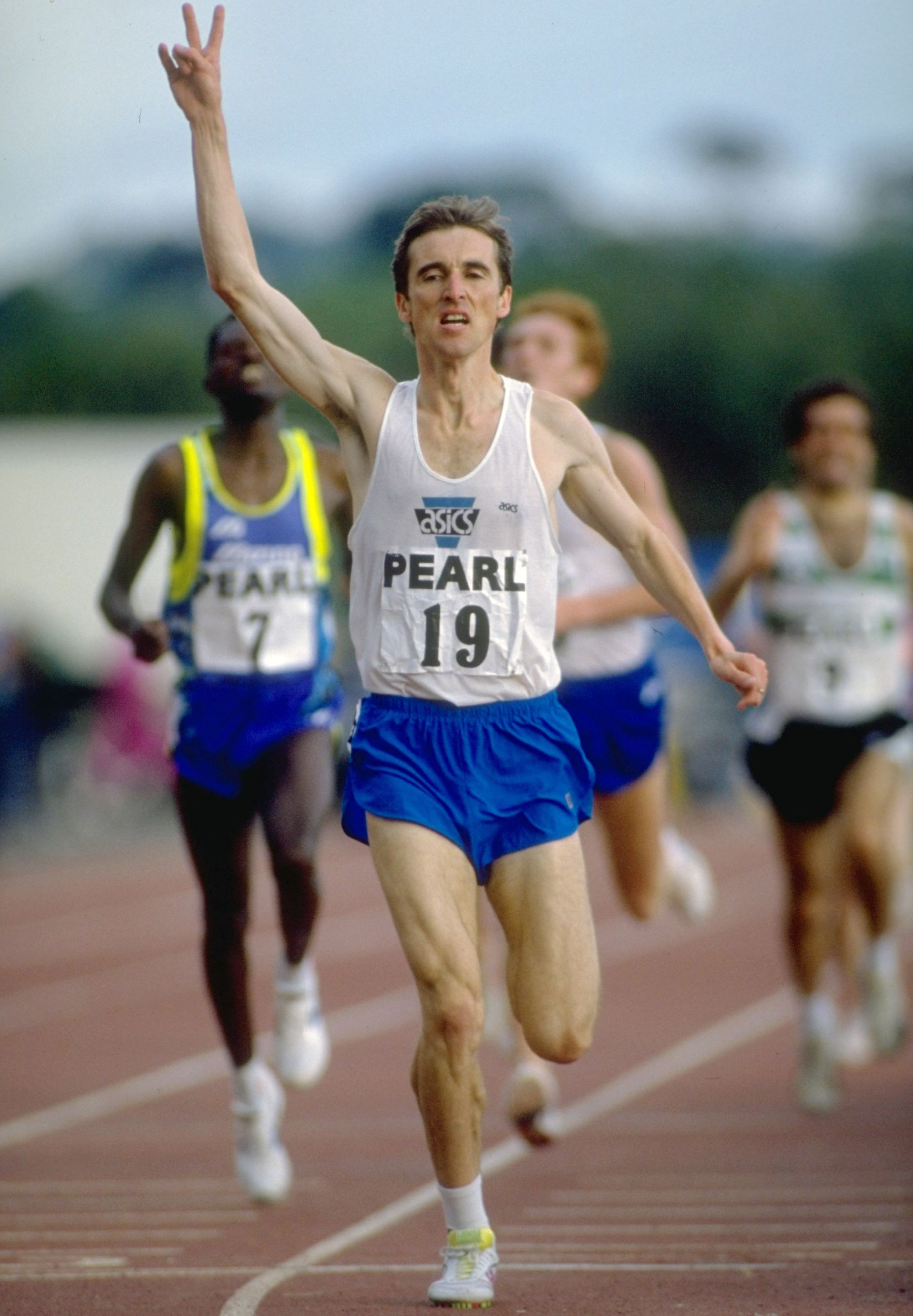
Frank O'Mara in action in 1993 (© Getty Images)
They were also evident in his life away from the track in Arkansas, where he earned degrees in engineering, business and law before enjoying a highly successful post-running career as an executive in the telecoms industry.
Those deeply ingrained personal qualities have been most prominent of all, though, in the daily battle O’Mara has fought since being diagnosed with Parkinson’s disease at the age of 48.
At one stage, as he writes on the Parkinson’s Foundation website, “I couldn’t walk, could barely talk, experienced extreme restlessness, suffered from debilitating and scary cramping and full-body tremors. I was in a pitiful condition and relied heavily on my wife, family and friends to survive.”
Battling steadfastly against the neurological condition throughout, the former world-beater has found some relief since undergoing deep brain stimulation (DBS).
“Tiny holes were drilled through my skull and electrodes implanted deep into my brain, attached to a pulse generator in my chest,” O’Mara relates. “This allowed voltage to constantly run to my brain, which serves to dampen the faulty signalling caused by Parkinson’s.”
Fascinated by polar exploration since boyhood, the iron-willed Irishman was able to complete a National Geographic voyage to the Antarctic early in 2022 to mark the 100th anniversary of the death of his lifelong hero Ernest Shackleton.
Accompanied by his great friend Marcus O’Sullivan, the three-time world indoor 1500m champion, O’Mara visited Elephant Island, where Shackleton, after being trapped on the ice for two winters, left most of the crew from his wrecked ship Endurance before completing a successful 800-mile trip to find a rescue vessel in South Georgia.
O’Sullivan, a distant relative of Tim McCarthy, one of the polar explorer’s five helpers on the rescue mission, then helped his old schoolboy rival and Olympic teammate to complete two gruelling Antarctic hikes.
“Today, I am first and foremost a Parkinson’s warrior,” O’Mara writes in his book. “My everyday schedule consists of one task above all others: to do battle with the disease and slow its progression.
“Against hard evidence, I refused to accept my burden, my ever-growing list of disabilities…I would bend, but not break.”
Simon Turnbull for World Athletics Heritage