

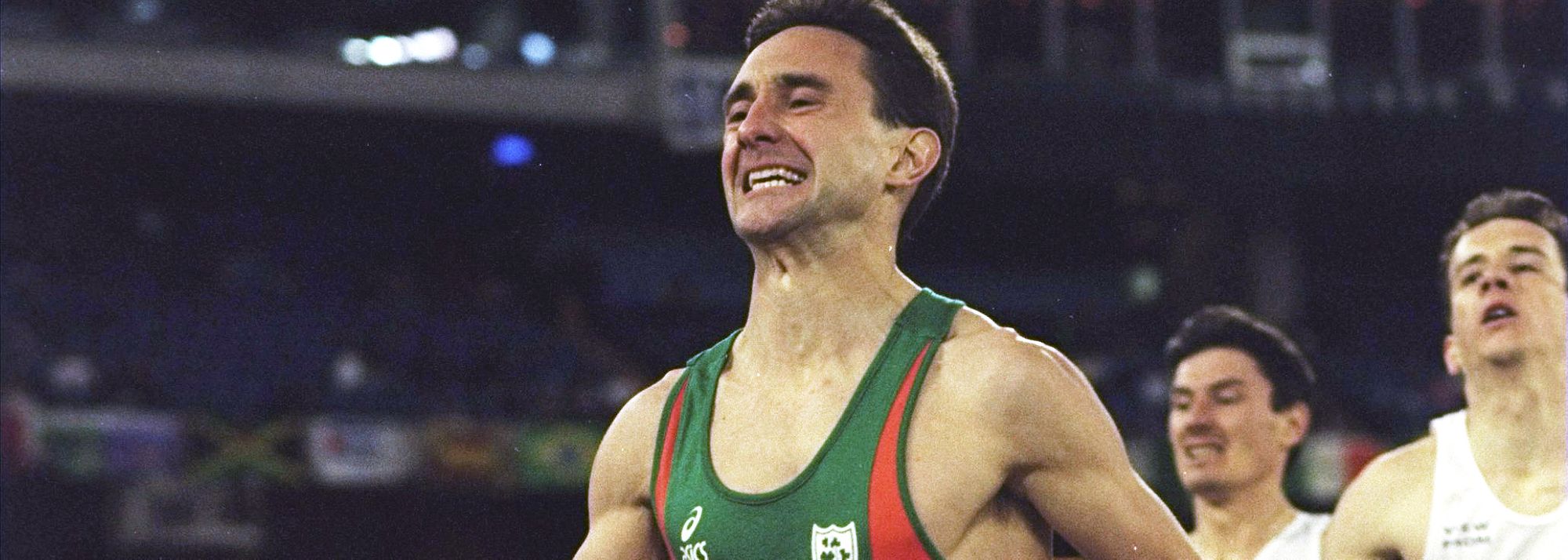


Marcus O'Sullivan wins the 1500m at the 1993 World Indoor Championships (© Getty Images)
If Eamonn Coghlan was Ireland’s ‘Chairman of the Boards’, then Marcus O’Sullivan was the Chief Executive.
Between them, the two Irishmen were the masters of the indoor mile and its metric equivalent from the middle of the 1970s right through to the early 1990s. Both were products of that vaunted Stateside finishing school of Irish middle-distance maestros, Villanova University, and the trajectory of their careers intersected over the course of two compelling indoor seasons in the mid-1980s.
O’Sullivan, the junior by nine years, got the better of his celebrated compatriot in an unbeaten 1986 campaign, inflicting Coghlan’s first indoor mile loss for five years.
At the age of 34, a rejuvenated Coghlan regained the upper hand in the opening months of 1987, beating his young compatriot to claim a record seventh Wanamaker Mile win and clocking a world indoor best at 2000m before heading to the inaugural World Athletics Indoor Championships in Indianapolis as favourite for the 1500m.
As fate would have it, though, the native Dubliner who struck gold at the first outdoor World Championships in Helsinki in 1983 failed to make it beyond the heats in the Hoosier Dome. After making up a 30-metre loss from a mid-race tumble, Coghlan paid a heavy price for easing up before the line, losing a qualifying slot as two rivals nipped past.
It was left to O’Sullivan to grasp the hand of history. The 25-year-old from Cork produced a textbook performance in the final to become his country’s first world indoor champion – proudly sporting the green Irish vest that he has kindly donated to the Museum of World Athletics, together with the spikes that carried him to victory that day, 7 March 1987.
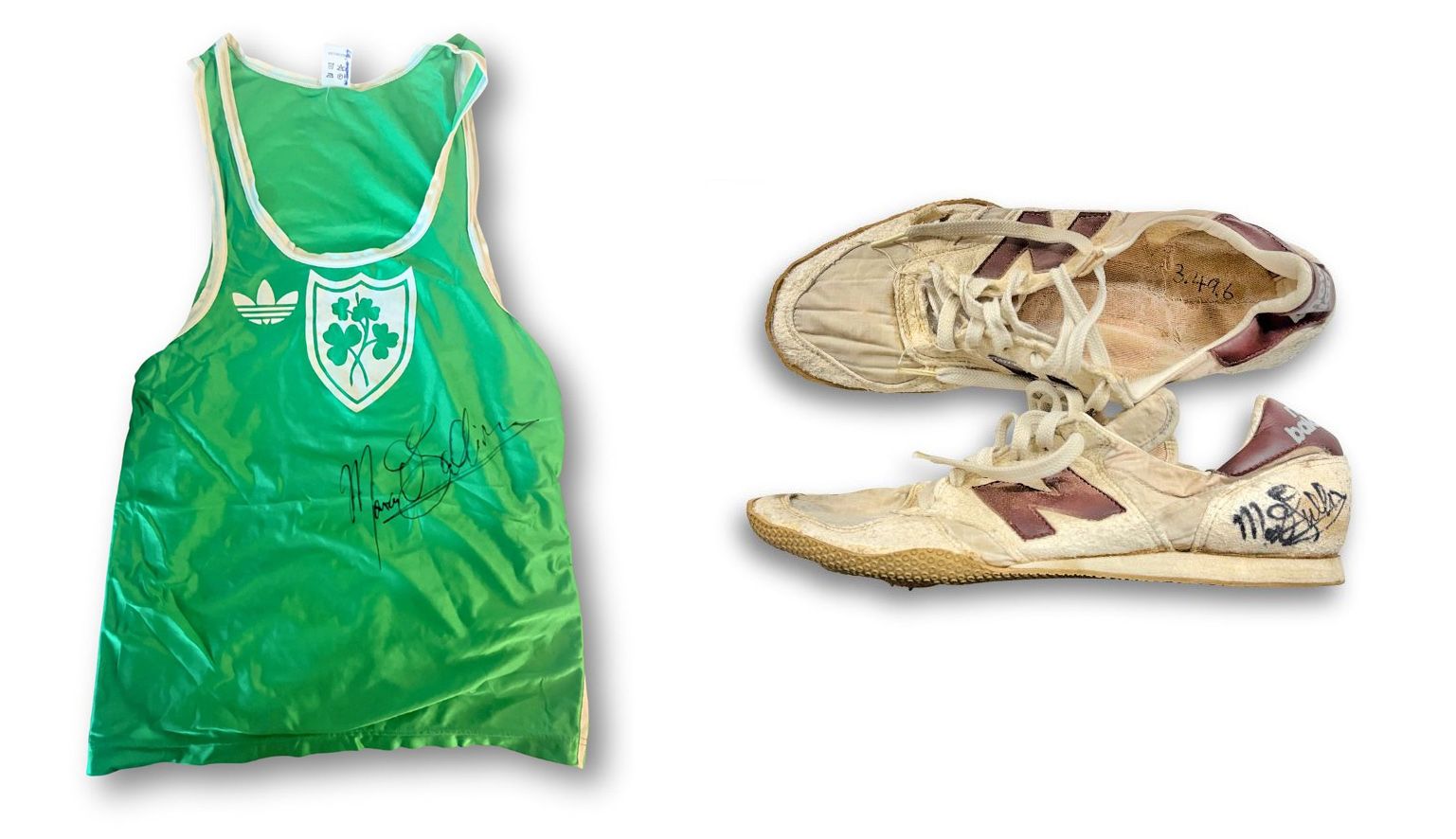
Marcus O'Sullivan's singlet and spikes from the 1987 World Indoor Championships
Watched by a crowd of 20,023 – a record for an indoor athletics event at the time – O’Sullivan bided his time, second from the back of the nine-man field. Meanwhile, Jim Spivey – a big local hope, as the star of the Indiana University team – cut out the early pace.
Building an indoor champion
The slightly built Irishman glided through the field when Jose Abascal made his break approaching the 1000m mark, then nipped inside Spivey at the bell before slugging out a thrilling duel with the Spaniard who had taken Olympic 1500m bronze in 1984. The pair were locked together, side by side, until O’Sullivan edged ahead in the final 10 metres to win by 0.09 in 3:39.04.
“My legs were coming from under me,” he told a trackside interviewer, reflecting on the home-straight scrap. “I gave everything I could. I just didn’t want to lose, more than wanting to win.”
O’Sullivan had to work hard to make the grade as a middle-distance man. He left school as a 4:25 miler and spent a year grafting as a sailmaker before emerging as a 4:05 exponent worthy of a Villanova scholarship.
For his first six months, he was guided by Jumbo Elliott, the veteran coach who moulded Ron Delany into an Olympic champion. After Elliott’s sudden death in 1981, Tom Donnelly assumed stewardship and proceeded to steer O’Sullivan to a hat-trick of world indoor 1500m titles, a world indoor 1500m record, five Wanamaker Mile wins, and a quartet of Olympic appearances.
Above all of his accomplishments, O’Sullivan treasures most the collection of 101 sub-four-minute miles that he racked up between 1983 and 1998.
“It means so much to me because it represents who I was as an athlete,” he says. “I was a flogger who kept on going to work every day.”
For the past 27 years, O’Sullivan has been going to work as track coach at Villanova. At the age of 64, he still holds a share of the 4x1mile global best of 15:49.08 achieved in 1985. O’Sullivan clocked the fastest split, 3:55.3, the baton having passed from the Chairman of the Boards to the future Chief Executive.
Simon Turnbull for World Athletics Heritage