
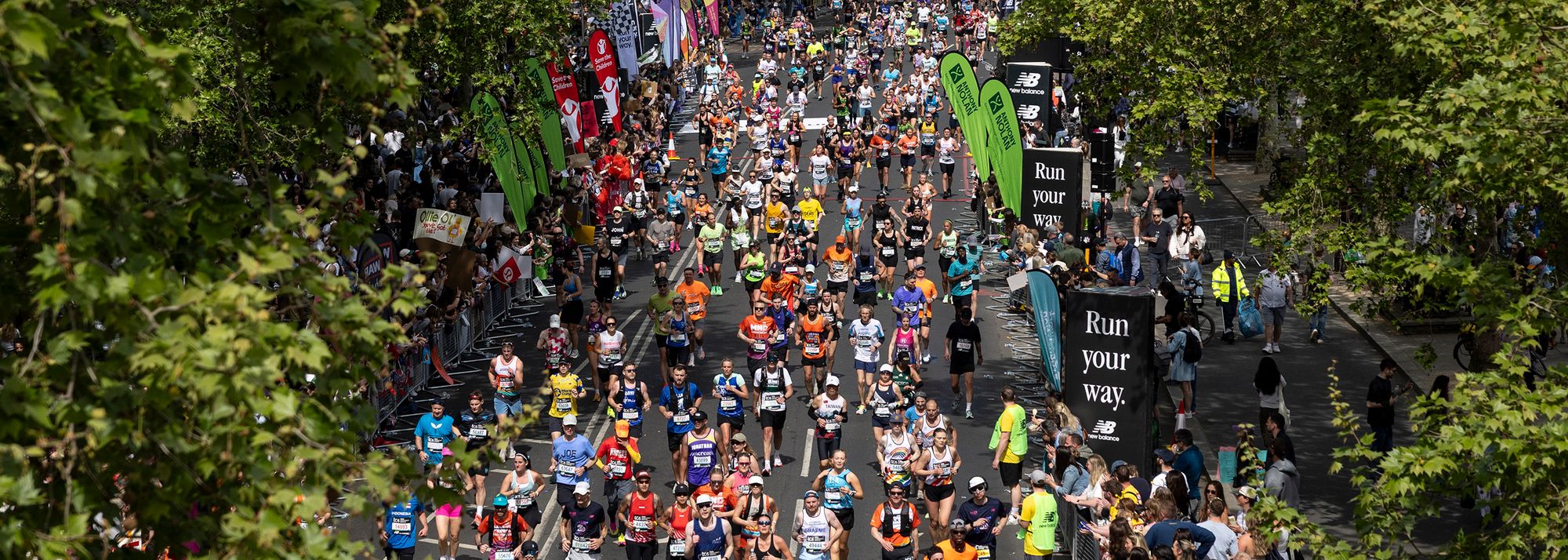


TCS London Marathon (© London Marathon Events)
The 2026 TCS London Marathon earned platinum-level recognition under the Athletics for a Better World (ABW) Standard, World Athletics’ tiered evaluation system for measuring an event’s sustainable delivery.
The annual Abbott World Marathon Majors fixture is only the third one-day athletics event – and the first mass participation road running event – to reach the standard’s highest level since its launch in 2024.
The recognition followed a comprehensive assessment and on-site audit by international sustainability experts of the organising team’s efforts to reduce the marathon’s environmental impact and maximise its social and local economic benefits.
“The TCS London Marathon's efforts to reduce their environmental impacts and increase the event’s social benefits illustrate clearly that they take their responsibility as one of the world's biggest marathons very seriously,” said World Athletics President Sebastian Coe. “With strong leadership and clear vision, they have created a sustainability model that all sports can follow. Congratulations to the entire London Marathon team."
The ABW Standard covers 55 action areas across six pillars spanning every aspect of event delivery, from transport, waste and energy management to procurement, community engagement and social impact. The marathon performed strongly across all six, integrating sustainability into nearly every stage of planning and delivery.
Group CFO and CCO of London Marathon Events Jeanette Wong said: “To become the first mass participation event of its kind to receive platinum-level recognition for sustainability delivery reflects our commitment to embedding sustainability across every aspect of the TCS London Marathon.
“From helping participants make greener choices to the decisions we take on energy supply and procurement; positive social and environmental change is at the heart of what we do. We are incredibly proud of this achievement and recognise that sustainability is a continuous journey. We remain committed to learning, improving and finding new ways to drive meaningful change.”
A strong focus on biofuels, public transport and air quality awareness
Organisers procured biofuels to power the temporary generators used at the event, resulting in a 92.8% renewable share of the event's energy sources. Excel London, venue for the five-day TCS London Marathon Running Show, which welcomed more than 220,000 visitors, was powered by 100% renewable energy.
Through a partnership with Transport for London, all 59,830 participants, staff and volunteers received free travel on the London Underground, as well as selected Overground services and buses. Participants and spectators were also encouraged to use the event’s Green Travel Planner to help them find low carbon travel routes throughout Marathon Week.
The event’s carbon compensation strategy includes a £31 (EUR 36 / USD 41) levy paid by each international entrant. The fee helps finance high-quality carbon-removal credits or projects that directly reduce emissions.
Addressing the ABW Standard’s Local Environment & Air Quality pillar, this year’s event introduced an air-quality monitoring plan. Air quality was measured and modelled across the course, with live data shared during the event and displayed on large screens at the start. In addition, 6000 trees were planted through a forest-restoration partnership with Trees not Tees, which allows participants to opt-out of a finisher T-shirt and have a tree planted instead.
Procurement, catering and waste
A robust procurement policy strengthened local sourcing: more than 65% of products and services were procured within 100km of Greater London, and much of the hospitality food – including a wide range of plant-based options – was sourced locally. To reduce the environmental impact of catering, the event prohibited beef, while its main food supplier used a fully electric, carbon-neutral delivery service. Where possible, non-perishable surplus food is either used at other events organised by London Marathon Events later in the year, or donated to The Felix Project, a charity that addresses food poverty.
Nearly 60% of event waste was diverted from landfill and incineration. Hospitality and media areas used compostable plates and cutlery alongside reusable glassware, and all food vendors were required to provide compostable or recyclable serveware. Water refill stations along the course increased from three to five, while elite athletes were offered reusable water bottles at their accommodation for the first time.
Strong community engagement
Building on its long-standing charitable commitment, the 2026 edition raised a record £87.5 million (EUR 103 million / USD 116 million). More than 17.5 tonnes of clothing were donated to the Salvation Army, and 545 pairs of shoes were collected, including 295 distributed to community groups in need. Through partnerships with local organisations and universities, the event also delivered training and skills-development programmes to recruit volunteers, create employment opportunities for adults with learning disabilities and autism, and launch a new course for the next generation of sports and event professionals.
About the Athletics for a Better World Standard
In January 2024, sustainability reporting through the Athletics for a Better World Standard became a requirement for most global elite competitions managed or awarded by World Athletics.
In 2024, 104 events submitted sustainability reports, rising to 121 in 2025. More than 100 events are expected to report in 2026, most for the first time. Once fully adopted, the ABW Standard will be the largest sustainability evaluation system in the sports industry.
The London Marathon is the fifth event to earn platinum recognition against the ABW Standard, and the first road race. The Oslo Bislett Games reached the top tier in 2024 and 2025 and the Weltklasse Zurich in 2025. The World Athletics Indoor Championships Glasgow 24 and World Athletics Championships Tokyo 25 also achieved platinum.
Among road races, three events have achieved gold: the TCS Sydney Marathon and BMW Berlin Marathon in 2025, and the C&D Xiamen Marathon in 2026. Six others have achieved silver.
The complete list of ABW Standard certified events is here.