
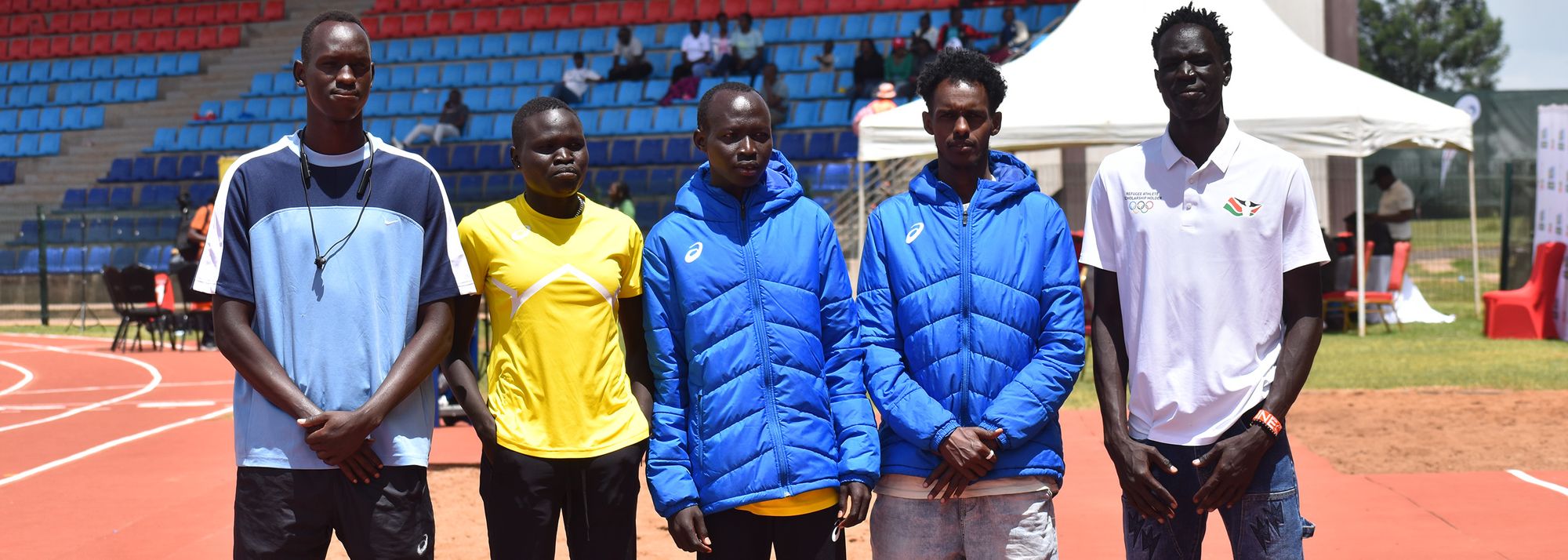


The World Athletics Athlete Refugee Team (© Michelle Katami)
What does it mean to be safe? As the world marks World Refugee Day on Saturday (20) under the UNHCR theme ‘Until Everyone is Safe’, members of the World Athletics Athlete Refugee Team (ART) reflect on what it truly means.
“Being safe means sleeping without fear of gunshots,” says Susan Nakiru. “It means my siblings can walk to school and come back safe.”
For Aron Gebremariam, it is having a calm and peaceful life with his family.
“Being free from harm, war and bad news,” says the 19-year-old. “It is feeling secure wherever I go, not living in fear.”
Displaced by war and refugee
Nakiru fled South Sudan at night with only the clothes she was wearing, and Gebremariam fled Eritrea. Like millions of other refugees, they endured psychological, emotional and physical abuse as a result of being displaced.
“We suffer in ways people cannot see. It is not just bombs,” Nakiru elaborates. “It is losing birthdays, friends and the chance to be a child. We suffer from hunger, from sickness in camps, cold nights, but the worst suffering is losing our identity.
“We slept hungry and missed school for many years. We are more than our pain. We are students, mothers, leaders, and the adults of tomorrow.”
Although she now lives, trains and studies in Kaptagat in Kenya, the trauma of war still lingers.
“Feeling safe after the trapping of the war? Some days yes, some days no,” she says. “My body is here in Kenya, safe, but my mind still hears sounds at night.”
Gebremariam’s journey took him to the United Kingdom, unsure of the future, after fleeing Eritrea due to political unrest.
“Life changed; it is harder than before,” he says. “The worry stays with you; you are never fully safe. War has caused great stress. You lose everything: family, home, in seconds.”
He continues to navigate his new life.
“Nothing comes easily when you start over,” he says. “Everything is different: the language, daily life, culture, new systems. You feel alone. Once you accept where you are, you can settle, make sacrifices and focus on your dreams.
“I feel safe living here now, that is the most important thing. I know I must work hard, push my limits, and keep going each day to succeed.”
These traumatic experiences are echoed by Perina Nakang, Abdifatah Aden Hassan and Solomon Ayela Okeny, who are also members of the ART who sought refuge in Kakuma and Dadaab.
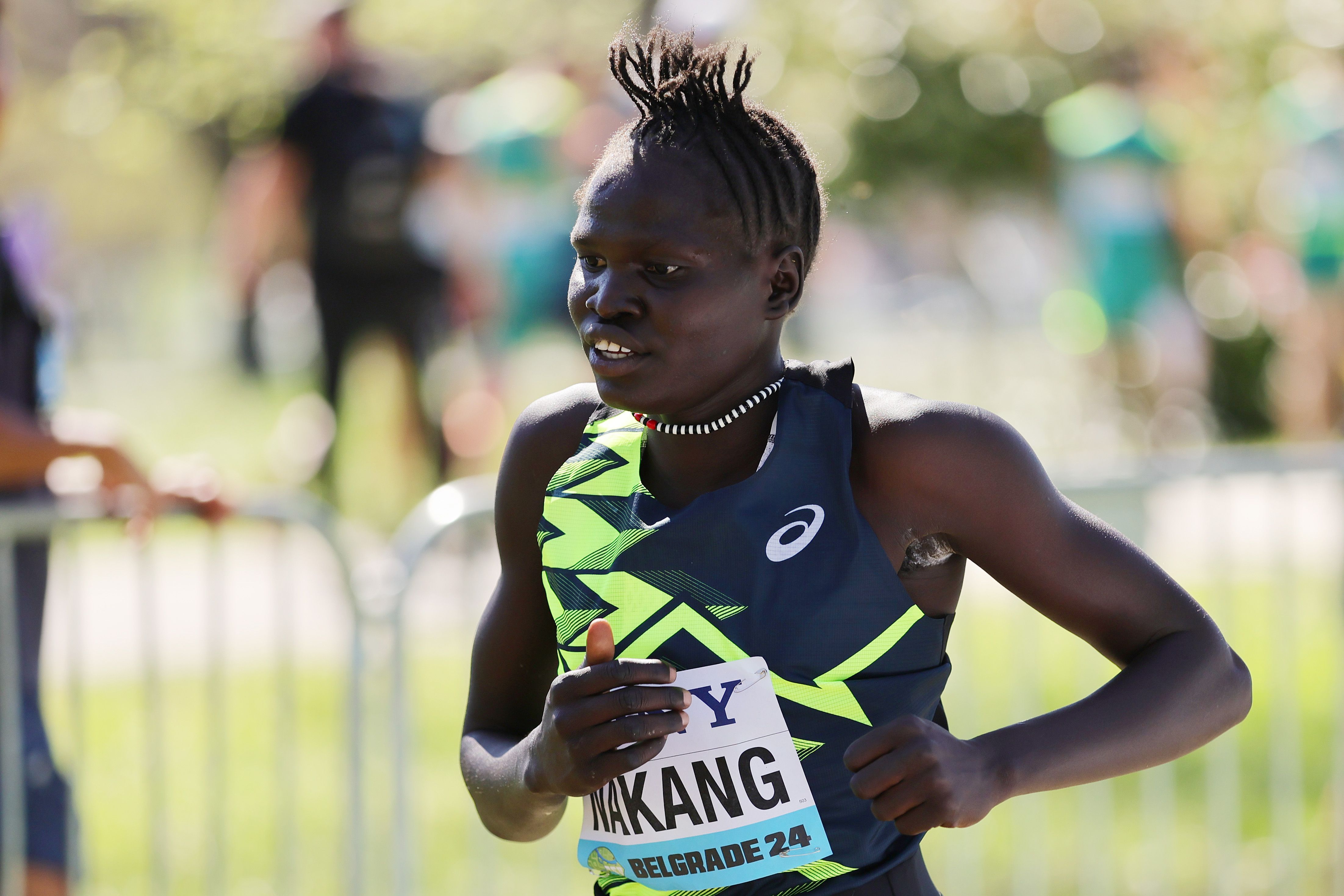
Perina Lokure Nakang of the ART at the World Athletics Cross Country Championships Belgrade 24 (© Getty Images)
“I still have some injury in my leg from passing through the bush. I was so scared because my elder brother and sister were nowhere to be found. I had to carry my little brother and sister,” says Ayela Okeny, recalling his ordeal of fleeing South Sudan in 2010 with his mother.
Against all odds, Ayela Okeny found Kakuma to be a great place, rich in talent.
“People are really talented there. In Kakuma, there are opportunities to improve in life, sport and education,” he says. “Some people call us a refugee, but we do say we belong.”
Nakang, who has competed at the Olympic Games, World Championships and World Cross Country Championships, became a refugee at seven years of age. She escaped with her aunt, travelling without food.
“There were thousands of people,” she says. “We got a ration, but it wasn’t enough. Life as a South Sudanese refugee is not good. I needed to leave Kakuma through a scholarship to come to Kapsabet and train well and earn something small to help my siblings.”
Hassan sought safety in Dadaab after war broke out in the Somali region of Ethiopia between rival communities and the federal government.
“Dadaab is very hot and food is limited,” he explains. “I used to live with my sister. There are no jobs. We used to depend on food given by UNHCR. I had to work hard to leave that life. Life there is very hard.”
Finding healing and purpose through athletics
Their pain is not the end of their story; it is the beginning of rebuilding. Through athletics and sport, they have found healing, strength, identity and opportunity.
“We suffered because we felt forgotten by the world,” says Nakiru. “But running gave me purpose. The track is one place where the past cannot catch me.
“When I run, I'm not from a war zone anymore. I'm just a girl chasing her dream and talent. That's why I run. Every race is in me, saying: ‘We are still here’.”
Every time she finishes a race, she remembers she has suffered far worse. But an injury threatened her dream.
“Last time I had a joint injury which made me hopeless,” she says. “I felt broken because running was the only thing that made me feel normal.”
Nairobi-based Ayela Okeny adds: “Athletics has changed my life, to be disciplined and to be motivated in my family. I've been travelling a lot, and I can provide something for my family.”
He hopes to complete his high school level later this year before stepping up from 400m to 800m and 1500m.
Gebremariam has also dedicated his life to athletics, specialising in the 1500m, 3000m and 5000m. In June, he won The London 5000 at Parliament Hill, clocking a personal best of 13:26.84. The time qualifies him for the 2027 European U23 Championships, where he would be eligible to compete as a refugee athlete.
“I chose to keep chasing athletics in a new land, even when I had no family or close friends nearby,” he says. “I love running deeply and aim to reach the highest level. It was never easy, but I told myself: don’t stop, just try.”
He lives by the rule that every small daily effort brings them closer to their dreams.
“Nothing changes while you sleep; change comes step by step once you wake up and try,” he adds. “Sometimes I win, sometimes I lose, sometimes I get injured then I treat myself and work back to full strength.”
Hassan’s academic success in Dadaab earned him a UNHCR scholarship to attend high school in Ngong, on the outskirts of Nairobi, where he joined Kenyan athletes in training.
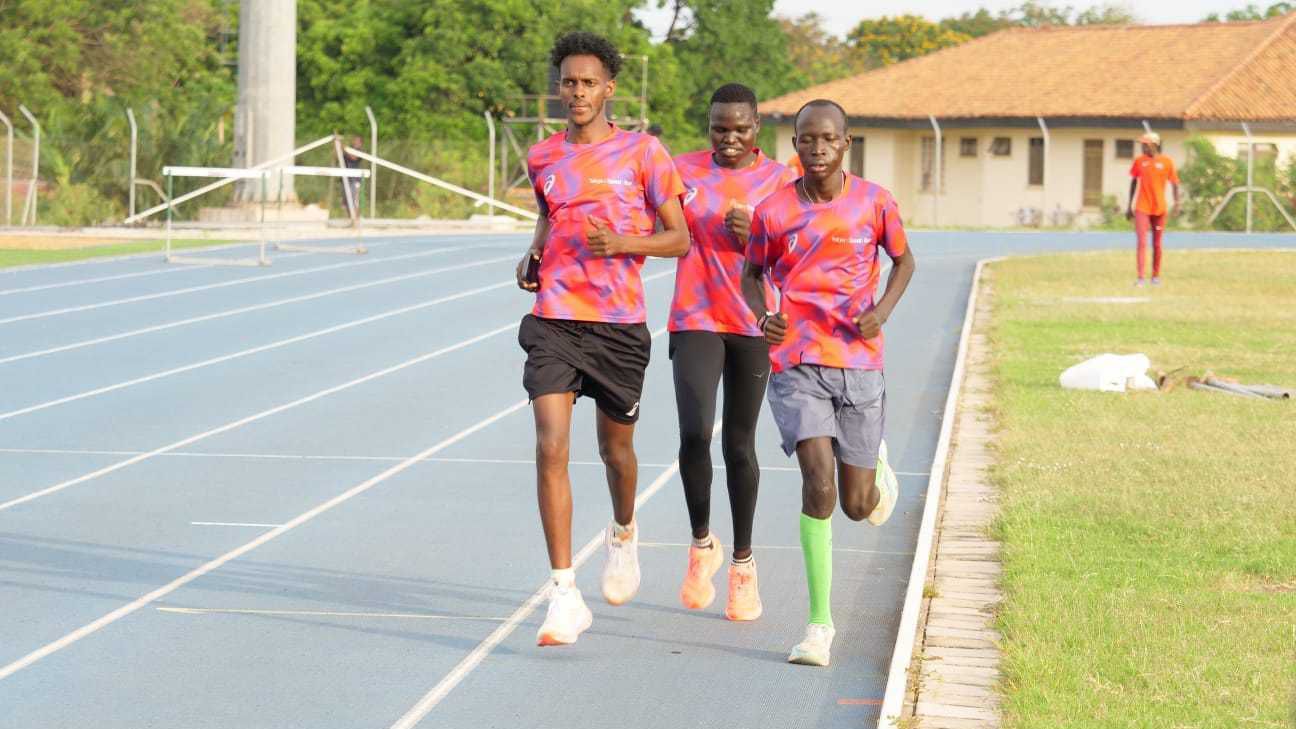
Abdifatah Aden Hassan, Perina Lokure Nakang and Lokoro Dario during training in Accra (© Martin Moses)
Athletics gives refugees a sense of belonging and inclusion, a reason World Athletics launched the ART programme in 2016. The programme has expanded through collaborations with national federations and national Olympic committees, and athletes have competed at the Olympic Games, World Championships, World Cross Country Championships and, most recently, the African Games in Ghana.
Courage against all odds
Despite the hardship, these athletes face life with the utmost courage. They can’t afford to lose a step because many are the breadwinners for their families.
“Courage means accepting every moment, whatever happens, and keeping going even when things are hard,” says Gebremariam. “It means being ready to sacrifice for what matters most, and believing in yourself first.”
For Nakiru, it is waking up every day.
“It's not about being fearless. What makes me courageous is my family,” she says. “My little brother, who always gives me smiles – I hope to work hard for them, because when I see them, I must be strong.”
Courage pushes Ayela Okeny from his comfort zone and reminds him of his mother, who is his role model.
“Don't feel like someone is pushing you; you have to do it by yourself,” he says. “Love what you do first, then that thing will love you. I encourage myself that I'm doing my best. Where I came from, there are thousands of refugees who are looking for this chance.”
Hassan refuses to be defined by his refugee status. His dream is to be an Olympian, a world champion, and to study to become a sports scientist.
“A refugee is just a name. We are human beings like others,” he says. “No human being is limited; we can do whatever other human beings can do.”
On this World Refugee Day, the world is reminded that peace and safety are fundamental human needs.
Nakiru strongly believes that the world can achieve peace.
“I am talking about this day so that everyone is safe,” she says. “I do not know when it will happen, but I know it starts when one person chooses to care.”
Michelle Katami for World Athletics

