
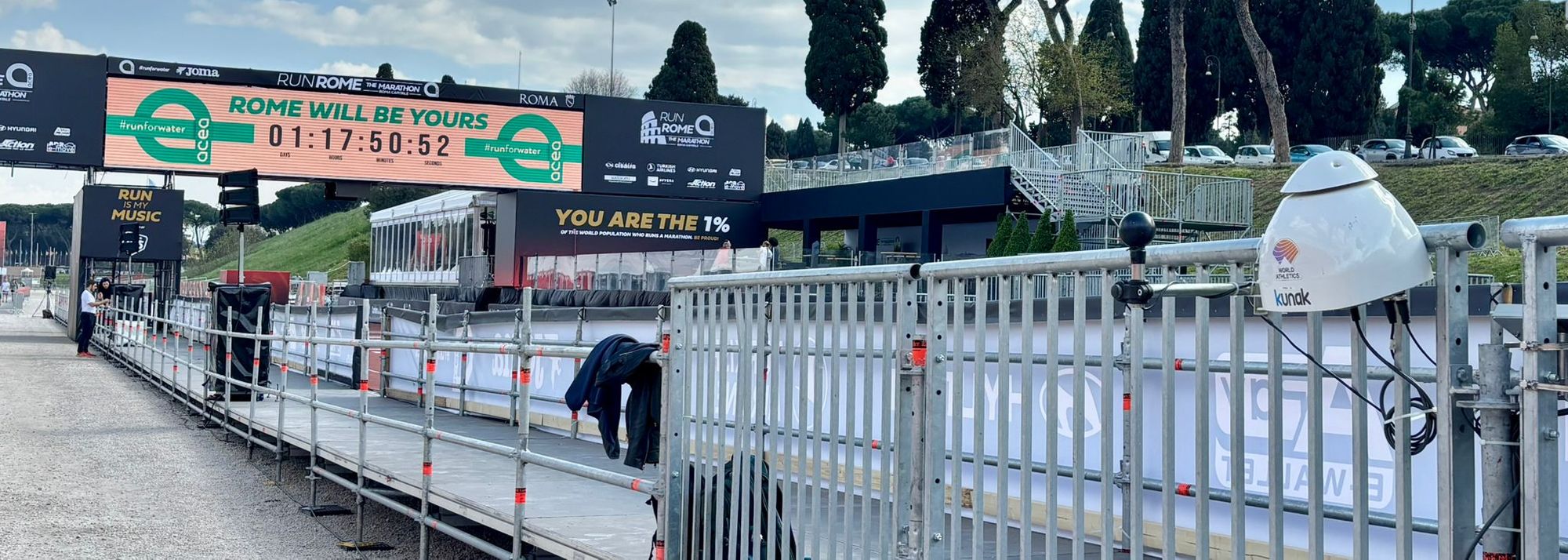


Air quality monitoring at Acea Run Rome The Marathon
An integrated atmospheric and air quality monitoring campaign was delivered through a collaboration between World Athletics, Sapienza University of Rome and the organisers of Acea Run Rome The Marathon during the World Athletics Elite Label road race in March.
The campaign combined static monitoring at the finish area with dynamic monitoring on the racecourse, reflecting the organisers’ request for both fixed-site and in-motion measurements during race operations. Monitoring was conducted on race day and in the days preceding the event, with static systems deployed to establish baseline conditions and enable comparison with race-day exposure.
For Sapienza’s Department of Physics, the monitoring activities were delivered in collaboration with Serco within the BAQUNIN project (Boundary-layer Air Quality analysis Using Network of Instruments), funded by the European Space Agency and the European Organisation for the Exploitation of Meteorological Satellites. This positioned the Rome Marathon campaign within a broader framework of advanced environmental observation and research.
A multi-sensor network along the route and on official vehicles
To ensure spatial coverage along the marathon corridor, the partnership deployed a network of fixed sensors at selected points on the racecourse, alongside mobile monitoring systems operating during the race. Additional devices were installed through Sapienza University’s cross-department collaboration, with instruments positioned along the route and on official vehicles moving on the course. The combination of static and mobile platforms enabled the capture of spatial and temporal variation in air quality across the event footprint.
Sensors recorded key parameters including particulate matter, gaseous pollutants and meteorological variables, generating a dataset designed to support both operational understanding and future scientific analysis.
Supporting athlete and public health in urban sport environments
By integrating research-grade monitoring with the delivery of a major mass-participation road race, the initiative aimed to improve understanding of environmental conditions experienced by athletes, staff, spectators and the broader city environment during competition. The resulting data will undergo further analysis and may contribute to future work on physical activity and air quality in urban settings, as well as strategies to support health protection and risk communication at major events.
This campaign builds on World Athletics’ wider commitment to environmental responsibility and evidence-based risk management in sport, and demonstrates how major events can serve as platforms for innovation, knowledge generation and inter-institutional collaboration.