

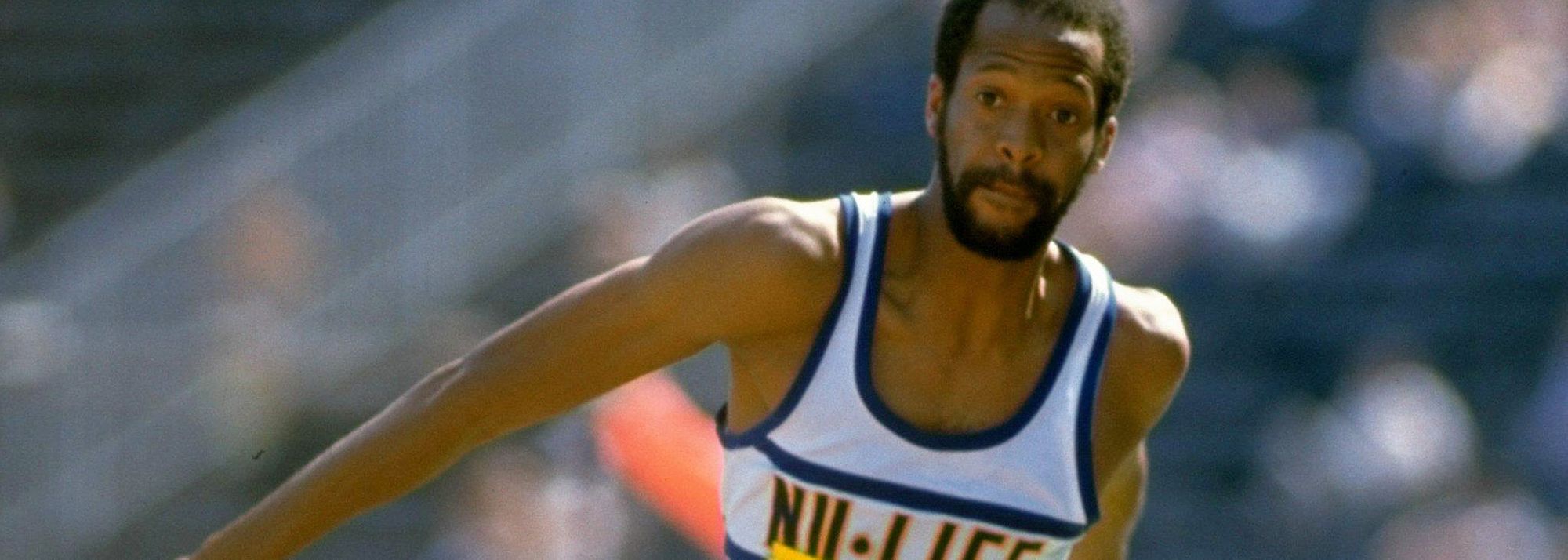


US triple jumper Willie Banks in action in 1985 (© Getty Images)
For once, the eyes of the crowd at the Indiana-Purdue University Track and Soccer Stadium in Indianapolis were not solely trained on William Augustus Banks III as the great showman of the hop, step and jump prepared to take his second-round effort in the men’s triple jump final at the US Championships on the evening of 16 June 1985.
The women’s 800m final was unfolding on the track and Willie Banks himself had one eye on that.
Indeed, after haring down the runway with his new-found speed, bounding out to 6.32m, hopping 4.96m and launching into a 6.01m jump, his first act after emerging from the sandpit was to cheer on his LA Track Club team mate (and future wife) Louise Romo as she passed by, en route to a lifetime best 1:59.63 as runner-up to Claudette Groenendaal.
“Much like Beamon, it’s taken a while to sink in that he’s demolished the world record,” said Marty Liquori, the US miler turned ABC television summariser. “He’s improved by over a foot in one week.”
It was not quite a jump of the quantum nature that took Bob Beamon into the world record books with his singular 8.90m leap in the thin air of Mexico City in 1968. But, at the age of 29, the law school graduate popularly known as “the Bouncing Barrister” had made an indelible mark of his own in the history of the horizontal jumps: a distance of 17.97m.
It was an improvement of ‘only’ eight centimetres on the triple jump world record set by the Brazilian Joao Carlos de Oliviera at the 1975 Pam American Games. But that 17.89m jump had been achieved in Mexico City, at an altitude of 2,248m; Banks accomplished his at 213m.
The singlet and bib number he wore that night are on display in the Museum of World Athletics – alongside a bag of sand Banks collected from the pit – all donated with customary generosity by the genial Californian.
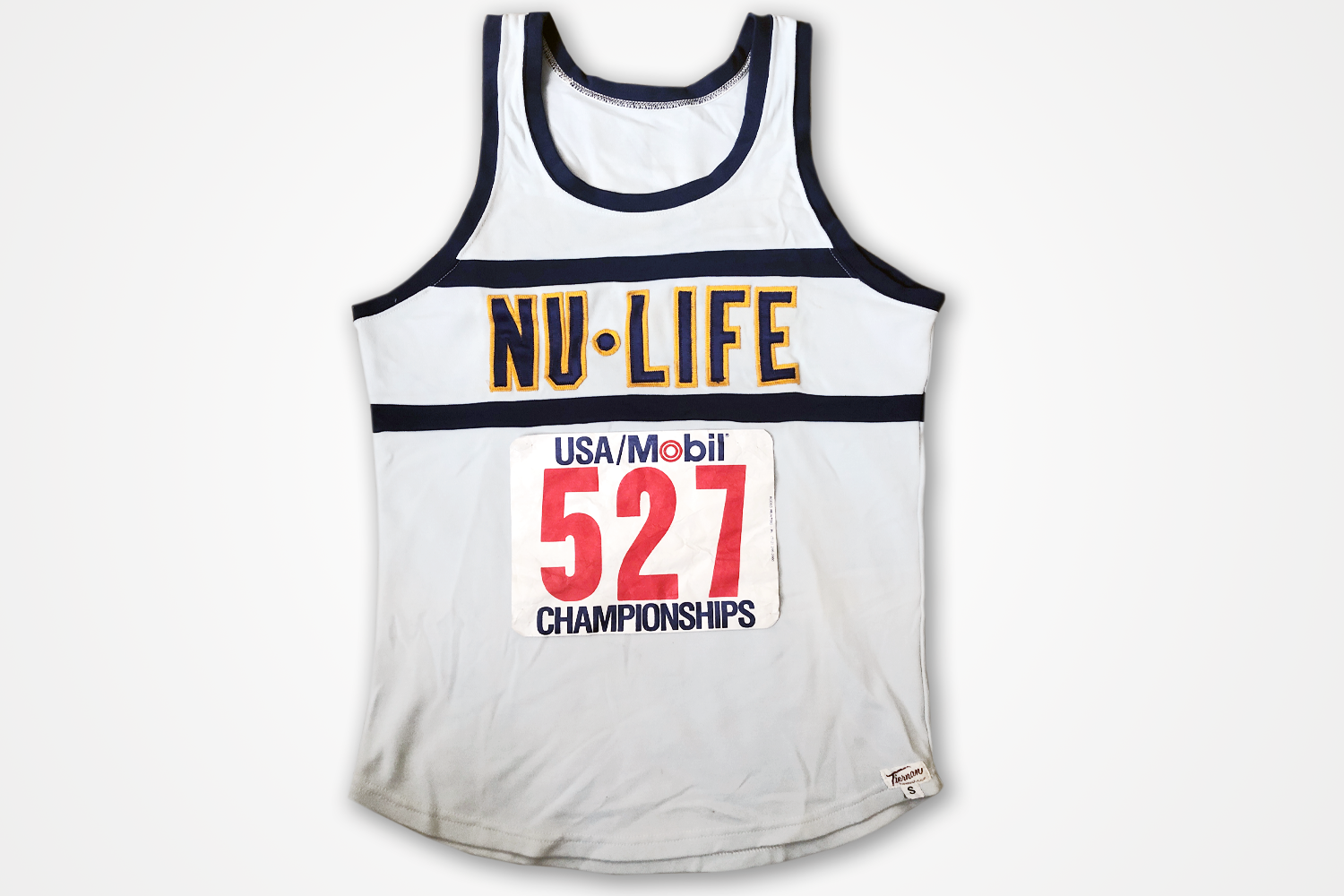
Willie Banks' vest (© World Athletics)
Handclapping routine – how it began
Studying the replay that evening 40 years ago, Liquori remarked: “He just hit it perfectly. The arms were in perfect sync with the legs.”
To Banks, the triple jump was all about rhythm. He considered it as one movement, not three, saying: “I’m swinging. It’s not like I’m touching down at all.”
As Andy Benns and Lawrence Harvey detail in their excellent tome ‘Triple Jump Trailblazers’, Banks would listen to the funk-rock bank Funkadelic through the headphones of his portable Walkman cassette player while preparing to head to take an attempt.
It was Banks who first got the crowd into the groove of the hand-clapping runway routine that has become routine with jumpers and vaulters in the track and field arena. The New York Times described him as “a travelling salesman for the triple jump”.
After producing the second-best jump of all time, 17.56m, at the 1981 US Championships in Sacramento, he lamented the flatness of the crowd at Hughes Stadium.
When the influential British promoter Andy Norman remarked that the triple jump would be absent from the majority of major European meets that season because it was “boring and did not put bums on seats,” Banks resolved to do something to generate an atmosphere that might have a mutual energising effect.
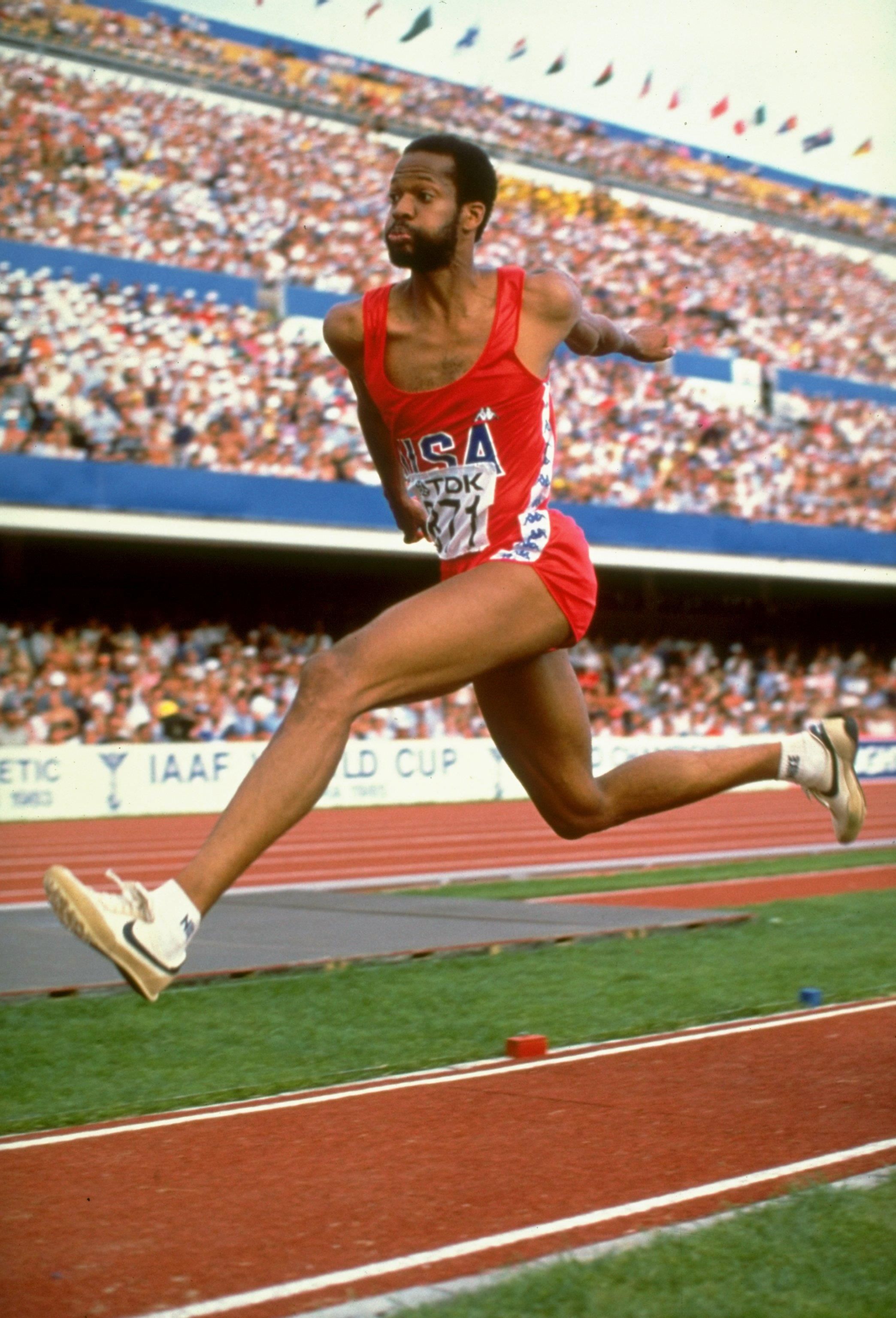
Willie Banks in action at the 1983 World Championships (© Getty Images)
His runway routine already involved clapping his hands three times before setting off and at the DN Galan meeting in Stockholm five drunk Swedes started to clap along with him. The participation spread with each attempt he took, until he found himself orchestrating the entirety of the 25,000 crowd in the grand old Olympic Stadium.
Boos echoed around the arena when the official at the take-off board raised a red flag to disqualify what would have been a world record jump but Banks finished with a flourish, sailing out to 17.55m, the third-best jump of all time.
‘It’s time. I know it’s time’
Born into a military family at Travis Air Force Base in California in 1956, Banks first registered on the global track and field radar when emerging victorious for his college, the illustrious University of California, Los Angeles (UCLA) in the heat of their annual raucous battle with the University of Southern California (USC) in 1975.
It was Banks’ major misfortune that Olympic success proved elusive. He was beaten by the US boycott in 1980 and hampered by a knee injury when finishing a distraught sixth in Los Angeles in 1984 – a year after taking the silver medal behind the unheralded Zdzislaw Hoffmann of Poland at the inaugural World Athletics Championships in Helsinki.
Interviewed at track side in the aftermath of his world record jump in Indianapolis, he was asked what had changed since the heartache of the home-state LA Olympics the previous year.
“I think the biggest change was that I was able to run,” replied the beaming Banks. “I’m not injured. I’m feeling good.
“I’ve just reintroduced myself to track and field. It’s no longer a life-and-death situation. I’m out there having fun. That’s the difference.”
Asked if he had placed too much pressure on himself leading into the 1984 Olympics, he concurred: “I think I did.
“It was no longer fun. It became a job for me: nine to five, all I did was triple jump. Also, I was injured. I wasn’t feeling healthy.
“Tonight, I knew I was going to jump very, very far. I told a few of my friends who were standing around after the first jump, ‘The next jump’s going to be the world record’.
“I told them, ‘It’s time. I know it’s time.’
“I felt it…Everything was perfect.”
It was a perfect year for Banks, who finished 1985 with a victory at the World Cup in Canberra.
Injury restricted him to another sixth-place finish at the 1988 Olympic Games in Seoul but his world record endured beyond his retirement – until Jonathan Edwards took it into another dimension in 1995.
A member of the World Athletics Council since 2019, the Bouncing Barrister has continued to serve his beloved sport with distinction – even entering the age-group world record books not just as a triple jumper but also as a high jumper.
Competing at the California State Games in 2021, the 65-year-old Banks set an M65 world record with a 1.70m straddle clearance.
Simon Turnbull for World Athletics Heritage


