

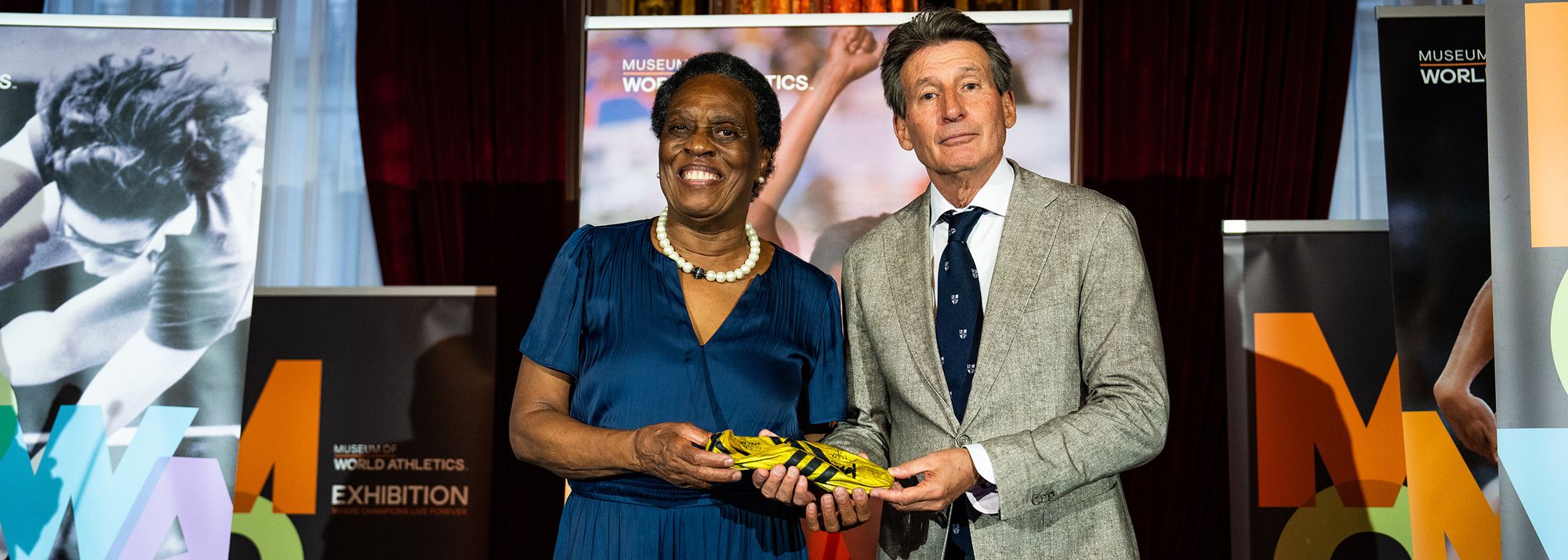


Wyomia Tyus makes her Heritage donation to World Athletics President Sebastian Coe (© Christel Saneh for World Athletics)
On the day that the athletics programme began at the Paris 2024 Olympic Games, the Museum of World Athletics (MOWA) received historic items from two Olympic champions and honoured a third posthumously.
At a ceremony in the centre of the French capital, US sprinter Wyomia Tyus, the first athlete to win two Olympic 100m titles, donated one of the spikes she wore when earning her second gold at the 1968 Mexico Games.
Ukraine’s Beijing 2008 heptathlon champion and World Athletics Council member Nataliya Dobrynska then presented World Athletics President Sebastian Coe with the singlet and spikes she wore on the opening day of that Olympic competition in China.
Coe also presented a World Athletics Heritage Plaque in the posthumous category of 'Legend' to Martin Ostermeyer, nephew of France’s Micheline Ostermeyer who won shot put and discus gold and high jump bronze at the 1948 London Olympics.
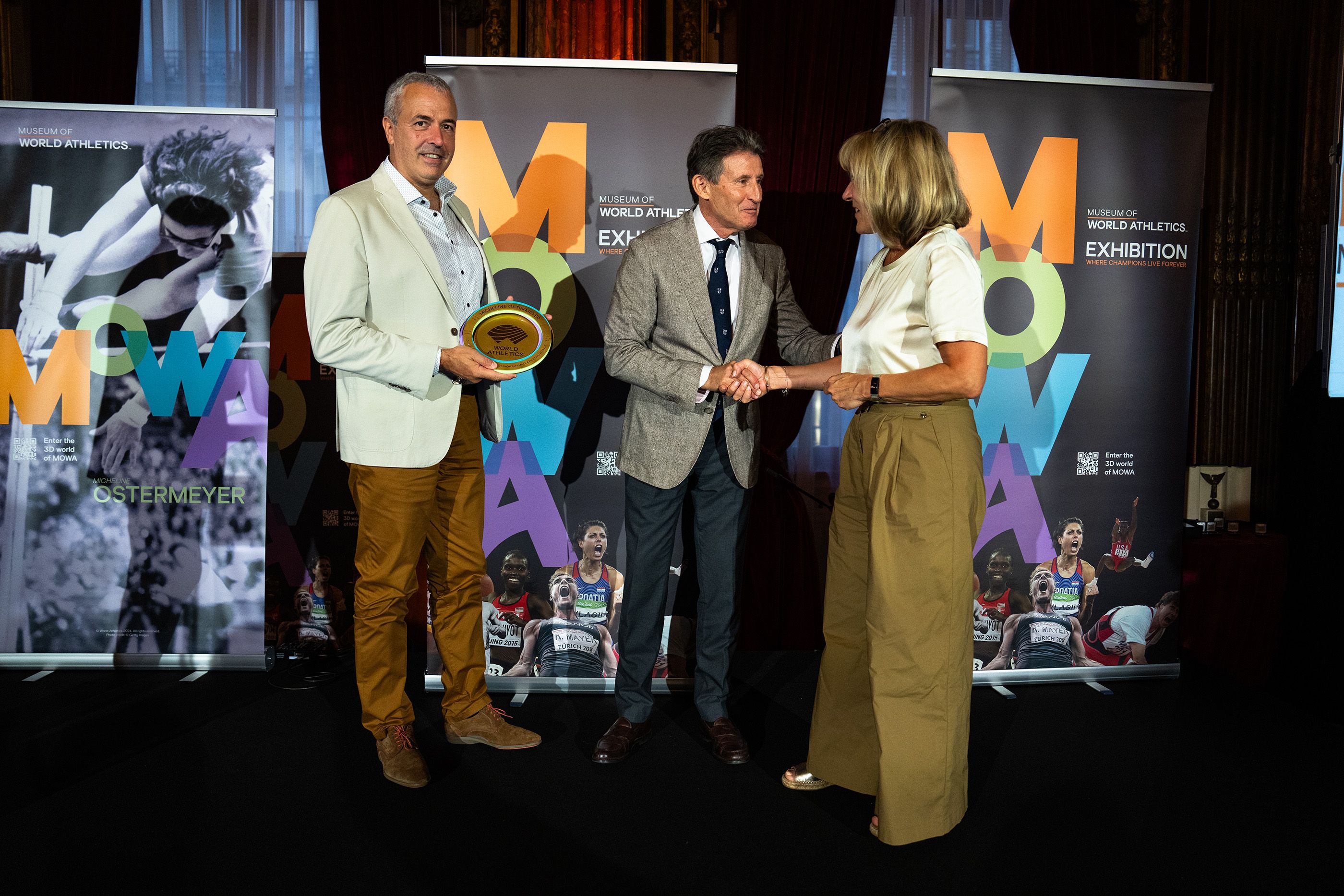
World Athletics President Sebastian Coe presents Micheline Ostermeyer's Heritage Plaque (© Christel Saneh for World Athletics)
Tyus set two of her seven world records en route to winning the 100m titles at the 1964 Tokyo Games, where she also earned 4x100m relay silver, and in Mexico four years later, where she was part of the United States team that won 4x100m gold, setting a world record of 11.00 in the individual final and contributing to a world record of 42.88 in the relay.
Asked if leading the way for future double Olympic 100m winners Carl Lewis, Gail Devers, Shelly-Ann Fraser-Pryce, Usain Bolt and Elaine Thompson-Herah represented the proudest achievement of her running career, Tyus agreed.
But it could be argued that this was not the crowning moment of the Mexico Olympics for the 23-year-old who had grown up in the segregated south on a Georgia dairy farm.
That came when she decided to wear black rather than white shorts in the women's 4x100m final in support of the podium protest by 200m gold and bronze medallists Tommie Smith and John Carlos that sent shockwaves through the Olympic Movement and the wider world.
It was a gesture that exposed her to clear risk, given the fact that there were angry calls for the two US sprinters to be sent home in disgrace.
“My father always said to me you need to speak your mind, and if this is what you believe in you need to let people know what you believe in,” Tyus told World Athletics after the ceremony. “And he said I should never let anybody take my power away.”
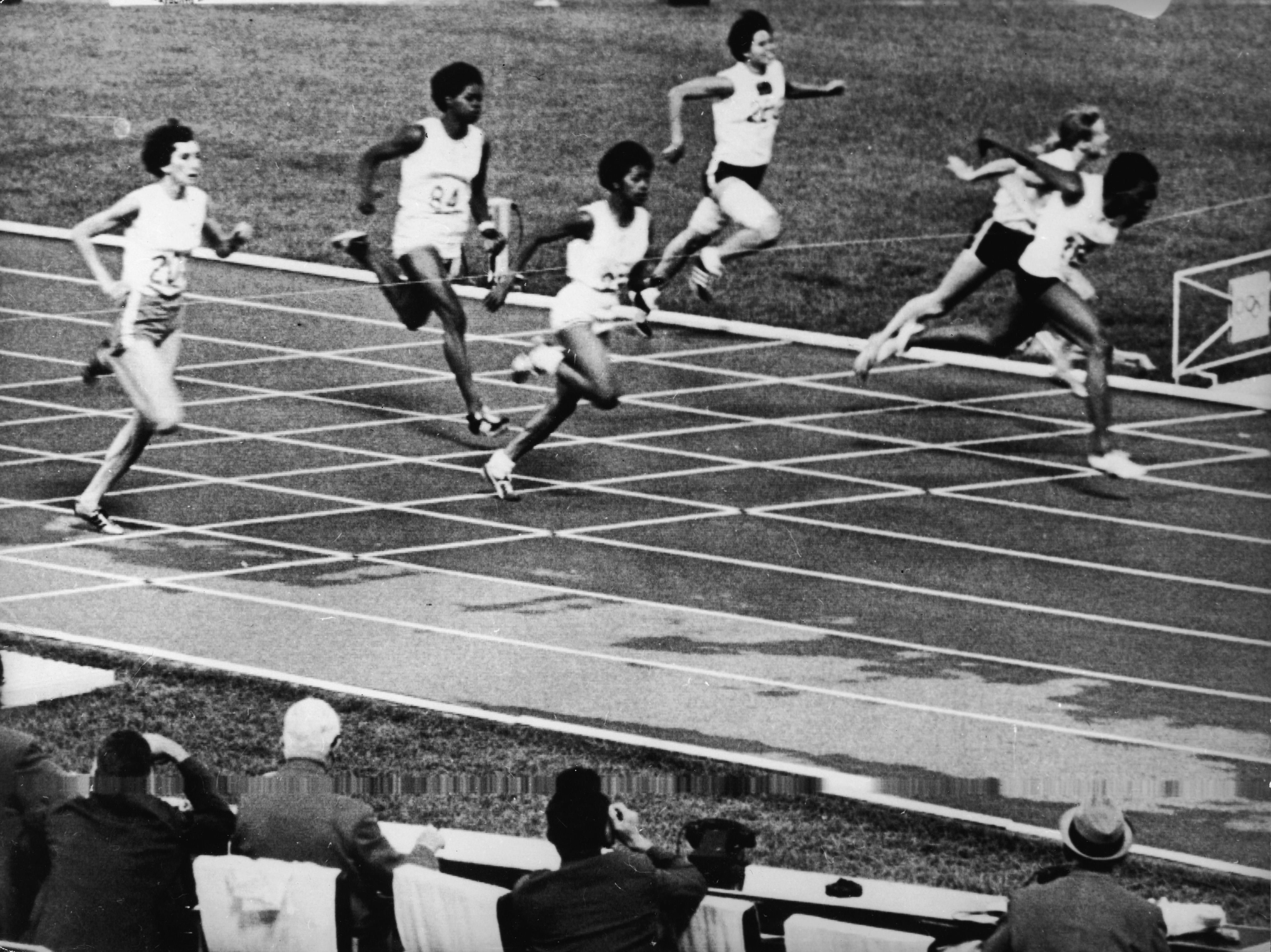
Wyomia Tyus wins the 100m at the 1968 Olympic Games in Mexico City (© AFP / Getty Images)
Reflecting on her 1964 and 1968 triumphs, she added: “They are totally different. Because in 1964 I never thought that I was going to win a gold medal. I had known my teammate Edith McGuire, who was from Georgia, since we were about 15 – she was a year older than me.
“We went to college together and everybody was saying she was going to win. Our coach said to me: ‘Tyus, it’s a great thing that you are here. I’m not expecting too much from you. We’re looking for you to do great things in ’68.’
“I had made the team when I was 18 and I turned 19 when I was at the Olympic Games. So, I was like a little kid saying: ‘OK, that’s fine, I’m learning!’
“When we were warming up for the final, our coach came up to me and said: “Tyus you looked very good in your heats. You might be able to win a medal. But we’re not expecting too much from you so don’t get the big head, just go out there and run. Although I wasn’t speaking it, I was thinking in my head as I warmed up: ‘I’m feeling good. I think I can do better than getting just a medal.
“When the gun goes off, I start running. Halfway down the track I think, ‘where’s Edith?’ Because Edith always beat me. When I was up to 70 metres I said again, ‘where’s Edith?’ But I knew not to look to my side. At 80 metres I could smell her coming, I could hear her coming. Next thing I know, the race is over and she’s yelling and screaming: ‘Tyus, you won!’ To me we had crossed at the same time – but she could see because she was behind me!”
Like Tyus in 1964, Dobrynska was not expected to win at the Beijing 2008 Games, where she entered the competition ranked 13th among the contenders.
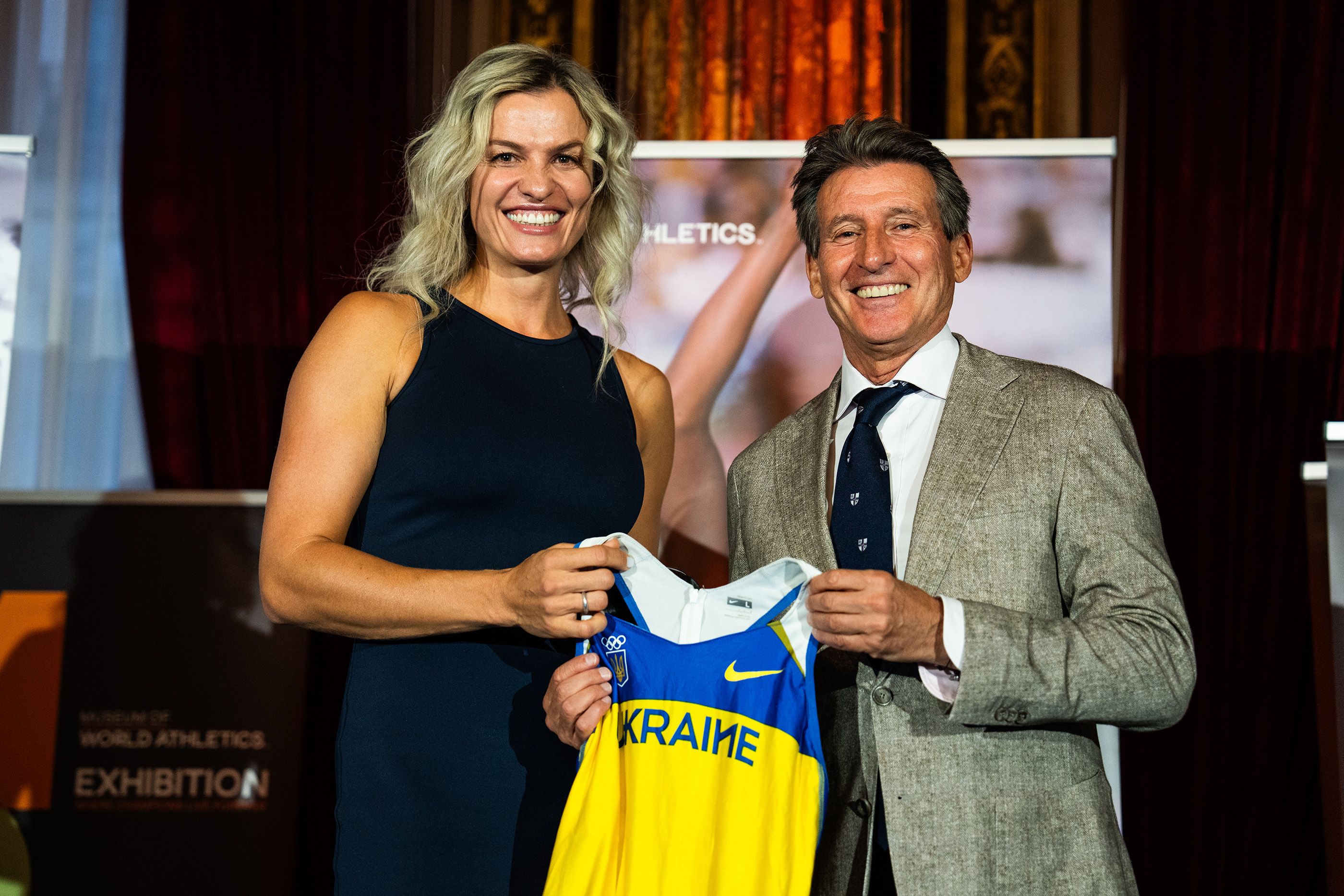
Nataliya Dobrynska and Sebastian Coe in Paris (© Christel Saneh for World Athletics)
But five lifetime bests which included 17.29m in the shot, a heptathlon world best, meant that she beat her previous record by 346 points, earning gold by a margin of 14 points.
Ostermeyer, who was also a European medallist in the sprint hurdles, is France’s second most successful Olympic track and field athlete after Marie-Jose Perec, who won 400m gold at the 1992 Barcelona Games and 200m and 400m gold at the Atlanta 1996 Games.
Uniquely, Ostermeyer was also a virtuoso concert pianist, winning the highest award from the Paris Conservatory of Music.

Micheline Ostermeyer at the London 1948 Olympics (© Getty Images)
There was an additional surprise presentation of a World Athletics Heritage Plaque to Michael Burke for his invaluable support for the MOWA project.
“Tonight we would like to say a very public ‘thank you’ to someone who, ever since attending the World Athletics Heritage Mile Night in Monaco in 2019, has helped finance our heritage activities,” said Chris Turner, Director of the Heritage team.
“Our online 3D museum platform, the first of its kind in the world of sport when it was launched in March 2021, has been largely funded by the extraordinary generosity of this man.
“A sprinter when studying in the University College Dublin, someone who has held a lifelong passion for our sport. His hero is Emil Zatopek. And if he hasn’t recognised himself by now, I would be very surprised!”
Coe offered his thanks to all who had worked on the Paris 2024 project before offering an overview of the route sport should take in the coming years.
“Each sport faces its own challenge, but all sports face one immutable challenge, and that is simply, if you like, the holy grail, which is to remain relevant to new audiences, young audiences, aspiring sports men and women, coaches, and those who officiate in our sport,” he said.
“We don’t compete against each other – well, not always. Sport competes with so many other things that steal the attention of young people today. To compete for their time and their attention we need to adapt and we need to move on.
“We need to re-define our role in the world today. This means we must prioritise sport, we must talk about it, we must listen, we must try new things, and at times we have to make tough decisions.
“We have more tools than ever before in our history to do exactly that. And I sense this is our moment.
“I was reminded recently of US leadership guru John C Maxwell. Change is inevitable, he said. But growth is optional. Let’s make it sport’s mission to choose growth.”
Mike Rowbottom for World Athletics Heritage